 Add to Chrome
 Add to Firefox
 Add to Edge
Dual Distillation for Few-Shot Anomaly Detection
Mar 02, 2026
Anomaly detection is a critical task in computer vision with profound implications for medical imaging, where identifying pathologies early can directly impact patient outcomes. While recent unsupervised anomaly detection approaches show promise, they require substantial normal training data and struggle to generalize across anatomical contexts. We introduce D$^2$4FAD, a novel dual distillation framework for few-shot anomaly detection that identifies anomalies in previously unseen tasks using only a small number of normal reference images. Our approach leverages a pre-trained encoder as a teacher network to extract multi-scale features from both support and query images, while a student decoder learns to distill knowledge from the teacher on query images and self-distill on support images. We further propose a learn-to-weight mechanism that dynamically assesses the reference value of each support image conditioned on the query, optimizing anomaly detection performance. To evaluate our method, we curate a comprehensive benchmark dataset comprising 13,084 images across four organs, four imaging modalities, and five disease categories. Extensive experiments demonstrate that D$^2$4FAD significantly outperforms existing approaches, establishing a new state-of-the-art in few-shot medical anomaly detection. Code is available at https://github.com/ttttqz/D24FAD.

NTIRE 2025 Challenge on Day and Night Raindrop Removal for Dual-Focused Images: Methods and Results
Apr 19, 2025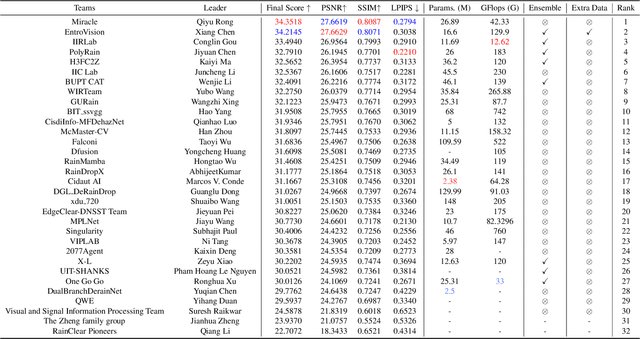
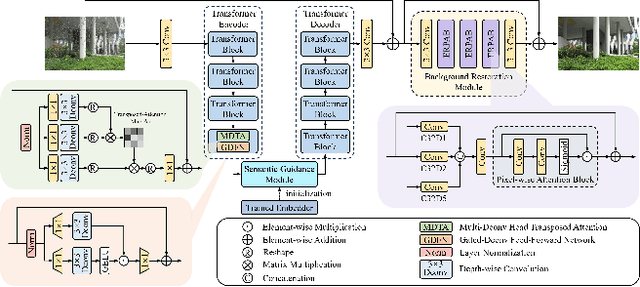
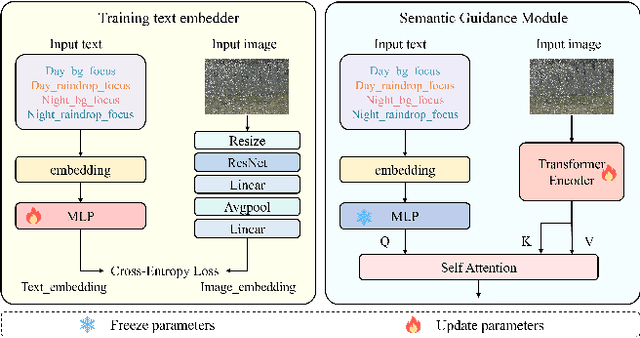
This paper reviews the NTIRE 2025 Challenge on Day and Night Raindrop Removal for Dual-Focused Images. This challenge received a wide range of impressive solutions, which are developed and evaluated using our collected real-world Raindrop Clarity dataset. Unlike existing deraining datasets, our Raindrop Clarity dataset is more diverse and challenging in degradation types and contents, which includes day raindrop-focused, day background-focused, night raindrop-focused, and night background-focused degradations. This dataset is divided into three subsets for competition: 14,139 images for training, 240 images for validation, and 731 images for testing. The primary objective of this challenge is to establish a new and powerful benchmark for the task of removing raindrops under varying lighting and focus conditions. There are a total of 361 participants in the competition, and 32 teams submitting valid solutions and fact sheets for the final testing phase. These submissions achieved state-of-the-art (SOTA) performance on the Raindrop Clarity dataset. The project can be found at https://lixinustc.github.io/CVPR-NTIRE2025-RainDrop-Competition.github.io/.