 Add to Chrome
 Add to Firefox
 Add to Edge
Getting the Parameters Right: A Difficulty-Graded Benchmark and Probe-Guided Training for LLM Tool Calls
Aug 04, 2026
Large language model agents derive much of their capability from tool use. Existing research on tool use has largely focused on selecting the right tool and orchestrating the order of calls. However, correctly filling the parameters of a tool call is equally critical for successful execution and has received far less attention. In domains such as cloud networking, even frontier models correctly complete fewer than half of tool calls. Inspired by recent analyses showing that LLM hidden states encode rich information about model predictions, we discover that while the model generates a parameter value, its hidden state contains a strong correctness signal: a simple linear probe can accurately predict whether the value will be correct. Based on this observation, we propose a unified probe-guided framework with two complementary approaches: probe-filtered bootstrapped training (PBT), which uses the probe to filter reliable self-generated calls for fine-tuning, and probe-guided reranking (PGR), which uses the probe to select better candidates during inference. To support systematic evaluation, we release ParamBench, a benchmark built from real cloud-network APIs that categorizes every instance into five difficulty levels according to parameter nesting depth, cross-parameter dependencies, and the reasoning required to derive values from earlier calls. Extensive experiments across 5 open models on ParamBench and 6 external benchmarks demonstrate that our method substantially improves parameter generation, raising the average exact match from 19.7% to 59.6%.

Self-Supervised Consistency Enhanced Disentangled Learning for Neural Decoding Generalization in Brain-Machine Interface
Jul 27, 2026Brain-Machine Interfaces (BMIs) provide a direct communication pathway between the brain and external devices, enabling humans to control assistive and robotic technologies, with potential applications in rehabilitation, human motor augmentation, and human-centered robotics. However, due to neural drift, the performance of BMIs decreases over time, posing challenges for long-term viability, particularly for invasive BMIs (iBMIs). Existing solutions suffer from two main drawbacks: (i) difficulty in learning robust neural representations, and (ii) neglecting that neural drift varies across motor parameters (e.g., velocity, direction, and speed). To overcome these limitations, we propose Self-Supervised Consistency enhanced Disentangled Learning (SSCDL), a neural decoding generalization framework built on two key innovations. We first design a backbone model named Consistency enhanced Neural Decoder (CND), using a novel teacher-student consistency constraint with simulated neural signal perturbations to learn robust representations invariant to neural drift. Then, we employ three dedicated CNDs under the Complementary-Disentangled Generalization (CDG) mechanism, which disentangles motor signals into velocity, direction, and speed with inspiration from neural preference theory. This disentangled learning enables SSCDL to capture invariant neural representations from diverse neural preference perspectives, significantly enhancing cross-day generalization. Extensive experimental results show that SSCDL delivers state-of-the-art decoding performance, exhibiting high robustness and cross-day stability. These capabilities underscore its strong potential for long-term interaction in human-centric robotic and fine-grained assistive applications.
A Cyclic Adaptation-Generalization Framework with Uncertainty-Guided Self-Paced Learning for Long-Term Brain-Machine Interfaces
Jul 27, 2026Brain-Machine Interfaces (BMIs), which link the brain to external devices, hold great potential in rehabilitation, human performance augmentation, and human-centered robotics. However, invasive BMIs face a critical challenge for long-term deployment due to neural drift, which degrades decoding performance over time and necessitates frequent recalibration. Existing methods designed to mitigate neural drift typically rely on either domain adaptation (DA) or domain generalization (DG) alone and often fail to capture fine-grained distribution shifts across neural subdomains, resulting in limited performance. To overcome these limitations, we propose Uncertainty-guided Self-paced Cycling (UnSPC), a robust framework that synergizes DA and DG for target domain refining under an Uncertainty-guided Self-paced Pseudo-labeling (UnSPL) mechanism. To handle subdomain neural drift across domains, UNSPL is proposed to iteratively mine reliable pseudo-labeled samples with a noise-robust ranking strategy for further fine-tuning. Leveraging these high-quality samples, we introduce a novel Cycling Adaptation and Generalization (CycAG) strategy, which integrates DA and DG within an iterative cycle to progressively mitigate both global and subdomain drift. This cyclic process enables effective alignment to evolving target distributions while preserving robust and transferable representations, thereby mitigating performance degradation under long-term neural drifts. Extensive experiments on multiple neural decoding datasets demonstrate the effectiveness and robustness of UnSPC. To our knowledge, our proposed UnSPC is the first to cyclically integrate DA and DG with pseudo-labeling, paving the way toward stable long-term BMI controls.
Improving Unsupervised Task-driven Models of Ventral Visual Stream via Relative Position Predictivity
May 13, 2025Based on the concept that ventral visual stream (VVS) mainly functions for object recognition, current unsupervised task-driven methods model VVS by contrastive learning, and have achieved good brain similarity. However, we believe functions of VVS extend beyond just object recognition. In this paper, we introduce an additional function involving VVS, named relative position (RP) prediction. We first theoretically explain contrastive learning may be unable to yield the model capability of RP prediction. Motivated by this, we subsequently integrate RP learning with contrastive learning, and propose a new unsupervised task-driven method to model VVS, which is more inline with biological reality. We conduct extensive experiments, demonstrating that: (i) our method significantly improves downstream performance of object recognition while enhancing RP predictivity; (ii) RP predictivity generally improves the model brain similarity. Our results provide strong evidence for the involvement of VVS in location perception (especially RP prediction) from a computational perspective.
Speed-enhanced Subdomain Adaptation Regression for Long-term Stable Neural Decoding in Brain-computer Interfaces
Jul 25, 2024


Brain-computer interfaces (BCIs) offer a means to convert neural signals into control signals, providing a potential restoration of movement for people with paralysis. Despite their promise, BCIs face a significant challenge in maintaining decoding accuracy over time due to neural nonstationarities. However, the decoding accuracy of BCI drops severely across days due to the neural data drift. While current recalibration techniques address this issue to a degree, they often fail to leverage the limited labeled data, to consider the signal correlation between two days, or to perform conditional alignment in regression tasks. This paper introduces a novel approach to enhance recalibration performance. We begin with preliminary experiments that reveal the temporal patterns of neural signal changes and identify three critical elements for effective recalibration: global alignment, conditional speed alignment, and feature-label consistency. Building on these insights, we propose the Speed-enhanced Subdomain Adaptation Regression (SSAR) framework, integrating semi-supervised learning with domain adaptation techniques in regression neural decoding. SSAR employs Speed-enhanced Subdomain Alignment (SeSA) for global and speed conditional alignment of similarly labeled data, with Contrastive Consistency Constraint (CCC) to enhance the alignment of SeSA by reinforcing feature-label consistency through contrastive learning. Our comprehensive set of experiments, both qualitative and quantitative, substantiate the superior recalibration performance and robustness of SSAR.
Clean-image Backdoor Attacks
Mar 26, 2024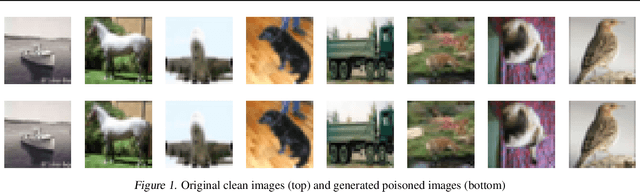
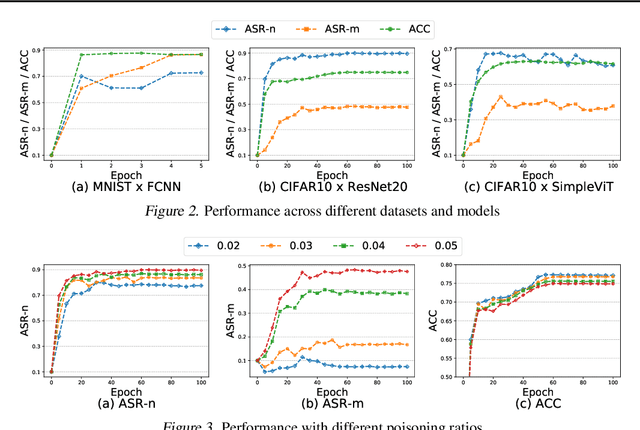


To gather a significant quantity of annotated training data for high-performance image classification models, numerous companies opt to enlist third-party providers to label their unlabeled data. This practice is widely regarded as secure, even in cases where some annotated errors occur, as the impact of these minor inaccuracies on the final performance of the models is negligible and existing backdoor attacks require attacker's ability to poison the training images. Nevertheless, in this paper, we propose clean-image backdoor attacks which uncover that backdoors can still be injected via a fraction of incorrect labels without modifying the training images. Specifically, in our attacks, the attacker first seeks a trigger feature to divide the training images into two parts: those with the feature and those without it. Subsequently, the attacker falsifies the labels of the former part to a backdoor class. The backdoor will be finally implanted into the target model after it is trained on the poisoned data. During the inference phase, the attacker can activate the backdoor in two ways: slightly modifying the input image to obtain the trigger feature, or taking an image that naturally has the trigger feature as input. We conduct extensive experiments to demonstrate the effectiveness and practicality of our attacks. According to the experimental results, we conclude that our attacks seriously jeopardize the fairness and robustness of image classification models, and it is necessary to be vigilant about the incorrect labels in outsourced labeling.
CoMeta: Enhancing Meta Embeddings with Collaborative Information in Cold-start Problem of Recommendation
Mar 14, 2023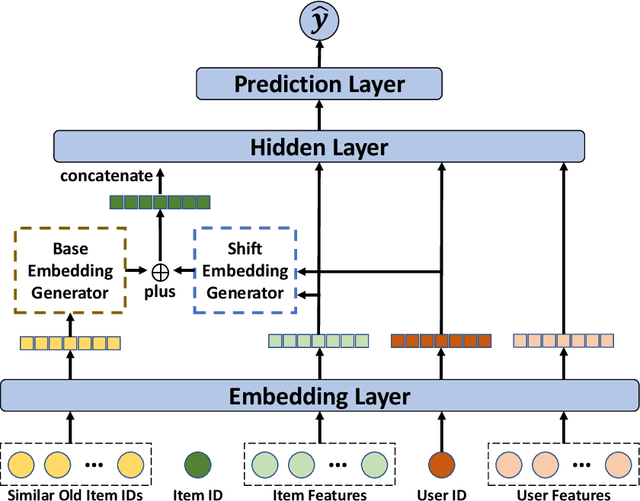

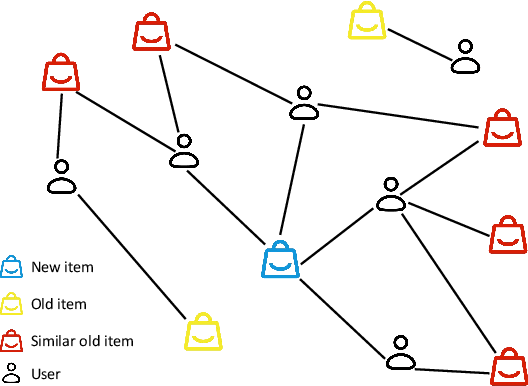
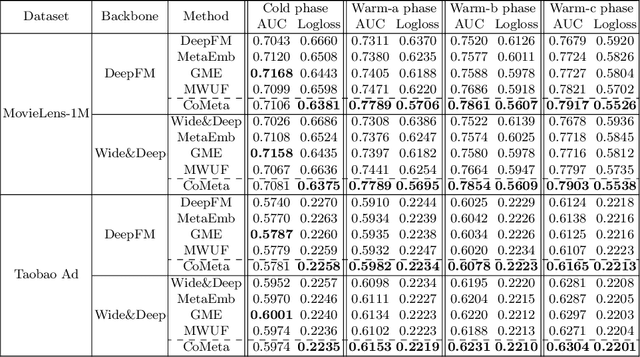
The cold-start problem is quite challenging for existing recommendation models. Specifically, for the new items with only a few interactions, their ID embeddings are trained inadequately, leading to poor recommendation performance. Some recent studies introduce meta learning to solve the cold-start problem by generating meta embeddings for new items as their initial ID embeddings. However, we argue that the capability of these methods is limited, because they mainly utilize item attribute features which only contain little information, but ignore the useful collaborative information contained in the ID embeddings of users and old items. To tackle this issue, we propose CoMeta to enhance the meta embeddings with the collaborative information. CoMeta consists of two submodules: B-EG and S-EG. Specifically, for a new item: B-EG calculates the similarity-based weighted sum of the ID embeddings of old items as its base embedding; S-EG generates its shift embedding not only with its attribute features but also with the average ID embedding of the users who interacted with it. The final meta embedding is obtained by adding up the base embedding and the shift embedding. We conduct extensive experiments on two public datasets. The experimental results demonstrate both the effectiveness and the compatibility of CoMeta.
Who is Gambling? Finding Cryptocurrency Gamblers Using Multi-modal Retrieval Methods
Nov 27, 2022With the popularity of cryptocurrencies and the remarkable development of blockchain technology, decentralized applications emerged as a revolutionary force for the Internet. Meanwhile, decentralized applications have also attracted intense attention from the online gambling community, with more and more decentralized gambling platforms created through the help of smart contracts. Compared with conventional gambling platforms, decentralized gambling have transparent rules and a low participation threshold, attracting a substantial number of gamblers. In order to discover gambling behaviors and identify the contracts and addresses involved in gambling, we propose a tool termed ETHGamDet. The tool is able to automatically detect the smart contracts and addresses involved in gambling by scrutinizing the smart contract code and address transaction records. Interestingly, we present a novel LightGBM model with memory components, which possesses the ability to learn from its own misclassifications. As a side contribution, we construct and release a large-scale gambling dataset at https://github.com/AwesomeHuang/Bitcoin-Gambling-Dataset to facilitate future research in this field. Empirically, ETHGamDet achieves a F1-score of 0.72 and 0.89 in address classification and contract classification respectively, and offers novel and interesting insights.
Demystifying Bitcoin Address Behavior via Graph Neural Networks
Nov 26, 2022

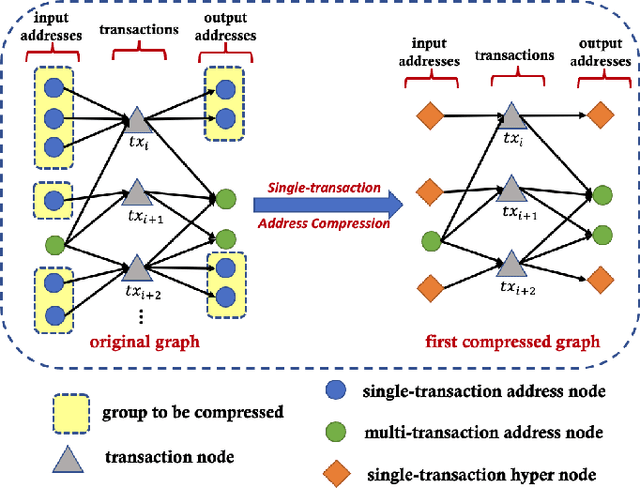
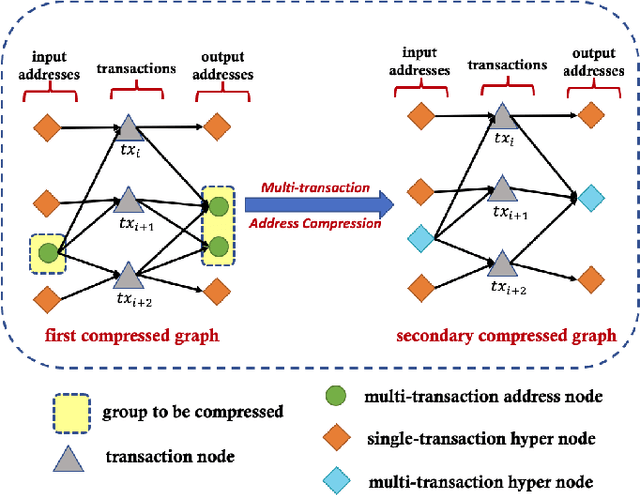
Bitcoin is one of the decentralized cryptocurrencies powered by a peer-to-peer blockchain network. Parties who trade in the bitcoin network are not required to disclose any personal information. Such property of anonymity, however, precipitates potential malicious transactions to a certain extent. Indeed, various illegal activities such as money laundering, dark network trading, and gambling in the bitcoin network are nothing new now. While a proliferation of work has been developed to identify malicious bitcoin transactions, the behavior analysis and classification of bitcoin addresses are largely overlooked by existing tools. In this paper, we propose BAClassifier, a tool that can automatically classify bitcoin addresses based on their behaviors. Technically, we come up with the following three key designs. First, we consider casting the transactions of the bitcoin address into an address graph structure, of which we introduce a graph node compression technique and a graph structure augmentation method to characterize a unified graph representation. Furthermore, we leverage a graph feature network to learn the graph representations of each address and generate the graph embeddings. Finally, we aggregate all graph embeddings of an address into the address-level representation, and engage in a classification model to give the address behavior classification. As a side contribution, we construct and release a large-scale annotated dataset that consists of over 2 million real-world bitcoin addresses and concerns 4 types of address behaviors. Experimental results demonstrate that our proposed framework outperforms state-of-the-art bitcoin address classifiers and existing classification models, where the precision and F1-score are 96% and 95%, respectively. Our implementation and dataset are released, hoping to inspire others.
Poisoning Deep Learning based Recommender Model in Federated Learning Scenarios
Apr 26, 2022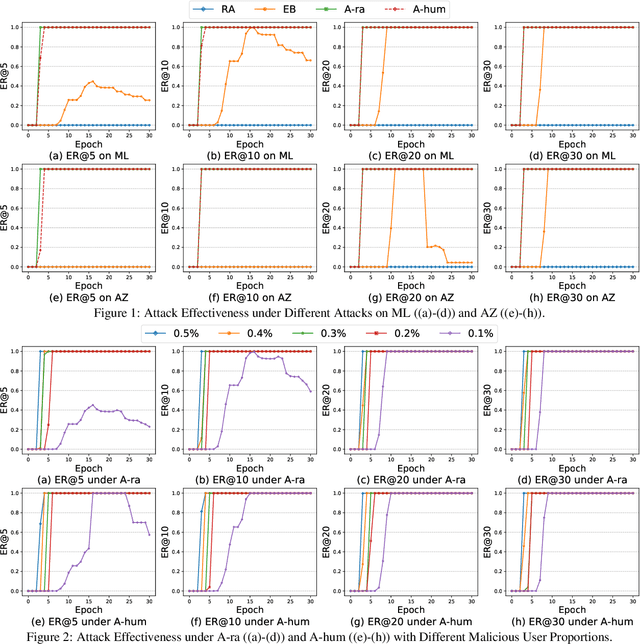
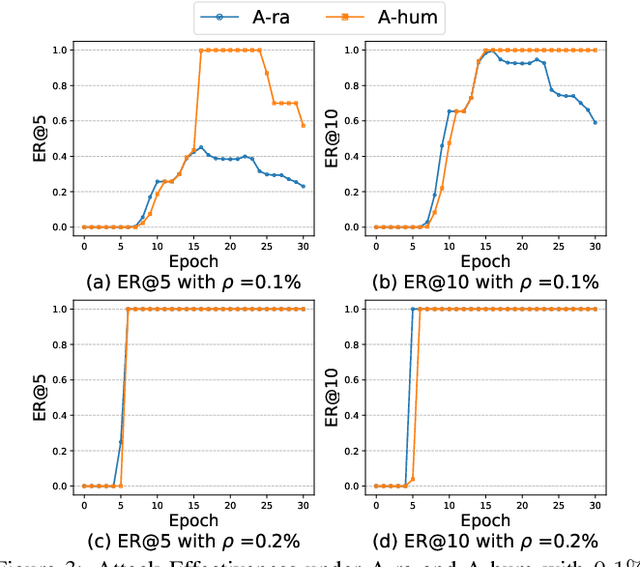
Various attack methods against recommender systems have been proposed in the past years, and the security issues of recommender systems have drawn considerable attention. Traditional attacks attempt to make target items recommended to as many users as possible by poisoning the training data. Benifiting from the feature of protecting users' private data, federated recommendation can effectively defend such attacks. Therefore, quite a few works have devoted themselves to developing federated recommender systems. For proving current federated recommendation is still vulnerable, in this work we probe to design attack approaches targeting deep learning based recommender models in federated learning scenarios. Specifically, our attacks generate poisoned gradients for manipulated malicious users to upload based on two strategies (i.e., random approximation and hard user mining). Extensive experiments show that our well-designed attacks can effectively poison the target models, and the attack effectiveness sets the state-of-the-art.