 Add to Chrome
 Add to Firefox
 Add to Edge
Getting the Parameters Right: A Difficulty-Graded Benchmark and Probe-Guided Training for LLM Tool Calls
Aug 04, 2026
Large language model agents derive much of their capability from tool use. Existing research on tool use has largely focused on selecting the right tool and orchestrating the order of calls. However, correctly filling the parameters of a tool call is equally critical for successful execution and has received far less attention. In domains such as cloud networking, even frontier models correctly complete fewer than half of tool calls. Inspired by recent analyses showing that LLM hidden states encode rich information about model predictions, we discover that while the model generates a parameter value, its hidden state contains a strong correctness signal: a simple linear probe can accurately predict whether the value will be correct. Based on this observation, we propose a unified probe-guided framework with two complementary approaches: probe-filtered bootstrapped training (PBT), which uses the probe to filter reliable self-generated calls for fine-tuning, and probe-guided reranking (PGR), which uses the probe to select better candidates during inference. To support systematic evaluation, we release ParamBench, a benchmark built from real cloud-network APIs that categorizes every instance into five difficulty levels according to parameter nesting depth, cross-parameter dependencies, and the reasoning required to derive values from earlier calls. Extensive experiments across 5 open models on ParamBench and 6 external benchmarks demonstrate that our method substantially improves parameter generation, raising the average exact match from 19.7% to 59.6%.

Blockchain-based Federated Recommendation with Incentive Mechanism
Sep 03, 2024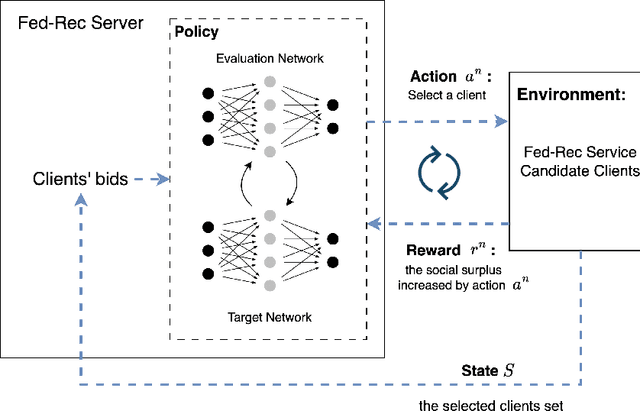
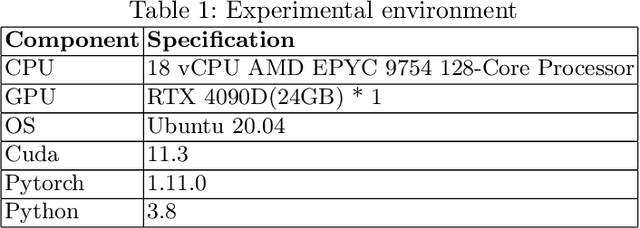
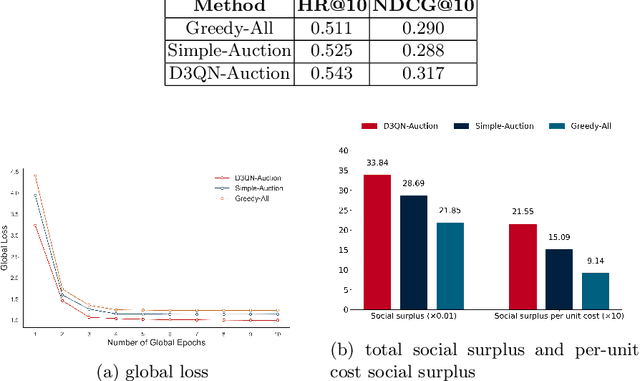
Nowadays, federated recommendation technology is rapidly evolving to help multiple organisations share data and train models while meeting user privacy, data security and government regulatory requirements. However, federated recommendation increases customer system costs such as power, computational and communication resources. Besides, federated recommendation systems are also susceptible to model attacks and data poisoning by participating malicious clients. Therefore, most customers are unwilling to participate in federated recommendation without any incentive. To address these problems, we propose a blockchain-based federated recommendation system with incentive mechanism to promote more trustworthy, secure, and efficient federated recommendation service. First, we construct a federated recommendation system based on NeuMF and FedAvg. Then we introduce a reverse auction mechanism to select optimal clients that can maximize the social surplus. Finally, we employ blockchain for on-chain evidence storage of models to ensure the safety of the federated recommendation system. The experimental results show that our proposed incentive mechanism can attract clients with superior training data to engage in the federal recommendation at a lower cost, which can increase the economic benefit of federal recommendation by 54.9\% while improve the recommendation performance. Thus our work provides theoretical and technological support for the construction of a harmonious and healthy ecological environment for the application of federal recommendation.
Clean-image Backdoor Attacks
Mar 26, 2024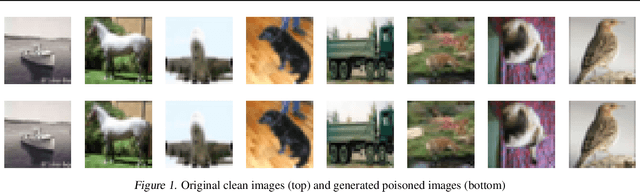
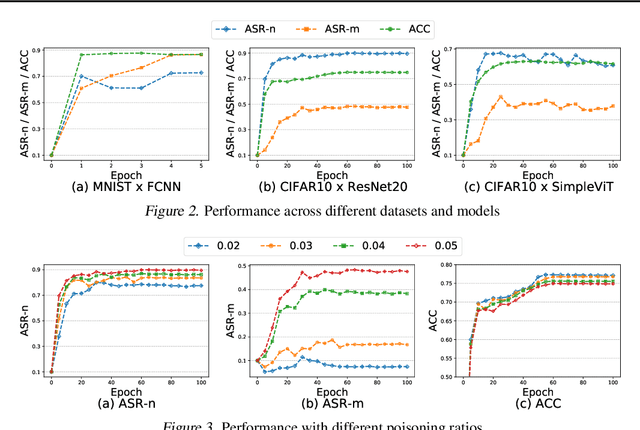


To gather a significant quantity of annotated training data for high-performance image classification models, numerous companies opt to enlist third-party providers to label their unlabeled data. This practice is widely regarded as secure, even in cases where some annotated errors occur, as the impact of these minor inaccuracies on the final performance of the models is negligible and existing backdoor attacks require attacker's ability to poison the training images. Nevertheless, in this paper, we propose clean-image backdoor attacks which uncover that backdoors can still be injected via a fraction of incorrect labels without modifying the training images. Specifically, in our attacks, the attacker first seeks a trigger feature to divide the training images into two parts: those with the feature and those without it. Subsequently, the attacker falsifies the labels of the former part to a backdoor class. The backdoor will be finally implanted into the target model after it is trained on the poisoned data. During the inference phase, the attacker can activate the backdoor in two ways: slightly modifying the input image to obtain the trigger feature, or taking an image that naturally has the trigger feature as input. We conduct extensive experiments to demonstrate the effectiveness and practicality of our attacks. According to the experimental results, we conclude that our attacks seriously jeopardize the fairness and robustness of image classification models, and it is necessary to be vigilant about the incorrect labels in outsourced labeling.