 Add to Chrome
 Add to Firefox
 Add to Edge
REIN: Bridging the Gap between Reasoning and Reliability via Reflection and Abstention Alignment
Aug 08, 2026
Large reasoning models (LRMs) are prone to hallucination, which undermines their reliability and poses challenges for safe deployment. Hallucinations in LRMs arise from two distinct failure sources: reasoning hallucination, where flawed inference steps propagate to an incorrect conclusion, and knowledge hallucination, where the model lacks the requisite factual knowledge to answer the query. To address reasoning hallucination, we propose REIN, an alignment framework that trains LRMs to produce a structured reasoning sequence, $\texttt{<think>} $$\rightarrow$ $\texttt{<reflection>} $$\rightarrow$ $\texttt{<answer>}$, enabling explicit self-reflection before committing to a final answer. To address knowledge hallucination, REIN introduces a reward mechanism that encourages explicit abstention (e.g., "I don't know") when none of the sampled reasoning chains yields a correct answer, allowing the model to refrain from unsupported predictions. Extensive evaluations on mathematical and commonsense reasoning benchmarks show that REIN consistently improves selective accuracy, reduces incorrect-but-self-endorsed responses, and maintains high coverage compared with competitive baselines. Notably, REIN achieves these gains within a single forward pass, without requiring process supervision, inference-time controllers, external search, or multi-round critiques. Experiments on multiple backbones show that REIN reduces the hallucination proxy by $58\sim72\%$ relative to the base models while maintaining $86\sim91\%$ average coverage, and improves selective accuracy on attempted questions by $6.6\sim14.2\%$.

A Cyclic Adaptation-Generalization Framework with Uncertainty-Guided Self-Paced Learning for Long-Term Brain-Machine Interfaces
Jul 27, 2026Brain-Machine Interfaces (BMIs), which link the brain to external devices, hold great potential in rehabilitation, human performance augmentation, and human-centered robotics. However, invasive BMIs face a critical challenge for long-term deployment due to neural drift, which degrades decoding performance over time and necessitates frequent recalibration. Existing methods designed to mitigate neural drift typically rely on either domain adaptation (DA) or domain generalization (DG) alone and often fail to capture fine-grained distribution shifts across neural subdomains, resulting in limited performance. To overcome these limitations, we propose Uncertainty-guided Self-paced Cycling (UnSPC), a robust framework that synergizes DA and DG for target domain refining under an Uncertainty-guided Self-paced Pseudo-labeling (UnSPL) mechanism. To handle subdomain neural drift across domains, UNSPL is proposed to iteratively mine reliable pseudo-labeled samples with a noise-robust ranking strategy for further fine-tuning. Leveraging these high-quality samples, we introduce a novel Cycling Adaptation and Generalization (CycAG) strategy, which integrates DA and DG within an iterative cycle to progressively mitigate both global and subdomain drift. This cyclic process enables effective alignment to evolving target distributions while preserving robust and transferable representations, thereby mitigating performance degradation under long-term neural drifts. Extensive experiments on multiple neural decoding datasets demonstrate the effectiveness and robustness of UnSPC. To our knowledge, our proposed UnSPC is the first to cyclically integrate DA and DG with pseudo-labeling, paving the way toward stable long-term BMI controls.
Self-Supervised Consistency Enhanced Disentangled Learning for Neural Decoding Generalization in Brain-Machine Interface
Jul 27, 2026Brain-Machine Interfaces (BMIs) provide a direct communication pathway between the brain and external devices, enabling humans to control assistive and robotic technologies, with potential applications in rehabilitation, human motor augmentation, and human-centered robotics. However, due to neural drift, the performance of BMIs decreases over time, posing challenges for long-term viability, particularly for invasive BMIs (iBMIs). Existing solutions suffer from two main drawbacks: (i) difficulty in learning robust neural representations, and (ii) neglecting that neural drift varies across motor parameters (e.g., velocity, direction, and speed). To overcome these limitations, we propose Self-Supervised Consistency enhanced Disentangled Learning (SSCDL), a neural decoding generalization framework built on two key innovations. We first design a backbone model named Consistency enhanced Neural Decoder (CND), using a novel teacher-student consistency constraint with simulated neural signal perturbations to learn robust representations invariant to neural drift. Then, we employ three dedicated CNDs under the Complementary-Disentangled Generalization (CDG) mechanism, which disentangles motor signals into velocity, direction, and speed with inspiration from neural preference theory. This disentangled learning enables SSCDL to capture invariant neural representations from diverse neural preference perspectives, significantly enhancing cross-day generalization. Extensive experimental results show that SSCDL delivers state-of-the-art decoding performance, exhibiting high robustness and cross-day stability. These capabilities underscore its strong potential for long-term interaction in human-centric robotic and fine-grained assistive applications.
Improving Unsupervised Task-driven Models of Ventral Visual Stream via Relative Position Predictivity
May 13, 2025Based on the concept that ventral visual stream (VVS) mainly functions for object recognition, current unsupervised task-driven methods model VVS by contrastive learning, and have achieved good brain similarity. However, we believe functions of VVS extend beyond just object recognition. In this paper, we introduce an additional function involving VVS, named relative position (RP) prediction. We first theoretically explain contrastive learning may be unable to yield the model capability of RP prediction. Motivated by this, we subsequently integrate RP learning with contrastive learning, and propose a new unsupervised task-driven method to model VVS, which is more inline with biological reality. We conduct extensive experiments, demonstrating that: (i) our method significantly improves downstream performance of object recognition while enhancing RP predictivity; (ii) RP predictivity generally improves the model brain similarity. Our results provide strong evidence for the involvement of VVS in location perception (especially RP prediction) from a computational perspective.
Self-Attentive Spatio-Temporal Calibration for Precise Intermediate Layer Matching in ANN-to-SNN Distillation
Jan 14, 2025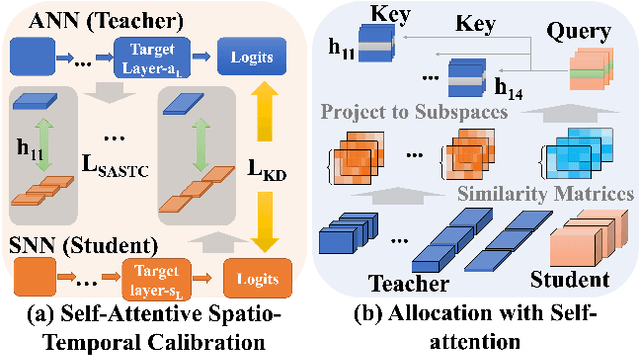
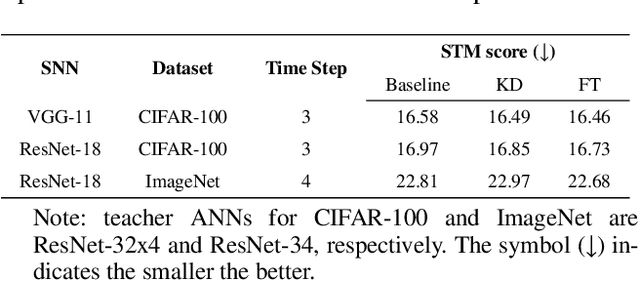
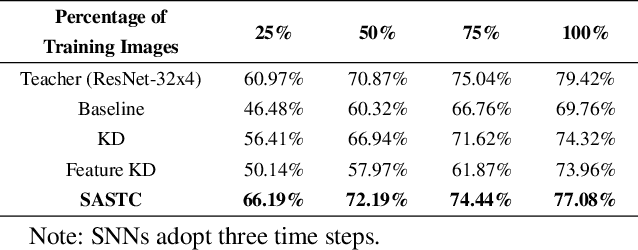
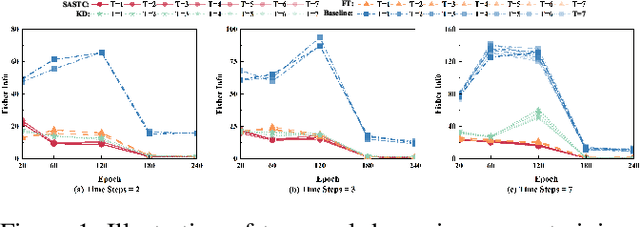
Spiking Neural Networks (SNNs) are promising for low-power computation due to their event-driven mechanism but often suffer from lower accuracy compared to Artificial Neural Networks (ANNs). ANN-to-SNN knowledge distillation can improve SNN performance, but previous methods either focus solely on label information, missing valuable intermediate layer features, or use a layer-wise approach that neglects spatial and temporal semantic inconsistencies, leading to performance degradation.To address these limitations, we propose a novel method called self-attentive spatio-temporal calibration (SASTC). SASTC uses self-attention to identify semantically aligned layer pairs between ANN and SNN, both spatially and temporally. This enables the autonomous transfer of relevant semantic information. Extensive experiments show that SASTC outperforms existing methods, effectively solving the mismatching problem. Superior accuracy results include 95.12% on CIFAR-10, 79.40% on CIFAR-100 with 2 time steps, and 68.69% on ImageNet with 4 time steps for static datasets, and 97.92% on DVS-Gesture and 83.60% on DVS-CIFAR10 for neuromorphic datasets. This marks the first time SNNs have outperformed ANNs on both CIFAR-10 and CIFAR-100, shedding the new light on the potential applications of SNNs.
LaSNN: Layer-wise ANN-to-SNN Distillation for Effective and Efficient Training in Deep Spiking Neural Networks
Apr 17, 2023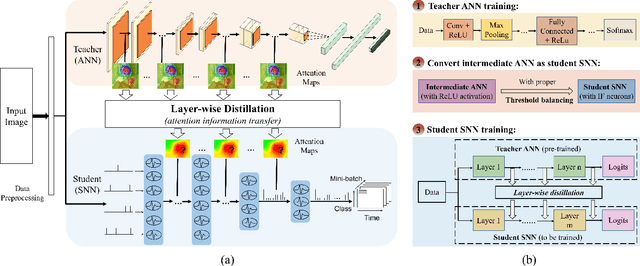
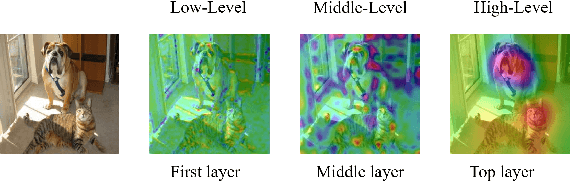
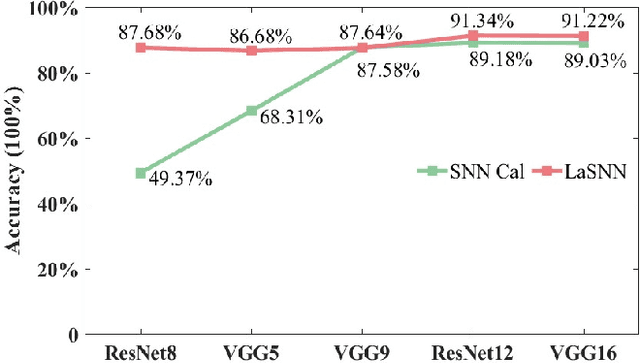
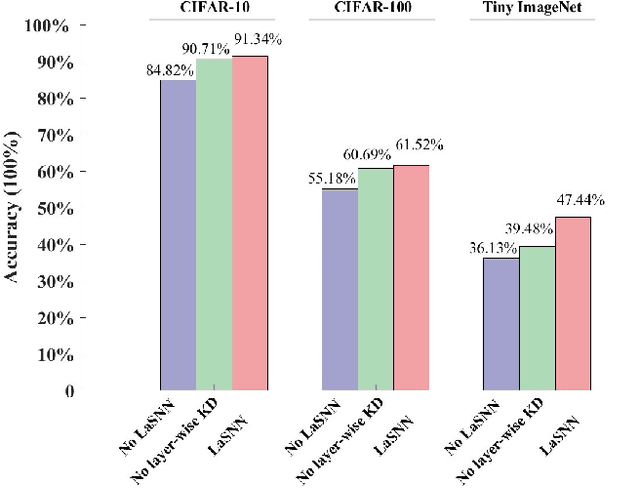
Spiking Neural Networks (SNNs) are biologically realistic and practically promising in low-power computation because of their event-driven mechanism. Usually, the training of SNNs suffers accuracy loss on various tasks, yielding an inferior performance compared with ANNs. A conversion scheme is proposed to obtain competitive accuracy by mapping trained ANNs' parameters to SNNs with the same structures. However, an enormous number of time steps are required for these converted SNNs, thus losing the energy-efficient benefit. Utilizing both the accuracy advantages of ANNs and the computing efficiency of SNNs, a novel SNN training framework is proposed, namely layer-wise ANN-to-SNN knowledge distillation (LaSNN). In order to achieve competitive accuracy and reduced inference latency, LaSNN transfers the learning from a well-trained ANN to a small SNN by distilling the knowledge other than converting the parameters of ANN. The information gap between heterogeneous ANN and SNN is bridged by introducing the attention scheme, the knowledge in an ANN is effectively compressed and then efficiently transferred by utilizing our layer-wise distillation paradigm. We conduct detailed experiments to demonstrate the effectiveness, efficacy, and scalability of LaSNN on three benchmark data sets (CIFAR-10, CIFAR-100, and Tiny ImageNet). We achieve competitive top-1 accuracy compared to ANNs and 20x faster inference than converted SNNs with similar performance. More importantly, LaSNN is dexterous and extensible that can be effortlessly developed for SNNs with different architectures/depths and input encoding methods, contributing to their potential development.