 Add to Chrome
 Add to Firefox
 Add to Edge
SkillCAT: Contrastive Assessment and Topology-Aware Skill Self-Evolution for LLM Agents
Jun 11, 2026
Skill self-evolution methods for LLM agents aim to turn execution trajectories into reusable skill documents, but current pipelines typically learn from one trajectory per task, merge candidate skill patches before checking them, and load the full skill corpus before inference. We propose SkillCAT, a training-free framework that separates this process into three stages. Contrastive Causal Extraction (CCE) samples multiple trajectories for each task and compares same-task success/failure pairs to identify evidence that explains outcome differences. Assessment-Augmented Evolution (AAE) replays each candidate patch on source-task clones and keeps only patches that improve or preserve task outcomes before hierarchical skill patch merging. Topology-Aware Task Execution (TTE) compiles the evolved skills into a routable sub-skill topology, so inference loads only the capability nodes relevant to the task. We evaluate SkillCAT on common agent benchmarks, including SpreadsheetBench, WikiTableQuestions, and DocVQA, and further test cross-model and out-of-distribution generalization. Across these settings, SkillCAT raises the average score over baselines by up to 40.40%, demonstrating reliable skill evolution without model training.

ConRAG: Consensus-Driven Multi-View Retrieval for Multi-Hop Question Answering
May 27, 2026Retrieval-augmented generation (RAG) has emerged as a promising paradigm for enhancing large language models (LLMs) on multi-hop question answering (QA), which requires reasoning over evidence from multiple documents. Current multi-hop RAG methods generally focus on either query-side task decomposition or corpus-side knowledge graph construction. Despite their progress, these methods still struggle to achieve satisfactory performance on complex multi-hop QA tasks. To this end, we propose ConRAG, a consensus-driven multi-view RAG framework that effectively boosts LLMs on complex multi-hop QA. The core of ConRAG is to systematically optimize both the query and corpus sides and to leverage multi-view evidence (relation, entity, and text signals) for more accurate retrieval. Extensive experiments on three multi-hop QA benchmarks show that ConRAG consistently outperforms all baselines by a clear margin, e.g., up to +26.9% average performance gains over vanilla RAG, and enables Gemma-4-31B to achieve a new state-of-the-art record on the challenging MuSiQue benchmark.
Tool Retrieval Bridge: Aligning Vague Instructions with Retriever Preferences via Bridge Model
Apr 09, 2026Tool learning has emerged as a promising paradigm for large language models (LLMs) to address real-world challenges. Due to the extensive and irregularly updated number of tools, tool retrieval for selecting the desired tool subset is essential. However, current tool retrieval methods are usually based on academic benchmarks containing overly detailed instructions (e.g., specific API names and parameters), while real-world instructions are more vague. Such a discrepancy would hinder the tool retrieval in real-world applications. In this paper, we first construct a new benchmark, VGToolBench, to simulate human vague instructions. Based on this, we conduct a series of preliminary analyses and find that vague instructions indeed damage the performance of tool retrieval. To this end, we propose a simple-yet-effective Tool Retrieval Bridge (TRB) approach to boost the performance of tool retrieval for vague instructions. The principle of TRB is to introduce a bridge model to rewrite the vague instructions into more specific ones and alleviate the gap between vague instructions and retriever preferences.We conduct extensive experiments under multiple commonly used retrieval settings, and the results show that TRB effectively mitigates the ambiguity of vague instructions while delivering consistent and substantial improvements across all baseline retrievers. For example, with the help of TRB, BM25 achieves a relative improvement of up to 111.51%, i.e., increasing the average NDCG score from 9.73 to 19.59. The source code and models are publicly available at https://github.com/kfchenhn/TRB.
Try, Check and Retry: A Divide-and-Conquer Framework for Boosting Long-context Tool-Calling Performance of LLMs
Mar 12, 2026Tool-calling empowers Large Language Models (LLMs) to interact with external environments. However, current methods often struggle to handle massive and noisy candidate tools in long-context tool-calling tasks, limiting their real-world application. To this end, we propose Tool-DC, a Divide-and-Conquer framework for boosting tool-calling performance of LLMs. The core of Tool-DC is to reduce the reasoning difficulty and make full use of self-reflection ability of LLMs via a "Try-Check-Retry" paradigm. Specifically, Tool-DC involves two variants: 1) the training-free Tool-DC (TF), which is plug-and-play and flexible; 2) the training-based Tool-DC (TB), which is more inference-efficient. Extensive experiments show that both Tool-DC methods outperform their counterparts by a clear margin. Tool-DC (TF) brings up to +25.10% average gains against the baseline on BFCL and ACEBench benchmarks, while Tool-DC (TB) enables Qwen2.5-7B to achieve comparable or even better performance than proprietary LLMs, e.g., OpenAI o3 and Claude-Haiku-4.5.
Learning from Imperfect Data: Towards Efficient Knowledge Distillation of Autoregressive Language Models for Text-to-SQL
Oct 15, 2024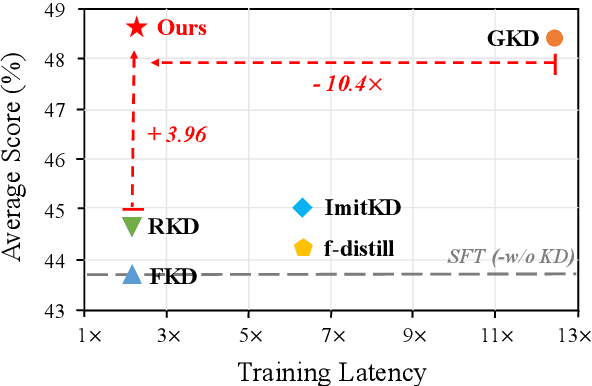

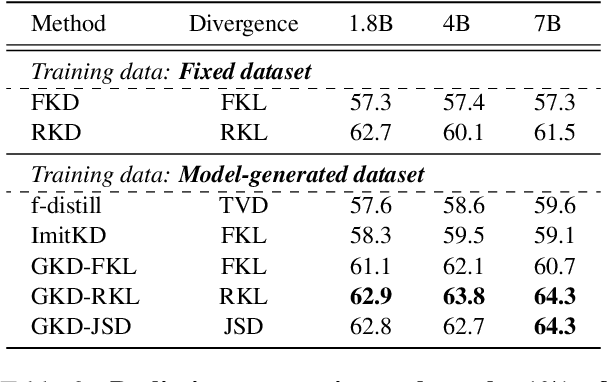

Large Language Models (LLMs) have shown promising performance in text-to-SQL, which involves translating natural language questions into SQL queries. However, current text-to-SQL LLMs are computationally expensive and challenging to deploy in real-world applications, highlighting the importance of compressing them. To achieve this goal, knowledge distillation (KD) is a common approach, which aims to distill the larger teacher model into a smaller student model. While numerous KD methods for autoregressive LLMs have emerged recently, it is still under-explored whether they work well in complex text-to-SQL scenarios. To this end, we conduct a series of analyses and reveal that these KD methods generally fall short in balancing performance and efficiency. In response to this problem, we propose to improve the KD with Imperfect Data, namely KID, which effectively boosts the performance without introducing much training budget. The core of KID is to efficiently mitigate the training-inference mismatch by simulating the cascading effect of inference in the imperfect training data. Extensive experiments on 5 text-to-SQL benchmarks show that, KID can not only achieve consistent and significant performance gains (up to +5.83% average score) across all model types and sizes, but also effectively improve the training efficiency.