 Add to Chrome
 Add to Firefox
 Add to Edge
From Reward-Free Representations to Preferences: Rethinking Offline Preference-Based Reinforcement Learning
May 31, 2026
Preference-based reinforcement learning (PbRL) avoids explicit reward engineering by learning from pairwise human preference feedback. Existing offline PbRL methods typically follow a two-stage pipeline, first learning a reward or preference model from labeled preferences and then performing offline RL on unlabeled data. We revisit offline PbRL through the lens of reward-free representation learning (RFRL) from the zero-shot RL literature, and propose a new training framework that first learns latent successor-measure representations from reward-free offline data, followed by contrastive search and fine-tuning using preference data. Through extensive experiments and ablations, we show that our method achieves superior preference efficiency over offline PbRL baselines. This work is the first to connect RFRL with PbRL, highlighting its potential as a feedback-efficient solution. Our code is publicly available at https://github.com/rl-bandits-lab/FB-PbRL.

Plan2Cleanse: Test-Time Backdoor Defense via Monte-Carlo Planning in Deep Reinforcement Learning
May 10, 2026Ensuring the security of reinforcement learning (RL) models is critical, particularly when they are trained by third parties and deployed in real-world systems. Attackers can implant backdoors into these models, causing them to behave normally under typical conditions, but execute malicious behaviors when specific triggers are activated. In this work, we propose Plan2Cleanse, a test-time detection and mitigation framework that adapts Monte Carlo Tree Search to efficiently identify and neutralize RL backdoor attacks without requiring model retraining. Our approach recasts backdoor detection as a planning problem, enabling systematic exploration of temporally extended trigger sequences while maintaining black-box access to the target policy. By leveraging the detection results, Plan2Cleanse can further achieve efficient mitigation through tree-search preventive replanning. We evaluated our method in competitive MuJoCo environments, simulated O-RAN wireless networks, and Atari games. Plan2Cleanse achieves substantial improvements, increasing trigger detection success rates by more than 61.4 percentage points in stealthy O-RAN scenarios and improving win rates from 35\% to 53\% in competitive Humanoid environments. These results demonstrate the effectiveness of our test-time defense approach and highlight the importance of proactive defenses against backdoor threats in RL deployments. Our implementation is publicly available at https://github.com/rl-bandits-lab/RL-Backdoor.
A Reward-Free Viewpoint on Multi-Objective Reinforcement Learning
Apr 27, 2026Many sequential decision-making tasks involve optimizing multiple conflicting objectives, requiring policies that adapt to different user preferences. In multi-objective reinforcement learning (MORL), one widely studied approach} addresses this by training a single policy network conditioned on preference-weighted rewards. In this paper, we explore a novel algorithmic perspective: leveraging reward-free reinforcement learning (RFRL) for MORL. While RFRL has historically been studied independently of MORL, it learns optimal policies for any possible reward function, making it a natural fit for MORL's challenge of handling unknown user preferences. We propose using the RFRL's training objective as an auxiliary task to enhance MORL, enabling more effective knowledge sharing beyond the multi-objective reward function given at training time. To this end, we adapt a state-of-the-art RFRL algorithm to the MORL setting and introduce a preference-guided exploration strategy that focuses learning on relevant parts of the environment. Through extensive experiments and ablation studies, we demonstrate that our approach significantly outperforms the state-of-the-art MORL methods across diverse MO-Gymnasium tasks, achieving superior performance and data efficiency. This work provides the first systematic adaptation of RFRL to MORL, demonstrating its potential as a scalable and empirically effective solution to multi-objective policy learning.
A Modularized Framework for Piecewise-Stationary Restless Bandits
Apr 11, 2026We study the piecewise-stationary restless multi-armed bandit (PS-RMAB) problem, where each arm evolves as a Markov chain but \emph{mean rewards may change across unknown segments}. To address the resulting exploration--detection delay trade-off, we propose a modular framework that integrates arbitrary RMAB base algorithms with change detection and a novel diminishing exploration mechanism. This design enables flexible plug-and-play use of existing solvers and detectors, while efficiently adapting to mean changes without prior knowledge of their number. To evaluate performance, we introduce a refined regret notion that measures the \emph{excess regret due to exploration and detection}, benchmarked against an oracle that restarts the base algorithm at the true change points. Under this metric, we prove a regret bound of $\tilde{O}(\sqrt{LMKT})$, where $L$ denotes the maximum mixing time of the Markov chains across all arms and segments, $M$ the number of segments, $K$ the number of arms, and $T$ the horizon. Simulations confirm that our framework achieves regret close to that of the segment oracle and consistently outperforms base solvers that do not incorporate any mechanism to handle environmental changes.
Cross-Domain Policy Optimization via Bellman Consistency and Hybrid Critics
Mar 12, 2026Cross-domain reinforcement learning (CDRL) is meant to improve the data efficiency of RL by leveraging the data samples collected from a source domain to facilitate the learning in a similar target domain. Despite its potential, cross-domain transfer in RL is known to have two fundamental and intertwined challenges: (i) The source and target domains can have distinct state space or action space, and this makes direct transfer infeasible and thereby requires more sophisticated inter-domain mappings; (ii) The transferability of a source-domain model in RL is not easily identifiable a priori, and hence CDRL can be prone to negative effect during transfer. In this paper, we propose to jointly tackle these two challenges through the lens of \textit{cross-domain Bellman consistency} and \textit{hybrid critic}. Specifically, we first introduce the notion of cross-domain Bellman consistency as a way to measure transferability of a source-domain model. Then, we propose $Q$Avatar, which combines the Q functions from both the source and target domains with an adaptive hyperparameter-free weight function. Through this design, we characterize the convergence behavior of $Q$Avatar and show that $Q$Avatar achieves reliable transfer in the sense that it effectively leverages a source-domain Q function for knowledge transfer to the target domain. Through experiments, we demonstrate that $Q$Avatar achieves favorable transferability across various RL benchmark tasks, including locomotion and robot arm manipulation. Our code is available at https://rl-bandits-lab.github.io/Cross-Domain-RL/.
Semi-Supervised Cross-Domain Imitation Learning
Feb 11, 2026Cross-domain imitation learning (CDIL) accelerates policy learning by transferring expert knowledge across domains, which is valuable in applications where the collection of expert data is costly. Existing methods are either supervised, relying on proxy tasks and explicit alignment, or unsupervised, aligning distributions without paired data, but often unstable. We introduce the Semi-Supervised CDIL (SS-CDIL) setting and propose the first algorithm for SS-CDIL with theoretical justification. Our method uses only offline data, including a small number of target expert demonstrations and some unlabeled imperfect trajectories. To handle domain discrepancy, we propose a novel cross-domain loss function for learning inter-domain state-action mappings and design an adaptive weight function to balance the source and target knowledge. Experiments on MuJoCo and Robosuite show consistent gains over the baselines, demonstrating that our approach achieves stable and data-efficient policy learning with minimal supervision. Our code is available at~ https://github.com/NYCU-RL-Bandits-Lab/CDIL.
Learning Human-Like RL Agents Through Trajectory Optimization With Action Quantization
Nov 19, 2025Human-like agents have long been one of the goals in pursuing artificial intelligence. Although reinforcement learning (RL) has achieved superhuman performance in many domains, relatively little attention has been focused on designing human-like RL agents. As a result, many reward-driven RL agents often exhibit unnatural behaviors compared to humans, raising concerns for both interpretability and trustworthiness. To achieve human-like behavior in RL, this paper first formulates human-likeness as trajectory optimization, where the objective is to find an action sequence that closely aligns with human behavior while also maximizing rewards, and adapts the classic receding-horizon control to human-like learning as a tractable and efficient implementation. To achieve this, we introduce Macro Action Quantization (MAQ), a human-like RL framework that distills human demonstrations into macro actions via Vector-Quantized VAE. Experiments on D4RL Adroit benchmarks show that MAQ significantly improves human-likeness, increasing trajectory similarity scores, and achieving the highest human-likeness rankings among all RL agents in the human evaluation study. Our results also demonstrate that MAQ can be easily integrated into various off-the-shelf RL algorithms, opening a promising direction for learning human-like RL agents. Our code is available at https://rlg.iis.sinica.edu.tw/papers/MAQ.
Action-Constrained Imitation Learning
Aug 20, 2025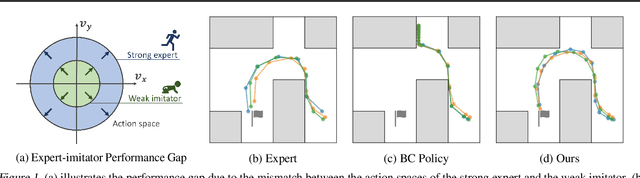
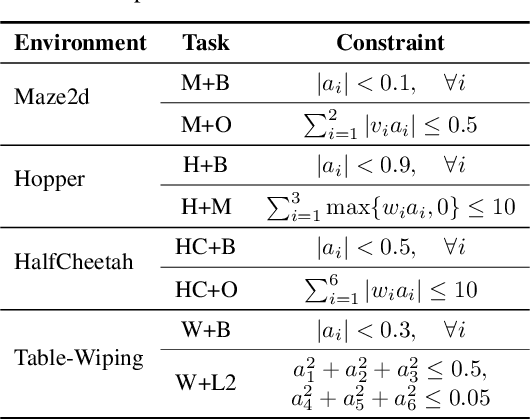
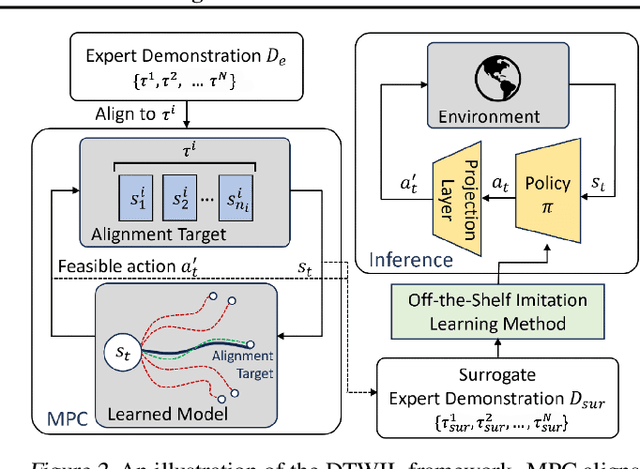
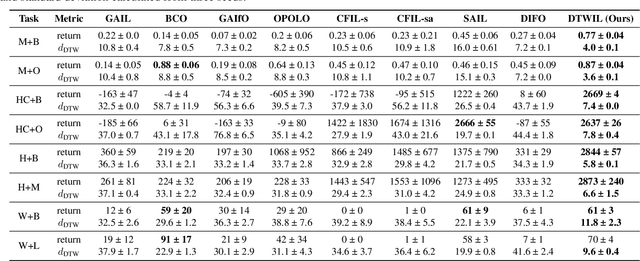
Policy learning under action constraints plays a central role in ensuring safe behaviors in various robot control and resource allocation applications. In this paper, we study a new problem setting termed Action-Constrained Imitation Learning (ACIL), where an action-constrained imitator aims to learn from a demonstrative expert with larger action space. The fundamental challenge of ACIL lies in the unavoidable mismatch of occupancy measure between the expert and the imitator caused by the action constraints. We tackle this mismatch through \textit{trajectory alignment} and propose DTWIL, which replaces the original expert demonstrations with a surrogate dataset that follows similar state trajectories while adhering to the action constraints. Specifically, we recast trajectory alignment as a planning problem and solve it via Model Predictive Control, which aligns the surrogate trajectories with the expert trajectories based on the Dynamic Time Warping (DTW) distance. Through extensive experiments, we demonstrate that learning from the dataset generated by DTWIL significantly enhances performance across multiple robot control tasks and outperforms various benchmark imitation learning algorithms in terms of sample efficiency. Our code is publicly available at https://github.com/NYCU-RL-Bandits-Lab/ACRL-Baselines.
BOFormer: Learning to Solve Multi-Objective Bayesian Optimization via Non-Markovian RL
May 29, 2025Bayesian optimization (BO) offers an efficient pipeline for optimizing black-box functions with the help of a Gaussian process prior and an acquisition function (AF). Recently, in the context of single-objective BO, learning-based AFs witnessed promising empirical results given its favorable non-myopic nature. Despite this, the direct extension of these approaches to multi-objective Bayesian optimization (MOBO) suffer from the \textit{hypervolume identifiability issue}, which results from the non-Markovian nature of MOBO problems. To tackle this, inspired by the non-Markovian RL literature and the success of Transformers in language modeling, we present a generalized deep Q-learning framework and propose \textit{BOFormer}, which substantiates this framework for MOBO via sequence modeling. Through extensive evaluation, we demonstrate that BOFormer constantly outperforms the benchmark rule-based and learning-based algorithms in various synthetic MOBO and real-world multi-objective hyperparameter optimization problems. We have made the source code publicly available to encourage further research in this direction.
Efficient Action-Constrained Reinforcement Learning via Acceptance-Rejection Method and Augmented MDPs
Mar 17, 2025Action-constrained reinforcement learning (ACRL) is a generic framework for learning control policies with zero action constraint violation, which is required by various safety-critical and resource-constrained applications. The existing ACRL methods can typically achieve favorable constraint satisfaction but at the cost of either high computational burden incurred by the quadratic programs (QP) or increased architectural complexity due to the use of sophisticated generative models. In this paper, we propose a generic and computationally efficient framework that can adapt a standard unconstrained RL method to ACRL through two modifications: (i) To enforce the action constraints, we leverage the classic acceptance-rejection method, where we treat the unconstrained policy as the proposal distribution and derive a modified policy with feasible actions. (ii) To improve the acceptance rate of the proposal distribution, we construct an augmented two-objective Markov decision process (MDP), which include additional self-loop state transitions and a penalty signal for the rejected actions. This augmented MDP incentives the learned policy to stay close to the feasible action sets. Through extensive experiments in both robot control and resource allocation domains, we demonstrate that the proposed framework enjoys faster training progress, better constraint satisfaction, and a lower action inference time simultaneously than the state-of-the-art ACRL methods. We have made the source code publicly available to encourage further research in this direction.