 Add to Chrome
 Add to Firefox
 Add to Edge
WallZero: Mastering the Game of WallGo with Strategic Analysis
Jun 16, 2026
WallGo is a recently introduced strategic board game popularized by the 2025 Netflix series The Devil's Plan. Although played on a small 7 x 7 board, its combination of stone movement and wall placement yields high game-tree complexity and intricate strategic interactions. Despite its growing popularity, WallGo remains underexplored. This paper presents WallZero, an AlphaZero-based agent for the two-player WallGo setting. We introduce tailored action and feature designs to improve playing performance significantly. In the evaluation, WallZero defeats two professional Go players who participated in this study, securing on average 1.98x more territory per game. Beyond its strength, we use WallZero to assess game fairness and identify key strategies for mastering WallGo. Interestingly, our results show that the opening used in the Netflix series yields a more balanced game. Our code is available at https://rlg.iis.sinica.edu.tw/papers/wallzero.

MINDGAMES: A Live Arena for Evaluating Social and Strategic Reasoning in Multi-Agent LLMs
May 28, 2026Large language models (LLMs) are increasingly deployed as interactive agents, yet their capacity for social and strategic reasoning over extended interaction remains poorly understood. Existing evaluations rely on static vignettes or single-game benchmarks that cannot capture the sustained, multi-faceted reasoning that real-world multi-agent settings demand. We introduce Mindgames, a multi-game arena and evaluation platform for LLM agents that operationalizes complementary reasoning demands relevant to ``theory of mind'': belief attribution under hidden information, opponent modeling through repeated strategic interaction, cooperative inference under knowledge asymmetries, and sustained deception in social deduction. Built on TextArena, Mindgames provides a unified interaction interface, TrueSkill-based rating, and full trajectory logging across four game environments. We instantiate Mindgames through a 2025 competition cycle hosted at a major AI conference, which assessed 944 submitted agents from 76 teams across four games: Colonel Blotto, Iterated Prisoner's Dilemma, Codenames, and Secret Mafia. Our analysis surfaces both agent-level and evaluation-level limitations: brittle rule adherence remains a major bottleneck, top-performing systems repeatedly rely on explicit structural scaffolding, and leaderboard validity differs sharply across environments. In particular, failure-heavy environments can reward robustness to opponent errors as much as strategic ability, with Secret Mafia exhibiting a pronounced error-survival confound in this cycle. We release a dataset of 29,571 multi-agent games with turn-level observations, actions, and rewards, together with MG-Ref, a deterministic offline tournament protocol that scores new agents against a frozen reference pool of top-ranked, low-error Stage~II submissions under the same error-attribution lens used in this analysis.
MAPLE: Multi-State Aggregated Policy Evaluation for AlphaZero in Imperfect-Information Games
May 22, 2026Imperfect-information games (IIGs) are challenging, as players must make decisions without fully observing the true game state. While AlphaZero has achieved remarkable success in perfect-information games, extending it to IIGs remains difficult. Existing search-based approaches, such as Perfect Information Monte Carlo (PIMC), suffer from strategy fusion, while Information Set Monte Carlo Tree Search (IS-MCTS) incurs high computational cost when combined with neural networks. In this paper, we propose Multi-State Aggregated PoLicy Evaluation (MAPLE), a tree search method that aggregates policy and value evaluations from multiple sampled world states within a single search tree, combining the advantages of PIMC and IS-MCTS while maintaining a controllable computational cost. We further incorporate a Siamese-based sampling strategy to select informative world states from the information set. Experiments on Phantom Go and Dark Hex show that MAPLE significantly outperforms the PIMC-based AlphaZero baseline, achieving Elo improvements of 291 and 136, respectively. These results demonstrate that MAPLE is an effective approach for AlphaZero-style learning in imperfect-information games.
Evaluating Game Difficulty in Tetris Block Puzzle
Mar 19, 2026Tetris Block Puzzle is a single player stochastic puzzle in which a player places blocks on an 8 x 8 grid to complete lines; its popular variants have amassed tens of millions of downloads. Despite this reach, there is little principled assessment of which rule sets are more difficult. Inspired by prior work that uses AlphaZero as a strong evaluator for chess variants, we study difficulty in this domain using Stochastic Gumbel AlphaZero (SGAZ), a budget-aware planning agent for stochastic environments. We evaluate rule changes including holding block h, preview holding block p, and additional Tetris block variants using metrics such as training reward and convergence iterations. Empirically, increasing h and p reduces difficulty (higher reward and faster convergence), while adding more Tetris block variants increases difficulty, with the T-pentomino producing the largest slowdown. Through analysis, SGAZ delivers strong play under small simulation budgets, enabling efficient, reproducible comparisons across rule sets and providing a reference for future design in stochastic puzzle games.
A Robust and Efficient Multi-Agent Reinforcement Learning Framework for Traffic Signal Control
Mar 12, 2026Reinforcement Learning (RL) in Traffic Signal Control (TSC) faces significant hurdles in real-world deployment due to limited generalization to dynamic traffic flow variations. Existing approaches often overfit static patterns and use action spaces incompatible with driver expectations. This paper proposes a robust Multi-Agent Reinforcement Learning (MARL) framework validated in the Vissim traffic simulator. The framework integrates three mechanisms: (1) Turning Ratio Randomization, a training strategy that exposes agents to dynamic turning probabilities to enhance robustness against unseen scenarios; (2) a stability-oriented Exponential Phase Duration Adjustment action space, which balances responsiveness and precision through cyclical, exponential phase adjustments; and (3) a Neighbor-Based Observation scheme utilizing the MAPPO algorithm with Centralized Training with Decentralized Execution (CTDE). By leveraging centralized updates, this approach approximates the efficacy of global observations while maintaining scalable local communication. Experimental results demonstrate that our framework outperforms standard RL baselines, reducing average waiting time by over 10%. The proposed model exhibits superior generalization in unseen traffic scenarios and maintains high control stability, offering a practical solution for adaptive signal control.
A Study of Solving Life-and-Death Problems in Go Using Relevance-Zone Based Solvers
Dec 23, 2025This paper analyzes the behavior of solving Life-and-Death (L&D) problems in the game of Go using current state-of-the-art computer Go solvers with two techniques: the Relevance-Zone Based Search (RZS) and the relevance-zone pattern table. We examined the solutions derived by relevance-zone based solvers on seven L&D problems from the renowned book "Life and Death Dictionary" written by Cho Chikun, a Go grandmaster, and found several interesting results. First, for each problem, the solvers identify a relevance-zone that highlights the critical areas for solving. Second, the solvers discover a series of patterns, including some that are rare. Finally, the solvers even find different answers compared to the given solutions for two problems. We also identified two issues with the solver: (a) it misjudges values of rare patterns, and (b) it tends to prioritize living directly rather than maximizing territory, which differs from the behavior of human Go players. We suggest possible approaches to address these issues in future work. Our code and data are available at https://rlg.iis.sinica.edu.tw/papers/study-LD-RZ.
Learning Human-Like RL Agents Through Trajectory Optimization With Action Quantization
Nov 19, 2025Human-like agents have long been one of the goals in pursuing artificial intelligence. Although reinforcement learning (RL) has achieved superhuman performance in many domains, relatively little attention has been focused on designing human-like RL agents. As a result, many reward-driven RL agents often exhibit unnatural behaviors compared to humans, raising concerns for both interpretability and trustworthiness. To achieve human-like behavior in RL, this paper first formulates human-likeness as trajectory optimization, where the objective is to find an action sequence that closely aligns with human behavior while also maximizing rewards, and adapts the classic receding-horizon control to human-like learning as a tractable and efficient implementation. To achieve this, we introduce Macro Action Quantization (MAQ), a human-like RL framework that distills human demonstrations into macro actions via Vector-Quantized VAE. Experiments on D4RL Adroit benchmarks show that MAQ significantly improves human-likeness, increasing trajectory similarity scores, and achieving the highest human-likeness rankings among all RL agents in the human evaluation study. Our results also demonstrate that MAQ can be easily integrated into various off-the-shelf RL algorithms, opening a promising direction for learning human-like RL agents. Our code is available at https://rlg.iis.sinica.edu.tw/papers/MAQ.
Relevance-Zone Reduction in Game Solving
Oct 01, 2025Game solving aims to find the optimal strategies for all players and determine the theoretical outcome of a game. However, due to the exponential growth of game trees, many games remain unsolved, even though methods like AlphaZero have demonstrated super-human level in game playing. The Relevance-Zone (RZ) is a local strategy reuse technique that restricts the search to only the regions relevant to the outcome, significantly reducing the search space. However, RZs are not unique. Different solutions may result in RZs of varying sizes. Smaller RZs are generally more favorable, as they increase the chance of reuse and improve pruning efficiency. To this end, we propose an iterative RZ reduction method that repeatedly solves the same position while gradually restricting the region involved, guiding the solver toward smaller RZs. We design three constraint generation strategies and integrate an RZ Pattern Table to fully leverage past solutions. In experiments on 7x7 Killall-Go, our method reduces the average RZ size to 85.95% of the original. Furthermore, the reduced RZs can be permanently stored as reusable knowledge for future solving tasks, especially for larger board sizes or different openings.
Dynamic Sight Range Selection in Multi-Agent Reinforcement Learning
May 19, 2025Multi-agent reinforcement Learning (MARL) is often challenged by the sight range dilemma, where agents either receive insufficient or excessive information from their environment. In this paper, we propose a novel method, called Dynamic Sight Range Selection (DSR), to address this issue. DSR utilizes an Upper Confidence Bound (UCB) algorithm and dynamically adjusts the sight range during training. Experiment results show several advantages of using DSR. First, we demonstrate using DSR achieves better performance in three common MARL environments, including Level-Based Foraging (LBF), Multi-Robot Warehouse (RWARE), and StarCraft Multi-Agent Challenge (SMAC). Second, our results show that DSR consistently improves performance across multiple MARL algorithms, including QMIX and MAPPO. Third, DSR offers suitable sight ranges for different training steps, thereby accelerating the training process. Finally, DSR provides additional interpretability by indicating the optimal sight range used during training. Unlike existing methods that rely on global information or communication mechanisms, our approach operates solely based on the individual sight ranges of agents. This approach offers a practical and efficient solution to the sight range dilemma, making it broadly applicable to real-world complex environments.
Online Learning of Counter Categories and Ratings in PvP Games
Feb 06, 2025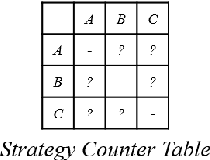
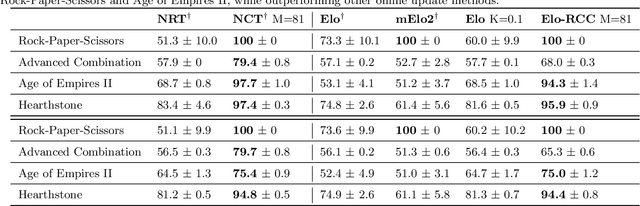
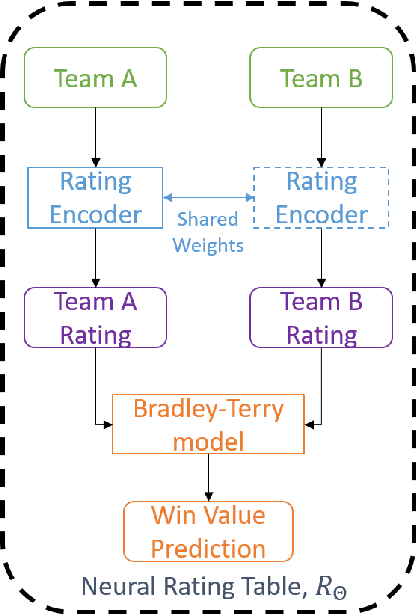
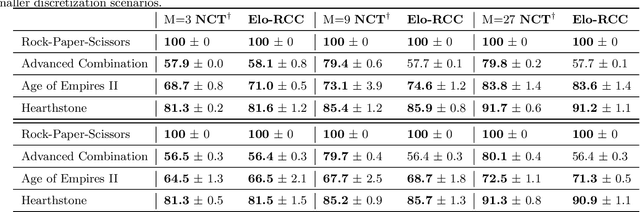
In competitive games, strength ratings like Elo are widely used to quantify player skill and support matchmaking by accounting for skill disparities better than simple win rate statistics. However, scalar ratings cannot handle complex intransitive relationships, such as counter strategies seen in Rock-Paper-Scissors. To address this, recent work introduced Neural Rating Table and Neural Counter Table, which combine scalar ratings with discrete counter categories to model intransitivity. While effective, these methods rely on neural network training and cannot perform real-time updates. In this paper, we propose an online update algorithm that extends Elo principles to incorporate real-time learning of counter categories. Our method dynamically adjusts both ratings and counter relationships after each match, preserving the explainability of scalar ratings while addressing intransitivity. Experiments on zero-sum competitive games demonstrate its practicality, particularly in scenarios without complex team compositions.