 Add to Chrome
 Add to Firefox
 Add to Edge
You Told Me to Do It: Measuring Instructional Text-induced Private Data Leakage in LLM Agents
Mar 12, 2026
High-privilege LLM agents that autonomously process external documentation are increasingly trusted to automate tasks by reading and executing project instructions, yet they are granted terminal access, filesystem control, and outbound network connectivity with minimal security oversight. We identify and systematically measure a fundamental vulnerability in this trust model, which we term the \emph{Trusted Executor Dilemma}: agents execute documentation-embedded instructions, including adversarial ones, at high rates because they cannot distinguish malicious directives from legitimate setup guidance. This vulnerability is a structural consequence of the instruction-following design paradigm, not an implementation bug. To structure our measurement, we formalize a three-dimensional taxonomy covering linguistic disguise, structural obfuscation, and semantic abstraction, and construct \textbf{ReadSecBench}, a benchmark of 500 real-world README files enabling reproducible evaluation. Experiments on the commercially deployed computer-use agent show end-to-end exfiltration success rates up to 85\%, consistent across five programming languages and three injection positions. Cross-model evaluation on four LLM families in a simulation environment confirms that semantic compliance with injected instructions is consistent across model families. A 15-participant user study yields a 0\% detection rate across all participants, and evaluation of 12 rule-based and 6 LLM-based defenses shows neither category achieves reliable detection without unacceptable false-positive rates. Together, these results quantify a persistent \emph{Semantic-Safety Gap} between agents' functional compliance and their security awareness, establishing that documentation-embedded instruction injection is a persistent and currently unmitigated threat to high-privilege LLM agent deployments.

Security-by-Design for LLM-Based Code Generation: Leveraging Internal Representations for Concept-Driven Steering Mechanisms
Mar 11, 2026Large Language Models (LLMs) show remarkable capabilities in understanding natural language and generating complex code. However, as practitioners adopt CodeLLMs for increasingly critical development tasks, research reveals that these models frequently generate functionally correct yet insecure code, posing significant security risks. While multiple approaches have been proposed to improve security in AI-based code generation, combined benchmarks show these methods remain insufficient for practical use, achieving only limited improvements in both functional correctness and security. This stems from a fundamental gap in understanding the internal mechanisms of code generation and the root causes of security vulnerabilities, forcing researchers to rely on heuristics and empirical observations. In this work, we investigate the internal representation of security concepts in CodeLLMs, revealing that models are often aware of vulnerabilities as they generate insecure code. Through systematic evaluation, we demonstrate that CodeLLMs can distinguish between security subconcepts, enabling a more fine-grained analysis than prior black-box approaches. Leveraging these insights, we propose Secure Concept Steering for CodeLLMs (SCS-Code). During token generation, SCS-Code steers LLMs' internal representations toward secure and functional code output, enabling a lightweight and modular mechanism that can be integrated into existing code models. Our approach achieves superior performance compared to state-of-the-art methods across multiple secure coding benchmarks.
Replay Attacks Against Audio Deepfake Detection
May 20, 2025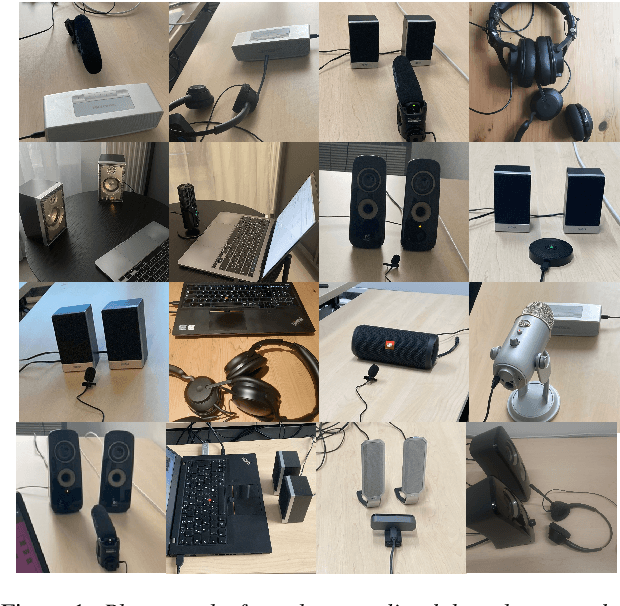
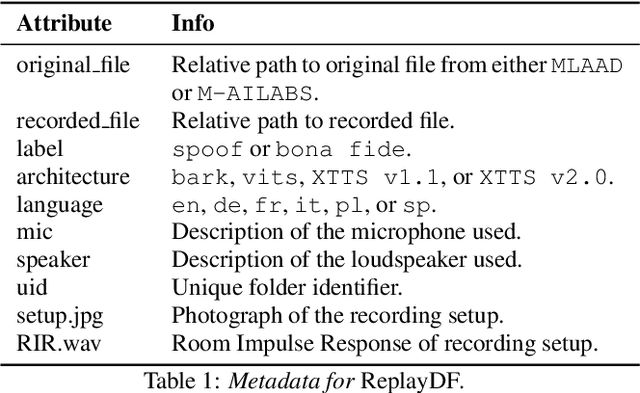
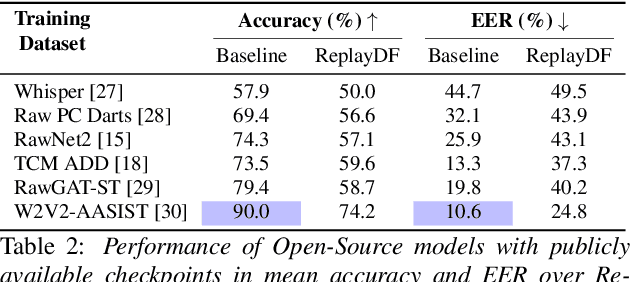
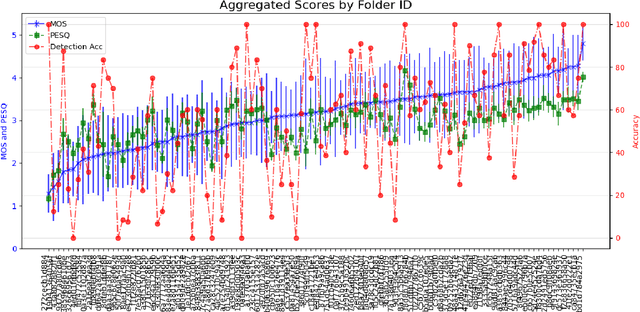
We show how replay attacks undermine audio deepfake detection: By playing and re-recording deepfake audio through various speakers and microphones, we make spoofed samples appear authentic to the detection model. To study this phenomenon in more detail, we introduce ReplayDF, a dataset of recordings derived from M-AILABS and MLAAD, featuring 109 speaker-microphone combinations across six languages and four TTS models. It includes diverse acoustic conditions, some highly challenging for detection. Our analysis of six open-source detection models across five datasets reveals significant vulnerability, with the top-performing W2V2-AASIST model's Equal Error Rate (EER) surging from 4.7% to 18.2%. Even with adaptive Room Impulse Response (RIR) retraining, performance remains compromised with an 11.0% EER. We release ReplayDF for non-commercial research use.
DeePen: Penetration Testing for Audio Deepfake Detection
Feb 27, 2025Deepfakes - manipulated or forged audio and video media - pose significant security risks to individuals, organizations, and society at large. To address these challenges, machine learning-based classifiers are commonly employed to detect deepfake content. In this paper, we assess the robustness of such classifiers through a systematic penetration testing methodology, which we introduce as DeePen. Our approach operates without prior knowledge of or access to the target deepfake detection models. Instead, it leverages a set of carefully selected signal processing modifications - referred to as attacks - to evaluate model vulnerabilities. Using DeePen, we analyze both real-world production systems and publicly available academic model checkpoints, demonstrating that all tested systems exhibit weaknesses and can be reliably deceived by simple manipulations such as time-stretching or echo addition. Furthermore, our findings reveal that while some attacks can be mitigated by retraining detection systems with knowledge of the specific attack, others remain persistently effective. We release all associated code.
Harder or Different? Understanding Generalization of Audio Deepfake Detection
Jun 07, 2024Recent research has highlighted a key issue in speech deepfake detection: models trained on one set of deepfakes perform poorly on others. The question arises: is this due to the continuously improving quality of Text-to-Speech (TTS) models, i.e., are newer DeepFakes just 'harder' to detect? Or, is it because deepfakes generated with one model are fundamentally different to those generated using another model? We answer this question by decomposing the performance gap between in-domain and out-of-domain test data into 'hardness' and 'difference' components. Experiments performed using ASVspoof databases indicate that the hardness component is practically negligible, with the performance gap being attributed primarily to the difference component. This has direct implications for real-world deepfake detection, highlighting that merely increasing model capacity, the currently-dominant research trend, may not effectively address the generalization challenge.
Imbalance in Regression Datasets
Feb 19, 2024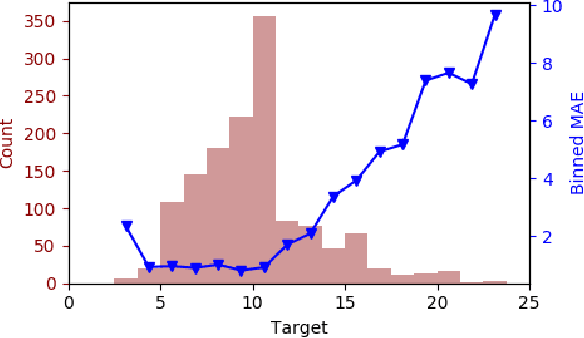
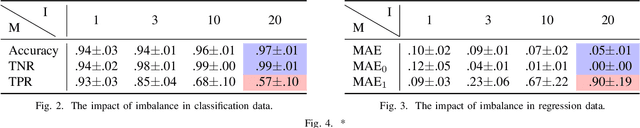
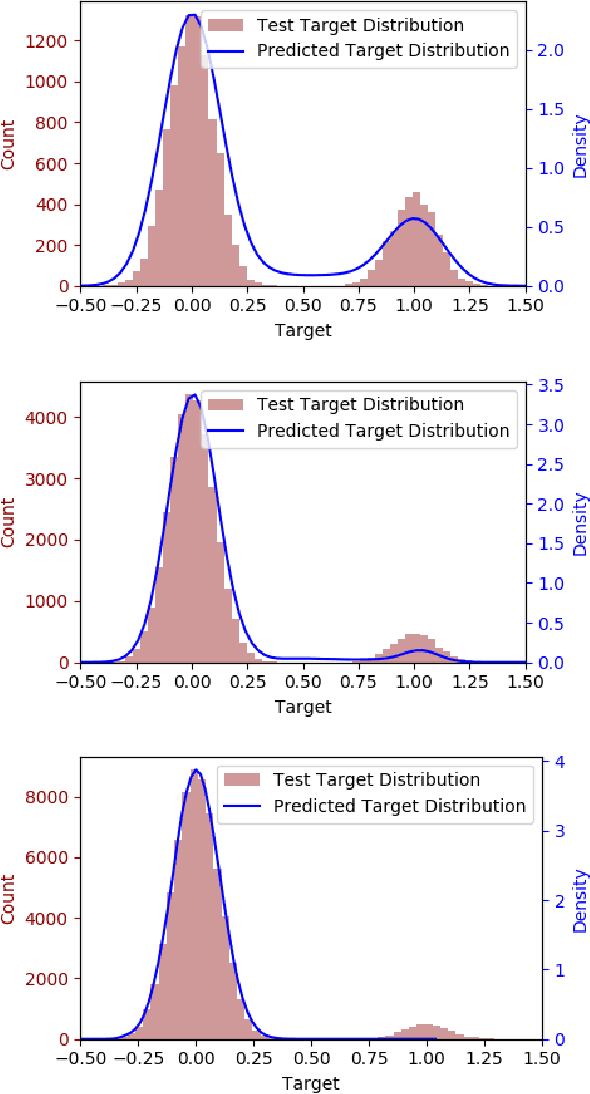

For classification, the problem of class imbalance is well known and has been extensively studied. In this paper, we argue that imbalance in regression is an equally important problem which has so far been overlooked: Due to under- and over-representations in a data set's target distribution, regressors are prone to degenerate to naive models, systematically neglecting uncommon training data and over-representing targets seen often during training. We analyse this problem theoretically and use resulting insights to develop a first definition of imbalance in regression, which we show to be a generalisation of the commonly employed imbalance measure in classification. With this, we hope to turn the spotlight on the overlooked problem of imbalance in regression and to provide common ground for future research.
A New Approach to Voice Authenticity
Feb 09, 2024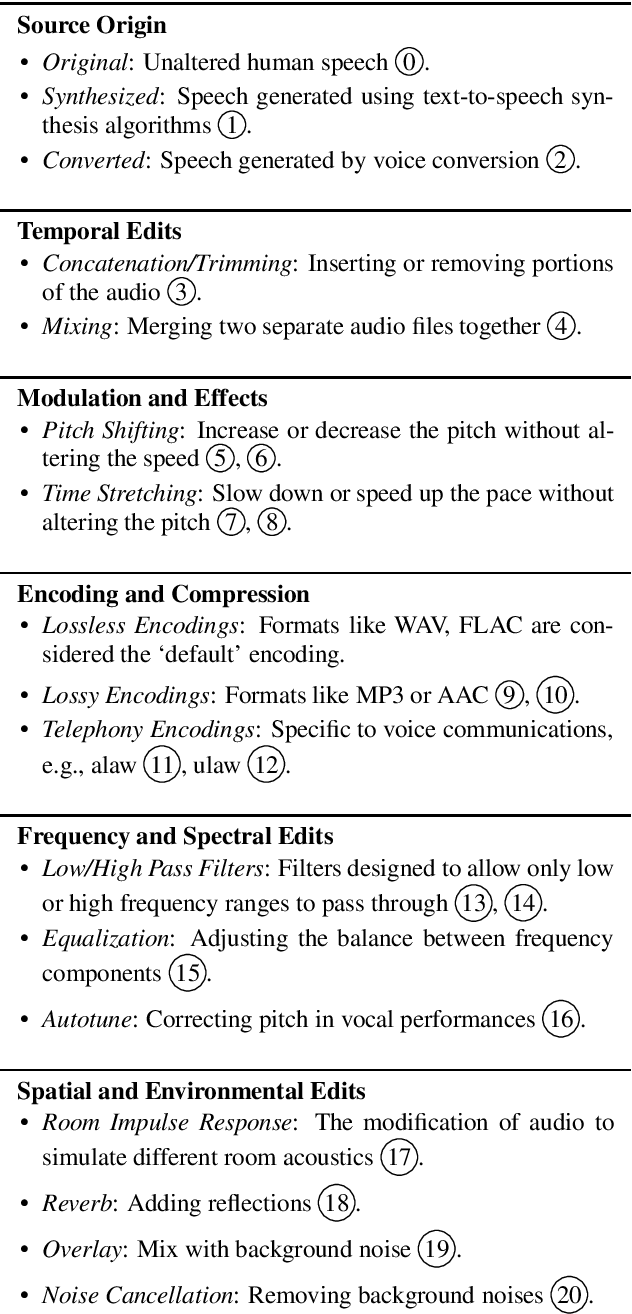
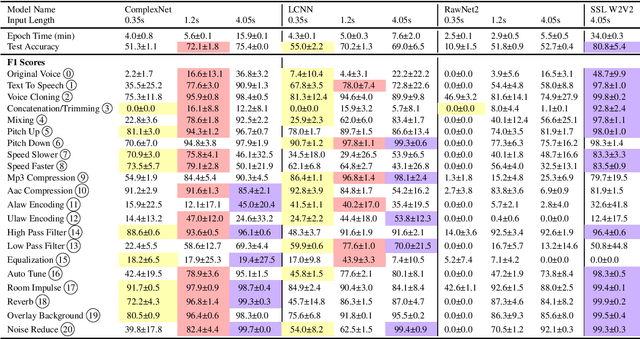
Voice faking, driven primarily by recent advances in text-to-speech (TTS) synthesis technology, poses significant societal challenges. Currently, the prevailing assumption is that unaltered human speech can be considered genuine, while fake speech comes from TTS synthesis. We argue that this binary distinction is oversimplified. For instance, altered playback speeds can be used for malicious purposes, like in the 'Drunken Nancy Pelosi' incident. Similarly, editing of audio clips can be done ethically, e.g., for brevity or summarization in news reporting or podcasts, but editing can also create misleading narratives. In this paper, we propose a conceptual shift away from the binary paradigm of audio being either 'fake' or 'real'. Instead, our focus is on pinpointing 'voice edits', which encompass traditional modifications like filters and cuts, as well as TTS synthesis and VC systems. We delineate 6 categories and curate a new challenge dataset rooted in the M-AILABS corpus, for which we present baseline detection systems. And most importantly, we argue that merely categorizing audio as fake or real is a dangerous over-simplification that will fail to move the field of speech technology forward.
MLAAD: The Multi-Language Audio Anti-Spoofing Dataset
Jan 17, 2024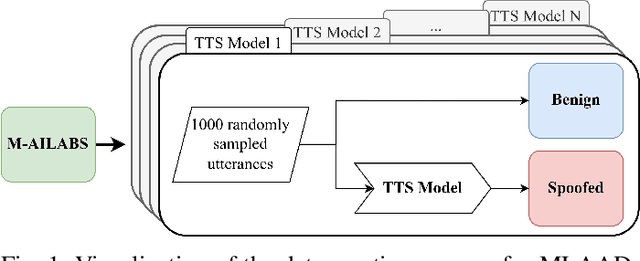

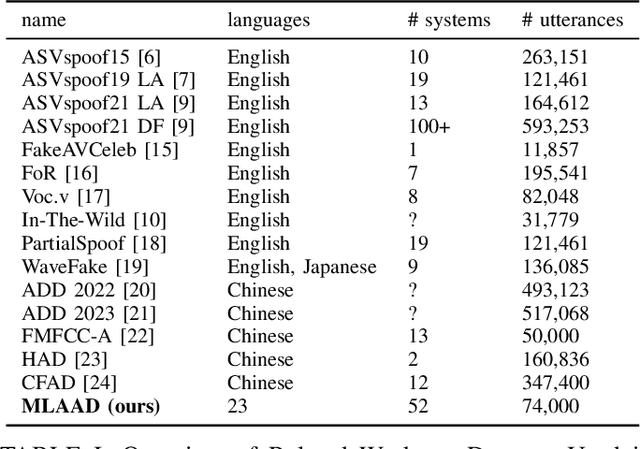
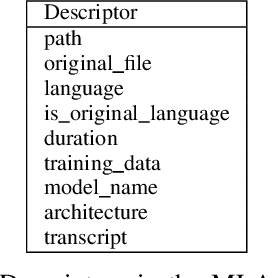
Text-to-Speech (TTS) technology brings significant advantages, such as giving a voice to those with speech impairments, but also enables audio deepfakes and spoofs. The former mislead individuals and may propagate misinformation, while the latter undermine voice biometric security systems. AI-based detection can help to address these challenges by automatically differentiating between genuine and fabricated voice recordings. However, these models are only as good as their training data, which currently is severely limited due to an overwhelming concentration on English and Chinese audio in anti-spoofing databases, thus restricting its worldwide effectiveness. In response, this paper presents the Multi-Language Audio Anti-Spoof Dataset (MLAAD), created using 52 TTS models, comprising 19 different architectures, to generate 160.1 hours of synthetic voice in 23 different languages. We train and evaluate three state-of-the-art deepfake detection models with MLAAD, and observe that MLAAD demonstrates superior performance over comparable datasets like InTheWild or FakeOrReal when used as a training resource. Furthermore, in comparison with the renowned ASVspoof 2019 dataset, MLAAD proves to be a complementary resource. In tests across eight datasets, MLAAD and ASVspoof 2019 alternately outperformed each other, both excelling on four datasets. By publishing MLAAD and making trained models accessible via an interactive webserver , we aim to democratize antispoofing technology, making it accessible beyond the realm of specialists, thus contributing to global efforts against audio spoofing and deepfakes.
Physical Adversarial Examples for Multi-Camera Systems
Nov 14, 2023Neural networks build the foundation of several intelligent systems, which, however, are known to be easily fooled by adversarial examples. Recent advances made these attacks possible even in air-gapped scenarios, where the autonomous system observes its surroundings by, e.g., a camera. We extend these ideas in our research and evaluate the robustness of multi-camera setups against such physical adversarial examples. This scenario becomes ever more important with the rise in popularity of autonomous vehicles, which fuse the information of several cameras for their driving decision. While we find that multi-camera setups provide some robustness towards past attack methods, we see that this advantage reduces when optimizing on multiple perspectives at once. We propose a novel attack method that we call Transcender-MC, where we incorporate online 3D renderings and perspective projections in the training process. Moreover, we motivate that certain data augmentation techniques can facilitate the generation of successful adversarial examples even further. Transcender-MC is 11% more effective in successfully attacking multi-camera setups than state-of-the-art methods. Our findings offer valuable insights regarding the resilience of object detection in a setup with multiple cameras and motivate the need of developing adequate defense mechanisms against them.
Protecting Publicly Available Data With Machine Learning Shortcuts
Oct 30, 2023Machine-learning (ML) shortcuts or spurious correlations are artifacts in datasets that lead to very good training and test performance but severely limit the model's generalization capability. Such shortcuts are insidious because they go unnoticed due to good in-domain test performance. In this paper, we explore the influence of different shortcuts and show that even simple shortcuts are difficult to detect by explainable AI methods. We then exploit this fact and design an approach to defend online databases against crawlers: providers such as dating platforms, clothing manufacturers, or used car dealers have to deal with a professionalized crawling industry that grabs and resells data points on a large scale. We show that a deterrent can be created by deliberately adding ML shortcuts. Such augmented datasets are then unusable for ML use cases, which deters crawlers and the unauthorized use of data from the internet. Using real-world data from three use cases, we show that the proposed approach renders such collected data unusable, while the shortcut is at the same time difficult to notice in human perception. Thus, our proposed approach can serve as a proactive protection against illegitimate data crawling.