 Add to Chrome
 Add to Firefox
 Add to Edge
Eroding Trust in Real Speech: A Large-Scale Study of Human Audio Deepfake Perception
May 21, 2026
Audio deepfakes have improved rapidly recently, yet their effect on human trust in real speech remains unstudied. We present the largest listening study on audio deepfake perception to date, collecting 35,532 judgments from 1,768 participants across 138 text-to-speech and voice conversion systems. Our central finding is a skepticism shift: compared to a 2021 baseline, human accuracy on fake samples barely changed (72.9% to 71.2%), but accuracy on real samples dropped from 72.7% to 64.1%. Participants are not worse at detecting synthesis artifacts; rather, they increasingly distrust authentic speech. Samples generated by commercial and autoregressive language model systems proved hardest to detect (61.3 - 65.9%), while those from traditional seq2seq and flow-matching models remain easier to spot (75.4 - 76.8%). An ML detector that served as a reference point maintained over 94.5% accuracy across all conditions. Our results suggest that the primary threat posed by modern deepfakes may not be mere deception, but the erosion of trust in genuine audio.

DeePen: Penetration Testing for Audio Deepfake Detection
Feb 27, 2025Deepfakes - manipulated or forged audio and video media - pose significant security risks to individuals, organizations, and society at large. To address these challenges, machine learning-based classifiers are commonly employed to detect deepfake content. In this paper, we assess the robustness of such classifiers through a systematic penetration testing methodology, which we introduce as DeePen. Our approach operates without prior knowledge of or access to the target deepfake detection models. Instead, it leverages a set of carefully selected signal processing modifications - referred to as attacks - to evaluate model vulnerabilities. Using DeePen, we analyze both real-world production systems and publicly available academic model checkpoints, demonstrating that all tested systems exhibit weaknesses and can be reliably deceived by simple manipulations such as time-stretching or echo addition. Furthermore, our findings reveal that while some attacks can be mitigated by retraining detection systems with knowledge of the specific attack, others remain persistently effective. We release all associated code.
MLAAD: The Multi-Language Audio Anti-Spoofing Dataset
Jan 17, 2024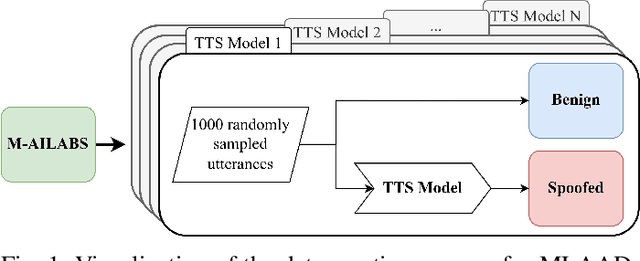

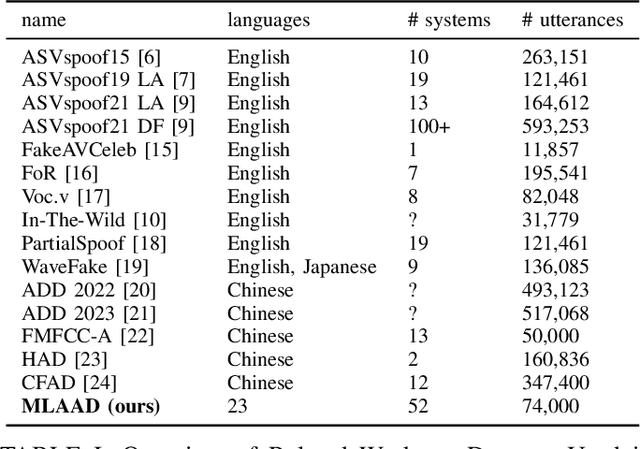
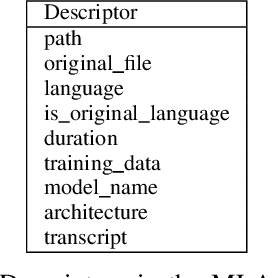
Text-to-Speech (TTS) technology brings significant advantages, such as giving a voice to those with speech impairments, but also enables audio deepfakes and spoofs. The former mislead individuals and may propagate misinformation, while the latter undermine voice biometric security systems. AI-based detection can help to address these challenges by automatically differentiating between genuine and fabricated voice recordings. However, these models are only as good as their training data, which currently is severely limited due to an overwhelming concentration on English and Chinese audio in anti-spoofing databases, thus restricting its worldwide effectiveness. In response, this paper presents the Multi-Language Audio Anti-Spoof Dataset (MLAAD), created using 52 TTS models, comprising 19 different architectures, to generate 160.1 hours of synthetic voice in 23 different languages. We train and evaluate three state-of-the-art deepfake detection models with MLAAD, and observe that MLAAD demonstrates superior performance over comparable datasets like InTheWild or FakeOrReal when used as a training resource. Furthermore, in comparison with the renowned ASVspoof 2019 dataset, MLAAD proves to be a complementary resource. In tests across eight datasets, MLAAD and ASVspoof 2019 alternately outperformed each other, both excelling on four datasets. By publishing MLAAD and making trained models accessible via an interactive webserver , we aim to democratize antispoofing technology, making it accessible beyond the realm of specialists, thus contributing to global efforts against audio spoofing and deepfakes.