 Add to Chrome
 Add to Firefox
 Add to Edge
Joint Energy Management and Coordinated AIGC Workload Scheduling for Distributed Data Centers: A Diffusion-Aided Reward Shaping Approach
May 03, 2026
Artificial intelligence-generated content (AIGC) has emerged as a transformative paradigm for automating the creation of diverse and customized content, giving rise to rapidly growing computational workloads in cloud data centers. It is imperative for AIGC service providers (ASPs) to strategically schedule AIGC workloads to reduce data center energy costs while guaranteeing high-quality content generation. However, the distinctive characteristics of AIGC services pose critical challenges, including model heterogeneity across ASPs, implicit service quality evaluation, and complex inference process control. To tackle these challenges, we propose a joint energy management and coordinated AIGC workload scheduling framework, which introduces an explicit mathematical characterization of service quality to promote both job transfer among ASPs and fine-grained inference process configuration. Moreover, various energy resources within data centers are jointly considered to enhance power usage flexibility. Subsequently, a system utility maximization problem is formulated to balance AIGC service revenue with operational penalties and costs. Nevertheless, the strong coupling among job scheduling decisions induces severe reward sparsity, which limits the effectiveness of existing deep reinforcement learning (DRL) algorithms. To address this issue, we develop a diffusion model-aided reward shaping approach to synthesize complementary reward signals through a multi-step denoising process. This approach is seamlessly integrated with DRL to enable efficient learning of scheduling policies under sparse environmental feedback. Experiments based on real-world models and datasets demonstrate that our scheme effectively accommodates electricity price fluctuations and AIGC model heterogeneity, while achieving superior learning convergence and system utility compared with benchmark methods.

Wetland mapping from sparse annotations with satellite image time series and temporal-aware segment anything model
Jan 16, 2026Accurate wetland mapping is essential for ecosystem monitoring, yet dense pixel-level annotation is prohibitively expensive and practical applications usually rely on sparse point labels, under which existing deep learning models perform poorly, while strong seasonal and inter-annual wetland dynamics further render single-date imagery inadequate and lead to significant mapping errors; although foundation models such as SAM show promising generalization from point prompts, they are inherently designed for static images and fail to model temporal information, resulting in fragmented masks in heterogeneous wetlands. To overcome these limitations, we propose WetSAM, a SAM-based framework that integrates satellite image time series for wetland mapping from sparse point supervision through a dual-branch design, where a temporally prompted branch extends SAM with hierarchical adapters and dynamic temporal aggregation to disentangle wetland characteristics from phenological variability, and a spatial branch employs a temporally constrained region-growing strategy to generate reliable dense pseudo-labels, while a bidirectional consistency regularization jointly optimizes both branches. Extensive experiments across eight global regions of approximately 5,000 km2 each demonstrate that WetSAM substantially outperforms state-of-the-art methods, achieving an average F1-score of 85.58%, and delivering accurate and structurally consistent wetland segmentation with minimal labeling effort, highlighting its strong generalization capability and potential for scalable, low-cost, high-resolution wetland mapping.
DynaQuant: Dynamic Mixed-Precision Quantization for Learned Image Compression
Nov 11, 2025Prevailing quantization techniques in Learned Image Compression (LIC) typically employ a static, uniform bit-width across all layers, failing to adapt to the highly diverse data distributions and sensitivity characteristics inherent in LIC models. This leads to a suboptimal trade-off between performance and efficiency. In this paper, we introduce DynaQuant, a novel framework for dynamic mixed-precision quantization that operates on two complementary levels. First, we propose content-aware quantization, where learnable scaling and offset parameters dynamically adapt to the statistical variations of latent features. This fine-grained adaptation is trained end-to-end using a novel Distance-aware Gradient Modulator (DGM), which provides a more informative learning signal than the standard Straight-Through Estimator. Second, we introduce a data-driven, dynamic bit-width selector that learns to assign an optimal bit precision to each layer, dynamically reconfiguring the network's precision profile based on the input data. Our fully dynamic approach offers substantial flexibility in balancing rate-distortion (R-D) performance and computational cost. Experiments demonstrate that DynaQuant achieves rd performance comparable to full-precision models while significantly reducing computational and storage requirements, thereby enabling the practical deployment of advanced LIC on diverse hardware platforms.
RoadGen: Generating Road Scenarios for Autonomous Vehicle Testing
Nov 29, 2024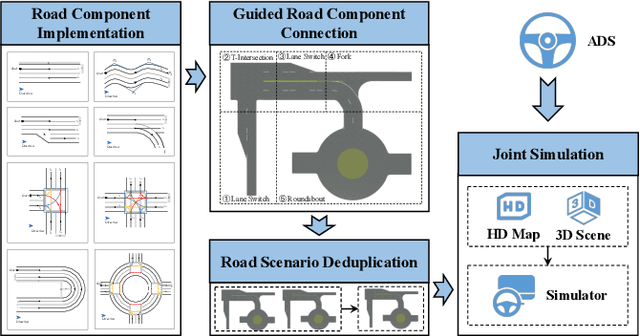
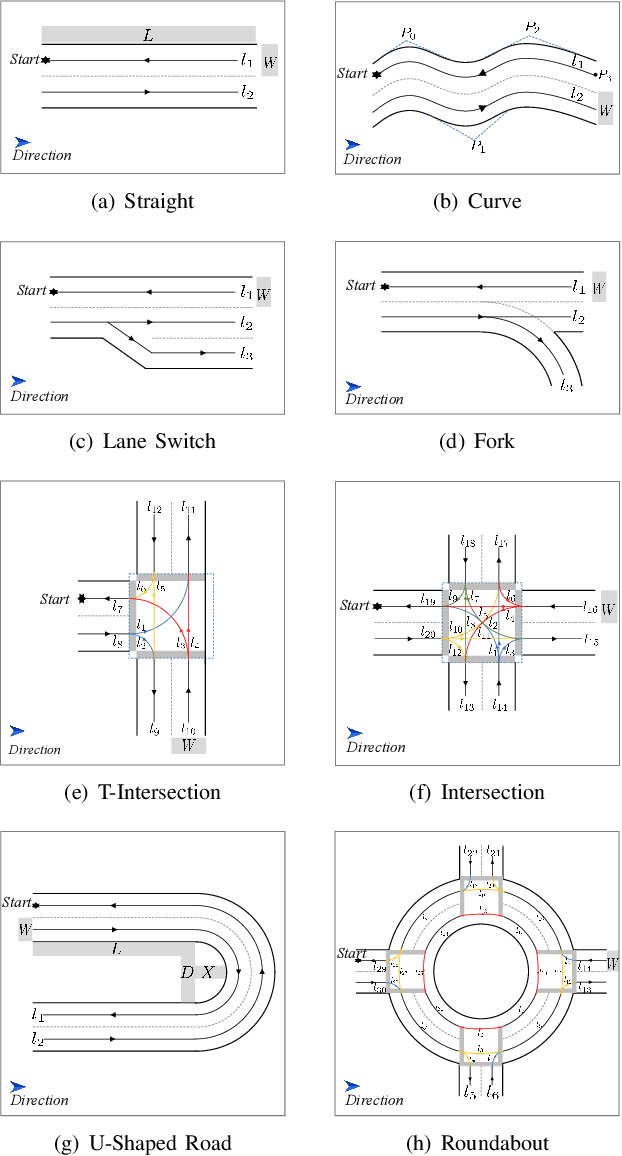

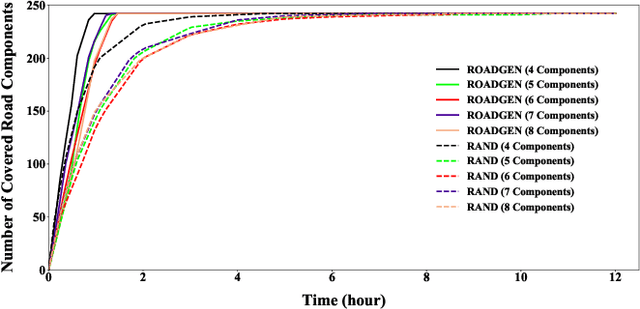
With the rapid development of autonomous vehicles, there is an increasing demand for scenario-based testing to simulate diverse driving scenarios. However, as the base of any driving scenarios, road scenarios (e.g., road topology and geometry) have received little attention by the literature. Despite several advances, they either generate basic road components without a complete road network, or generate a complete road network but with simple road components. The resulting road scenarios lack diversity in both topology and geometry. To address this problem, we propose RoadGen to systematically generate diverse road scenarios. The key idea is to connect eight types of parameterized road components to form road scenarios with high diversity in topology and geometry. Our evaluation has demonstrated the effectiveness and usefulness of RoadGen in generating diverse road scenarios for simulation.
End-to-End Out-of-distribution Detection with Self-supervised Sampling
Jul 02, 2023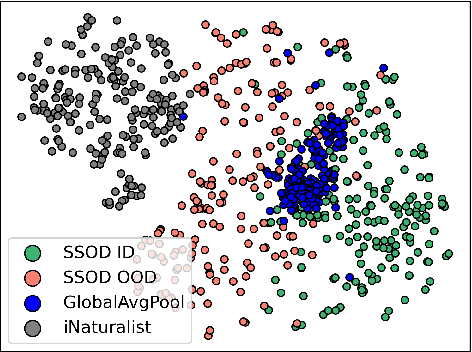
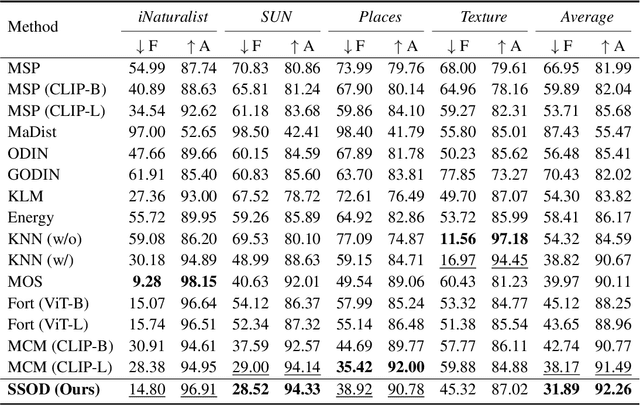
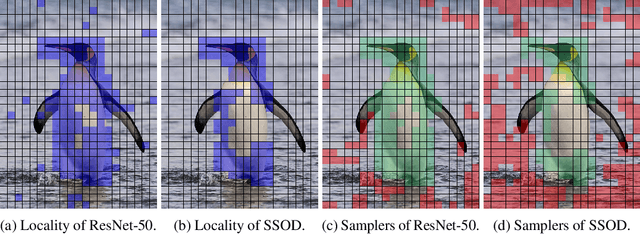
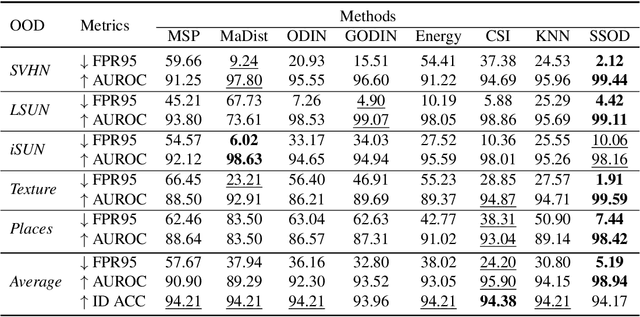
Out-of-distribution (OOD) detection empowers the model trained on the closed set to identify unknown data in the open world. Though many prior techniques have yielded considerable improvements, two crucial obstacles still remain. Firstly, a unified perspective has yet to be presented to view the developed arts with individual designs, which is vital for providing insights into the related directions. Secondly, most research focuses on the post-processing schemes of the pre-trained features while disregarding the superiority of end-to-end training, dramatically limiting the upper bound of OOD detection. To tackle these issues, we propose a general probabilistic framework to interpret many existing methods and an OOD-data-free model, namely Self-supervised Sampling for OOD Detection (SSOD), to unfold the potential of end-to-end learning. SSOD efficiently exploits natural OOD signals from the in-distribution (ID) data based on the local property of convolution. With these supervisions, it jointly optimizes the OOD detection and conventional ID classification. Extensive experiments reveal that SSOD establishes competitive state-of-the-art performance on many large-scale benchmarks, where it outperforms the most recent approaches, such as KNN, by a large margin, e.g., 48.99% to 35.52% on SUN at FPR95.