 Add to Chrome
 Add to Firefox
 Add to Edge
StatABench: Dataset and Framework for Evaluating Statistical Analysis Capabilities of LLMs
Jun 22, 2026
Statistical analysis is a broad, complex field requiring both domain knowledge and tool proficiency. While prior work has evaluated large language models (LLMs) in this domain, existing benchmarks remain limited in scope and format. To bridge this gap, we introduce StatABench (Statistical AnalysisBenchmark), a benchmark designed to systematically assess LLMs' statistical analysis capabilities. StatABench comprises two complementary components: Stat-Closed, containing 404 questions across 18 statistical topics in multiple formats (multiple-choice, fill-in-the-blank, decision-making, and practical application), and Stat-Open, featuring 30 complex open-ended modeling tasks adapted from professional competitions. We evaluate diverse LLMs using the LangChain MCP framework and multiple data science agents, and assess Stat-Open solutions via a validated LLM-as-Judge protocol. Experiments show that even GPT-5.1 achieves only 68.6% on Stat-Closed, while the best open-source model reaches 60.6%. On Stat-Open, the top agent framework scores 61.86 on average. These results reveal the gap between current LLMs and reliable statistical analysis, highlighting persistent challenges in tool-grounded reasoning, methodological decision-making, and end-to-end statistical modeling.

RPCANet++: Deep Interpretable Robust PCA for Sparse Object Segmentation
Aug 06, 2025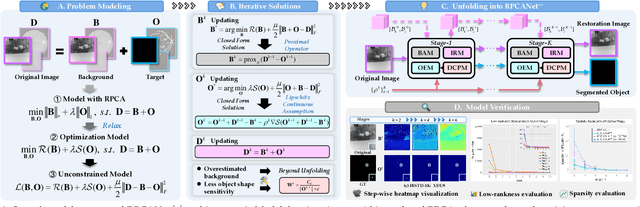
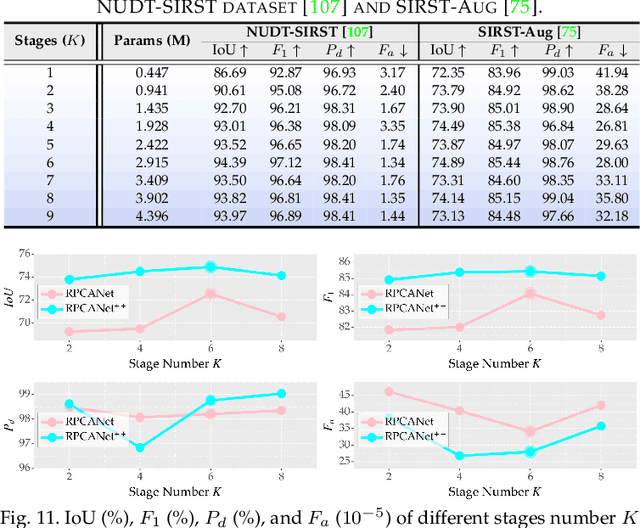
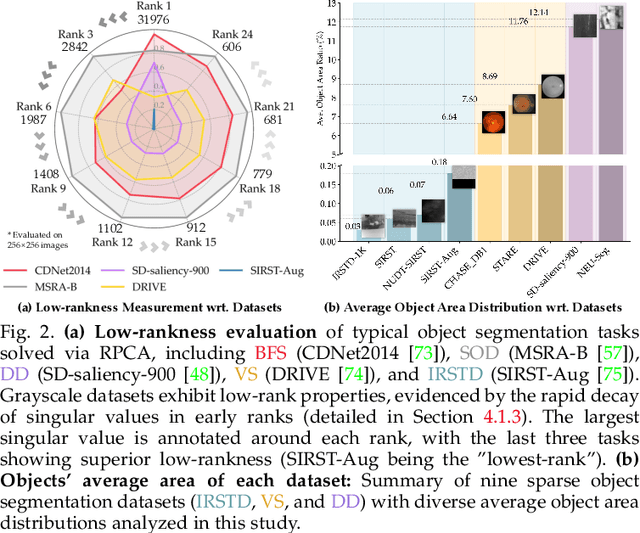
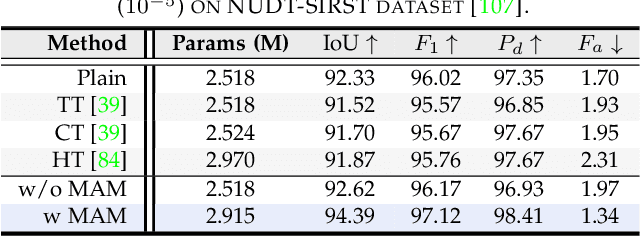
Robust principal component analysis (RPCA) decomposes an observation matrix into low-rank background and sparse object components. This capability has enabled its application in tasks ranging from image restoration to segmentation. However, traditional RPCA models suffer from computational burdens caused by matrix operations, reliance on finely tuned hyperparameters, and rigid priors that limit adaptability in dynamic scenarios. To solve these limitations, we propose RPCANet++, a sparse object segmentation framework that fuses the interpretability of RPCA with efficient deep architectures. Our approach unfolds a relaxed RPCA model into a structured network comprising a Background Approximation Module (BAM), an Object Extraction Module (OEM), and an Image Restoration Module (IRM). To mitigate inter-stage transmission loss in the BAM, we introduce a Memory-Augmented Module (MAM) to enhance background feature preservation, while a Deep Contrast Prior Module (DCPM) leverages saliency cues to expedite object extraction. Extensive experiments on diverse datasets demonstrate that RPCANet++ achieves state-of-the-art performance under various imaging scenarios. We further improve interpretability via visual and numerical low-rankness and sparsity measurements. By combining the theoretical strengths of RPCA with the efficiency of deep networks, our approach sets a new baseline for reliable and interpretable sparse object segmentation. Codes are available at our Project Webpage https://fengyiwu98.github.io/rpcanetx.