 Add to Chrome
 Add to Firefox
 Add to Edge
AI-boosted rare event sampling to characterize extreme weather
Oct 31, 2025
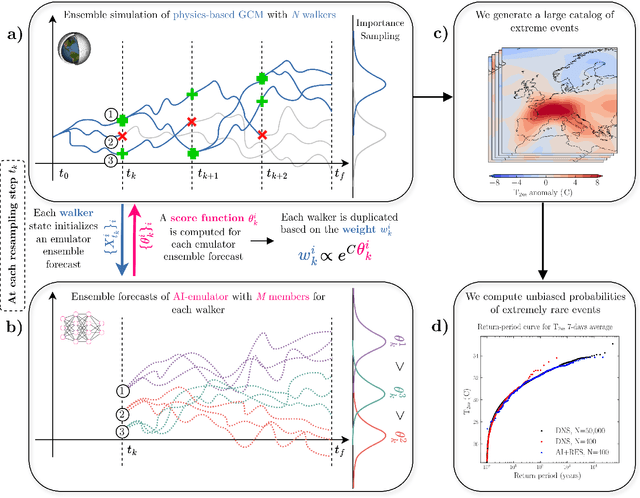
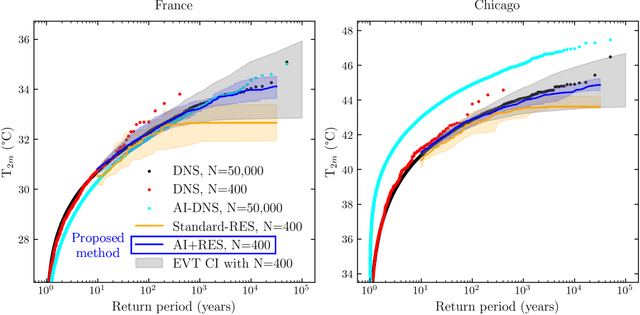
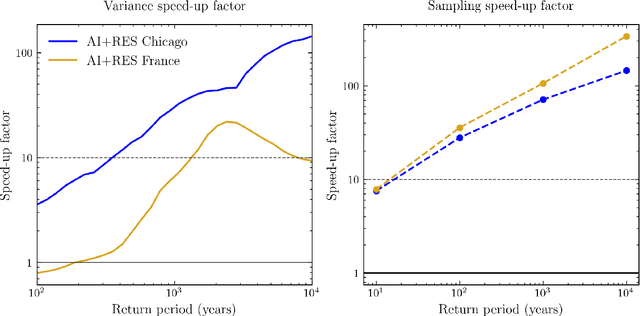
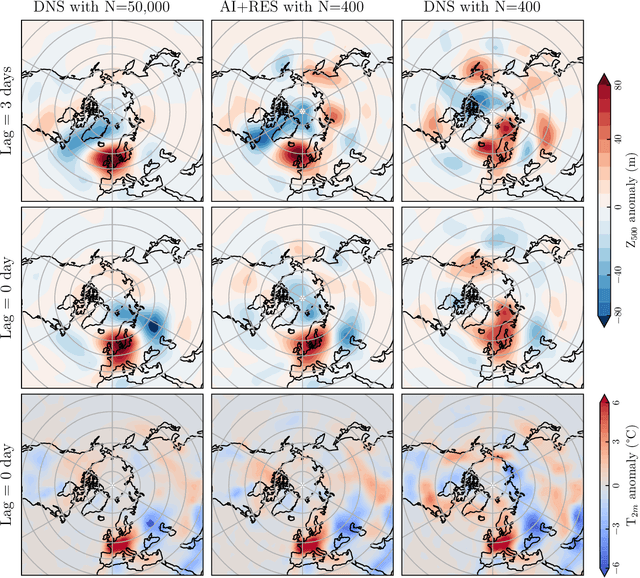
Assessing the frequency and intensity of extreme weather events, and understanding how climate change affects them, is crucial for developing effective adaptation and mitigation strategies. However, observational datasets are too short and physics-based global climate models (GCMs) are too computationally expensive to obtain robust statistics for the rarest, yet most impactful, extreme events. AI-based emulators have shown promise for predictions at weather and even climate timescales, but they struggle on extreme events with few or no examples in their training dataset. Rare event sampling (RES) algorithms have previously demonstrated success for some extreme events, but their performance depends critically on a hard-to-identify "score function", which guides efficient sampling by a GCM. Here, we develop a novel algorithm, AI+RES, which uses ensemble forecasts of an AI weather emulator as the score function to guide highly efficient resampling of the GCM and generate robust (physics-based) extreme weather statistics and associated dynamics at 30-300x lower cost. We demonstrate AI+RES on mid-latitude heatwaves, a challenging test case requiring a score function with predictive skill many days in advance. AI+RES, which synergistically integrates AI, RES, and GCMs, offers a powerful, scalable tool for studying extreme events in climate science, as well as other disciplines in science and engineering where rare events and AI emulators are active areas of research.

Can AI weather models predict out-of-distribution gray swan tropical cyclones?
Oct 19, 2024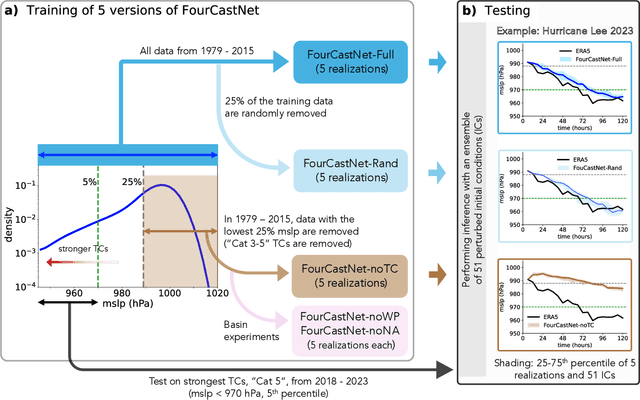
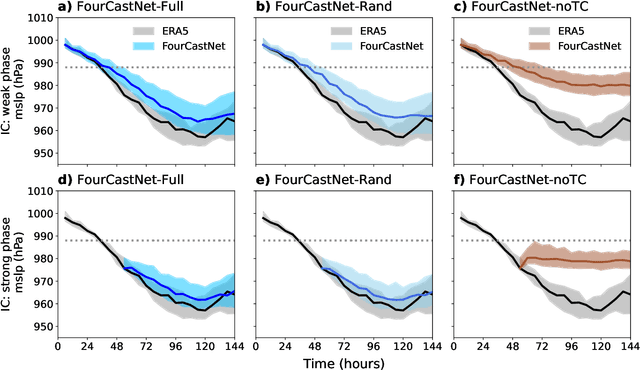
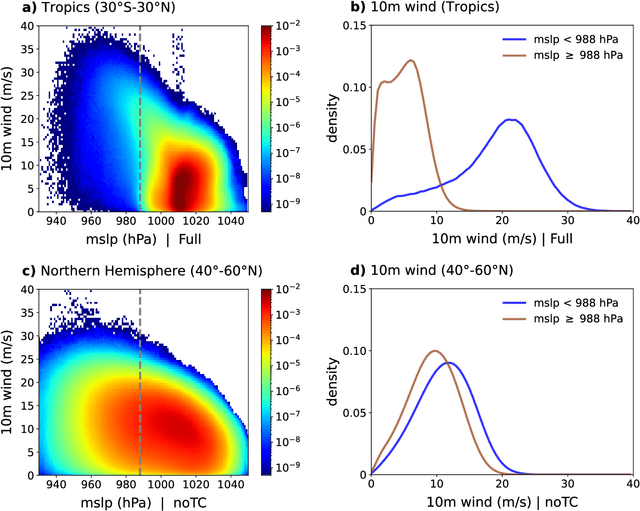
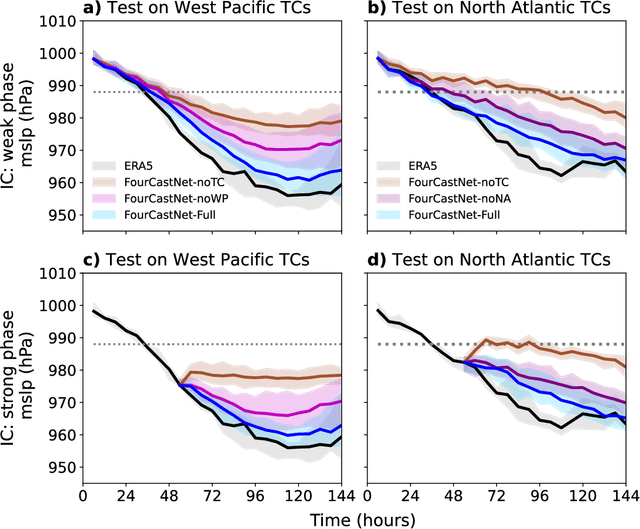
Predicting gray swan weather extremes, which are possible but so rare that they are absent from the training dataset, is a major concern for AI weather/climate models. An important open question is whether AI models can extrapolate from weaker weather events present in the training set to stronger, unseen weather extremes. To test this, we train independent versions of the AI model FourCastNet on the 1979-2015 ERA5 dataset with all data, or with Category 3-5 tropical cyclones (TCs) removed, either globally or only over the North Atlantic or Western Pacific basin. We then test these versions of FourCastNet on 2018-2023 Category 5 TCs (gray swans). All versions yield similar accuracy for global weather, but the one trained without Category 3-5 TCs cannot accurately forecast Category 5 TCs, indicating that these models cannot extrapolate from weaker storms. The versions trained without Category 3-5 TCs in one basin show some skill forecasting Category 5 TCs in that basin, suggesting that FourCastNet can generalize across tropical basins. This is encouraging and surprising because regional information is implicitly encoded in inputs. No version satisfies gradient-wind balance, implying that enforcing such physical constraints may not improve generalizability to gray swans. Given that current state-of-the-art AI weather/climate models have similar learning strategies, we expect our findings to apply to other models and extreme events. Our work demonstrates that novel learning strategies are needed for AI weather/climate models to provide early warning or estimated statistics for the rarest, most impactful weather extremes.
Using Explainable AI and Transfer Learning to understand and predict the maintenance of Atlantic blocking with limited observational data
Apr 12, 2024Blocking events are an important cause of extreme weather, especially long-lasting blocking events that trap weather systems in place. The duration of blocking events is, however, underestimated in climate models. Explainable Artificial Intelligence are a class of data analysis methods that can help identify physical causes of prolonged blocking events and diagnose model deficiencies. We demonstrate this approach on an idealized quasigeostrophic model developed by Marshall and Molteni (1993). We train a convolutional neural network (CNN), and subsequently, build a sparse predictive model for the persistence of Atlantic blocking, conditioned on an initial high-pressure anomaly. Shapley Additive ExPlanation (SHAP) analysis reveals that high-pressure anomalies in the American Southeast and North Atlantic, separated by a trough over Atlantic Canada, contribute significantly to prediction of sustained blocking events in the Atlantic region. This agrees with previous work that identified precursors in the same regions via wave train analysis. When we apply the same CNN to blockings in the ERA5 atmospheric reanalysis, there is insufficient data to accurately predict persistent blocks. We partially overcome this limitation by pre-training the CNN on the plentiful data of the Marshall-Molteni model, and then using Transfer Learning to achieve better predictions than direct training. SHAP analysis before and after transfer learning allows a comparison between the predictive features in the reanalysis and the quasigeostrophic model, quantifying dynamical biases in the idealized model. This work demonstrates the potential for machine learning methods to extract meaningful precursors of extreme weather events and achieve better prediction using limited observational data.