 Add to Chrome
 Add to Firefox
 Add to Edge
AI-boosted rare event sampling to characterize extreme weather
Oct 31, 2025
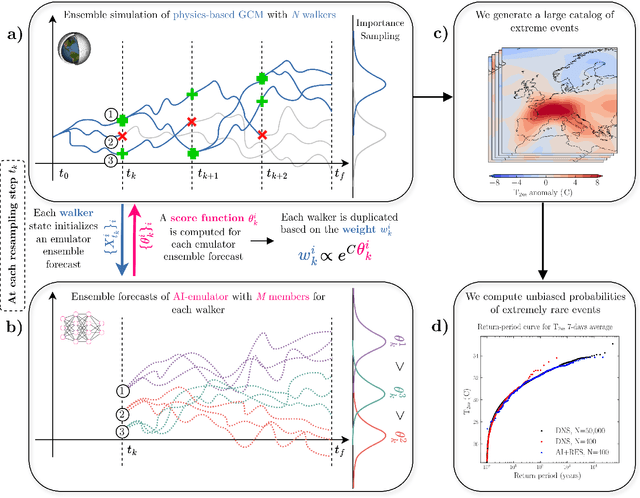
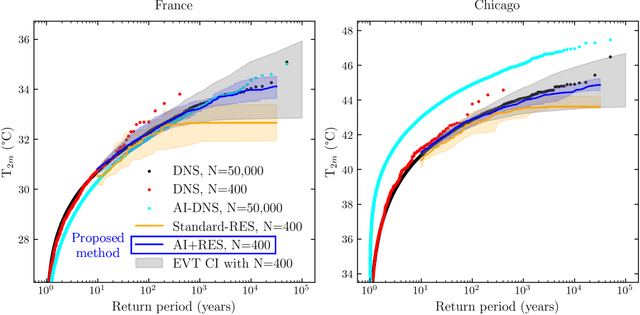
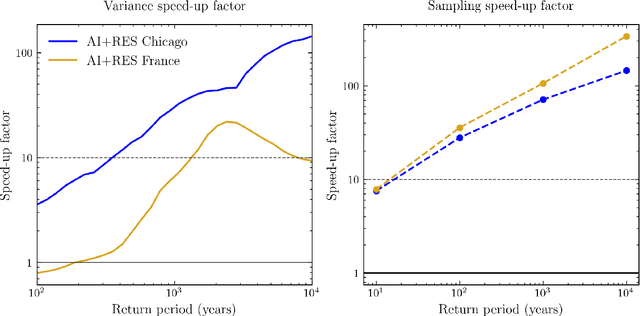
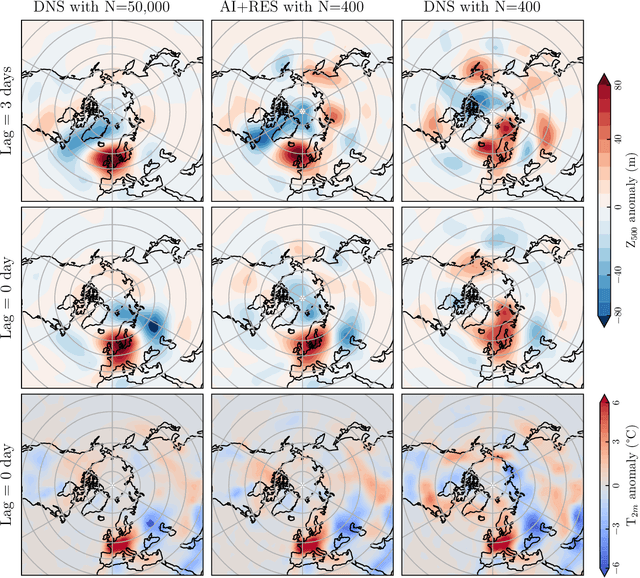
Assessing the frequency and intensity of extreme weather events, and understanding how climate change affects them, is crucial for developing effective adaptation and mitigation strategies. However, observational datasets are too short and physics-based global climate models (GCMs) are too computationally expensive to obtain robust statistics for the rarest, yet most impactful, extreme events. AI-based emulators have shown promise for predictions at weather and even climate timescales, but they struggle on extreme events with few or no examples in their training dataset. Rare event sampling (RES) algorithms have previously demonstrated success for some extreme events, but their performance depends critically on a hard-to-identify "score function", which guides efficient sampling by a GCM. Here, we develop a novel algorithm, AI+RES, which uses ensemble forecasts of an AI weather emulator as the score function to guide highly efficient resampling of the GCM and generate robust (physics-based) extreme weather statistics and associated dynamics at 30-300x lower cost. We demonstrate AI+RES on mid-latitude heatwaves, a challenging test case requiring a score function with predictive skill many days in advance. AI+RES, which synergistically integrates AI, RES, and GCMs, offers a powerful, scalable tool for studying extreme events in climate science, as well as other disciplines in science and engineering where rare events and AI emulators are active areas of research.

Tackling the Accuracy-Interpretability Trade-off in a Hierarchy of Machine Learning Models for the Prediction of Extreme Heatwaves
Oct 01, 2024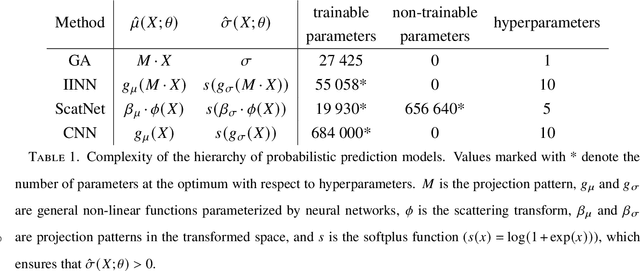
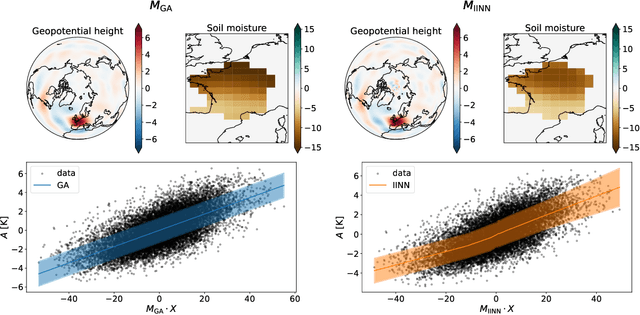
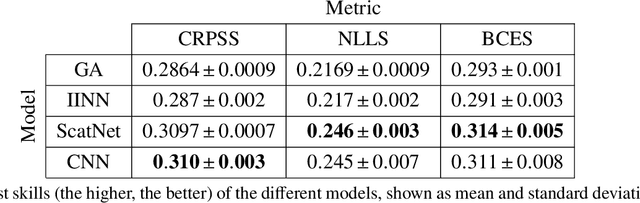
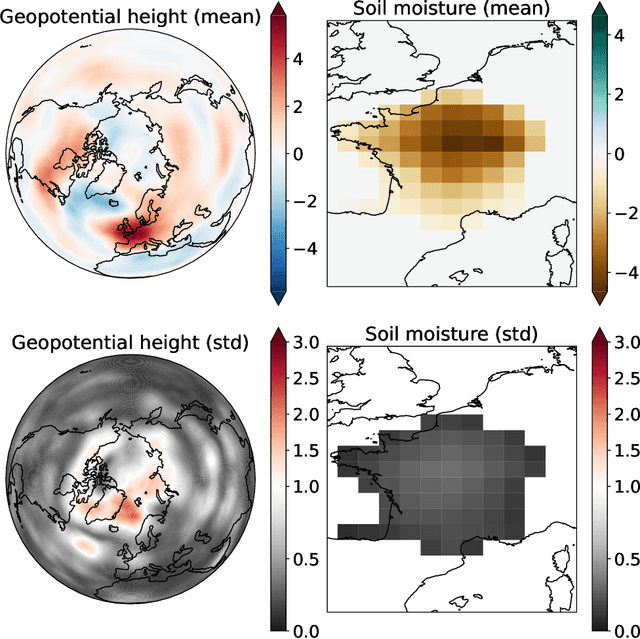
When performing predictions that use Machine Learning (ML), we are mainly interested in performance and interpretability. This generates a natural trade-off, where complex models generally have higher skills but are harder to explain and thus trust. Interpretability is particularly important in the climate community, where we aim at gaining a physical understanding of the underlying phenomena. Even more so when the prediction concerns extreme weather events with high impact on society. In this paper, we perform probabilistic forecasts of extreme heatwaves over France, using a hierarchy of increasingly complex ML models, which allows us to find the best compromise between accuracy and interpretability. More precisely, we use models that range from a global Gaussian Approximation (GA) to deep Convolutional Neural Networks (CNNs), with the intermediate steps of a simple Intrinsically Interpretable Neural Network (IINN) and a model using the Scattering Transform (ScatNet). Our findings reveal that CNNs provide higher accuracy, but their black-box nature severely limits interpretability, even when using state-of-the-art Explainable Artificial Intelligence (XAI) tools. In contrast, ScatNet achieves similar performance to CNNs while providing greater transparency, identifying key scales and patterns in the data that drive predictions. This study underscores the potential of interpretability in ML models for climate science, demonstrating that simpler models can rival the performance of their more complex counterparts, all the while being much easier to understand. This gained interpretability is crucial for building trust in model predictions and uncovering new scientific insights, ultimately advancing our understanding and management of extreme weather events.