 Add to Chrome
 Add to Firefox
 Add to Edge
Rigorous uncertainty quantification of probabilistic AI weather forecasts with conformal prediction
Jun 17, 2026
Probabilistic weather forecasting is undergoing rapid transformation with artificial intelligence (AI). In traditional numerical weather prediction, computing power can limit how well ensemble forecasts approximate the unknown statistical distribution of future states. AI models facilitate larger ensembles and are trained with probabilistic considerations, ideally leading to better uncertainty quantification. Forecasts from these state-of-the-art models are often considered well-calibrated. However, here we show that the statistical coverage of such models, the ultimate measure of calibration, can struggle, especially on extreme events. To address this shortcoming, we employ conformal prediction, a class of statistical methods that mathematically guarantees coverage under no distributional assumptions, unlike previous post-processing techniques. We apply online conformal prediction to temperature and precipitation forecasts (including extremes) of three leading global weather models, GenCast, NeuralGCM, and AIFS-ENS, ensuring calibrated uncertainty at no expense to other probabilistic metrics. This post-processing method can be applied to any forecasting model.

Auto-differentiable data assimilation: Co-learning of states, dynamics, and filtering algorithms
Mar 21, 2026Data assimilation algorithms estimate the state of a dynamical system from partial observations, where the successful performance of these algorithms hinges on costly parameter tuning and on employing an accurate model for the dynamics. This paper introduces a framework for jointly learning the state, dynamics, and parameters of filtering algorithms in data assimilation through a process we refer to as auto-differentiable filtering. The framework leverages a theoretically motivated loss function that enables learning from partial, noisy observations via gradient-based optimization using auto-differentiation. We further demonstrate how several well-known data assimilation methods can be learned or tuned within this framework. To underscore the versatility of auto-differentiable filtering, we perform experiments on dynamical systems spanning multiple scientific domains, such as the Clohessy-Wiltshire equations from aerospace engineering, the Lorenz-96 system from atmospheric science, and the generalized Lotka-Volterra equations from systems biology. Finally, we provide guidelines for practitioners to customize our framework according to their observation model, accuracy requirements, and computational budget.
Accelerating PDE Surrogates via RL-Guided Mesh Optimization
Mar 02, 2026Deep surrogate models for parametric partial differential equations (PDEs) can deliver high-fidelity approximations but remain prohibitively data-hungry: training often requires thousands of fine-grid simulations, each incurring substantial computational cost. To address this challenge, we introduce RLMesh, an end-to-end framework for efficient surrogate training under limited simulation budget. The key idea is to use reinforcement learning (RL) to adaptively allocate mesh grid points non-uniformly within each simulation domain, focusing numerical resolution in regions most critical for accurate PDE solutions. A lightweight proxy model further accelerates RL training by providing efficient reward estimates without full surrogate retraining. Experiments on PDE benchmarks demonstrate that RLMesh achieves competitive accuracy to baselines but with substantially fewer simulation queries. These results show that solver-level spatial adaptivity can dramatically improve the efficiency of surrogate training pipelines, enabling practical deployment of learning-based PDE surrogates across a wide range of problems.
A Model-Guided Neural Network Method for the Inverse Scattering Problem
Dec 10, 2025Inverse medium scattering is an ill-posed, nonlinear wave-based imaging problem arising in medical imaging, remote sensing, and non-destructive testing. Machine learning (ML) methods offer increased inference speed and flexibility in capturing prior knowledge of imaging targets relative to classical optimization-based approaches; however, they perform poorly in regimes where the scattering behavior is highly nonlinear. A key limitation is that ML methods struggle to incorporate the physics governing the scattering process, which are typically inferred implicitly from the training data or loosely enforced via architectural design. In this paper, we present a method that endows a machine learning framework with explicit knowledge of problem physics, in the form of a differentiable solver representing the forward model. The proposed method progressively refines reconstructions of the scattering potential using measurements at increasing wave frequencies, following a classical strategy to stabilize recovery. Empirically, we find that our method provides high-quality reconstructions at a fraction of the computational or sampling costs of competing approaches.
Sketch-Augmented Features Improve Learning Long-Range Dependencies in Graph Neural Networks
Nov 05, 2025Graph Neural Networks learn on graph-structured data by iteratively aggregating local neighborhood information. While this local message passing paradigm imparts a powerful inductive bias and exploits graph sparsity, it also yields three key challenges: (i) oversquashing of long-range information, (ii) oversmoothing of node representations, and (iii) limited expressive power. In this work we inject randomized global embeddings of node features, which we term \textit{Sketched Random Features}, into standard GNNs, enabling them to efficiently capture long-range dependencies. The embeddings are unique, distance-sensitive, and topology-agnostic -- properties which we analytically and empirically show alleviate the aforementioned limitations when injected into GNNs. Experimental results on real-world graph learning tasks confirm that this strategy consistently improves performance over baseline GNNs, offering both a standalone solution and a complementary enhancement to existing techniques such as graph positional encodings. Our source code is available at \href{https://github.com/ryienh/sketched-random-features}{https://github.com/ryienh/sketched-random-features}.
Hierarchical Implicit Neural Emulators
Jun 05, 2025Neural PDE solvers offer a powerful tool for modeling complex dynamical systems, but often struggle with error accumulation over long time horizons and maintaining stability and physical consistency. We introduce a multiscale implicit neural emulator that enhances long-term prediction accuracy by conditioning on a hierarchy of lower-dimensional future state representations. Drawing inspiration from the stability properties of numerical implicit time-stepping methods, our approach leverages predictions several steps ahead in time at increasing compression rates for next-timestep refinements. By actively adjusting the temporal downsampling ratios, our design enables the model to capture dynamics across multiple granularities and enforce long-range temporal coherence. Experiments on turbulent fluid dynamics show that our method achieves high short-term accuracy and produces long-term stable forecasts, significantly outperforming autoregressive baselines while adding minimal computational overhead.
Quality Measures for Dynamic Graph Generative Models
Mar 03, 2025Deep generative models have recently achieved significant success in modeling graph data, including dynamic graphs, where topology and features evolve over time. However, unlike in vision and natural language domains, evaluating generative models for dynamic graphs is challenging due to the difficulty of visualizing their output, making quantitative metrics essential. In this work, we develop a new quality metric for evaluating generative models of dynamic graphs. Current metrics for dynamic graphs typically involve discretizing the continuous-evolution of graphs into static snapshots and then applying conventional graph similarity measures. This approach has several limitations: (a) it models temporally related events as i.i.d. samples, failing to capture the non-uniform evolution of dynamic graphs; (b) it lacks a unified measure that is sensitive to both features and topology; (c) it fails to provide a scalar metric, requiring multiple metrics without clear superiority; and (d) it requires explicitly instantiating each static snapshot, leading to impractical runtime demands that hinder evaluation at scale. We propose a novel metric based on the \textit{Johnson-Lindenstrauss} lemma, applying random projections directly to dynamic graph data. This results in an expressive, scalar, and application-agnostic measure of dynamic graph similarity that overcomes the limitations of traditional methods. We also provide a comprehensive empirical evaluation of metrics for continuous-time dynamic graphs, demonstrating the effectiveness of our approach compared to existing methods. Our implementation is available at https://github.com/ryienh/jl-metric.
Can a calibration metric be both testable and actionable?
Feb 27, 2025Forecast probabilities often serve as critical inputs for binary decision making. In such settings, calibration$\unicode{x2014}$ensuring forecasted probabilities match empirical frequencies$\unicode{x2014}$is essential. Although the common notion of Expected Calibration Error (ECE) provides actionable insights for decision making, it is not testable: it cannot be empirically estimated in many practical cases. Conversely, the recently proposed Distance from Calibration (dCE) is testable but is not actionable since it lacks decision-theoretic guarantees needed for high-stakes applications. We introduce Cutoff Calibration Error, a calibration measure that bridges this gap by assessing calibration over intervals of forecasted probabilities. We show that Cutoff Calibration Error is both testable and actionable and examine its implications for popular post-hoc calibration methods, such as isotonic regression and Platt scaling.
Solving Inverse Problems with Deep Linear Neural Networks: Global Convergence Guarantees for Gradient Descent with Weight Decay
Feb 21, 2025Machine learning methods are commonly used to solve inverse problems, wherein an unknown signal must be estimated from few measurements generated via a known acquisition procedure. In particular, neural networks perform well empirically but have limited theoretical guarantees. In this work, we study an underdetermined linear inverse problem that admits several possible solution mappings. A standard remedy (e.g., in compressed sensing) establishing uniqueness of the solution mapping is to assume knowledge of latent low-dimensional structure in the source signal. We ask the following question: do deep neural networks adapt to this low-dimensional structure when trained by gradient descent with weight decay regularization? We prove that mildly overparameterized deep linear networks trained in this manner converge to an approximate solution that accurately solves the inverse problem while implicitly encoding latent subspace structure. To our knowledge, this is the first result to rigorously show that deep linear networks trained with weight decay automatically adapt to latent subspace structure in the data under practical stepsize and weight initialization schemes. Our work highlights that regularization and overparameterization improve generalization, while overparameterization also accelerates convergence during training.
Faster Adaptive Optimization via Expected Gradient Outer Product Reparameterization
Feb 03, 2025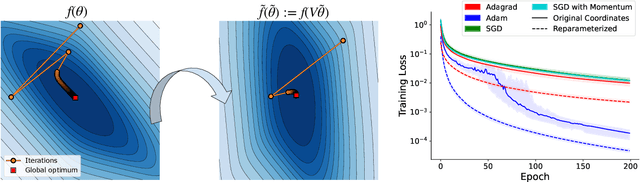
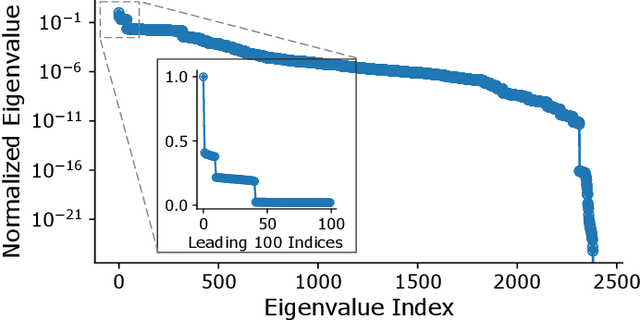
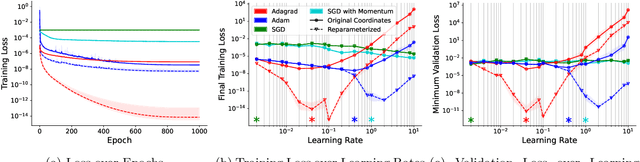
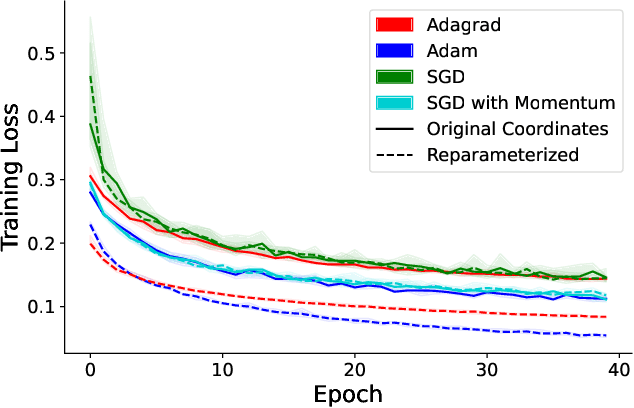
Adaptive optimization algorithms -- such as Adagrad, Adam, and their variants -- have found widespread use in machine learning, signal processing and many other settings. Several methods in this family are not rotationally equivariant, meaning that simple reparameterizations (i.e. change of basis) can drastically affect their convergence. However, their sensitivity to the choice of parameterization has not been systematically studied; it is not clear how to identify a "favorable" change of basis in which these methods perform best. In this paper we propose a reparameterization method and demonstrate both theoretically and empirically its potential to improve their convergence behavior. Our method is an orthonormal transformation based on the expected gradient outer product (EGOP) matrix, which can be approximated using either full-batch or stochastic gradient oracles. We show that for a broad class of functions, the sensitivity of adaptive algorithms to choice-of-basis is influenced by the decay of the EGOP matrix spectrum. We illustrate the potential impact of EGOP reparameterization by presenting empirical evidence and theoretical arguments that common machine learning tasks with "natural" data exhibit EGOP spectral decay.