 Add to Chrome
 Add to Firefox
 Add to Edge
TraceLab: Characterizing Coding Agent Workloads for LLM Serving
Jun 30, 2026
Coding agents are rapidly becoming a major application of agentic LLMs, but serving them efficiently remains challenging. Progress on this challenge requires understanding real workload patterns, yet the data needed for such analysis is largely absent. Existing public traces and benchmarks do not capture real, day-to-day coding-agent usage across multiple agents and model families for serving-system analysis. To help fill this gap, we collect and release a trace of roughly 4,300 coding-agent sessions, containing about 350,000 LLM steps and 430,000 tool calls from our own day-to-day use of Claude Code and Codex. Our analysis shows that coding-agent workloads feature long autonomous loops, long contexts with short outputs, diverse and heavily-tailed tool calls, and high but imperfect prefix cache hit rates. These findings point to concrete opportunities for optimizing serving, including lower-overhead tool calling, append-length-aware prefill, semantic-aware tool-latency prediction, and improved KV-cache management around human-paced gaps. We release the dataset, trace collection pipeline, and analysis code at https://github.com/uw-syfi/TraceLab.git the project website is https://tracelab.cs.washington.edu.

Natural Language Query to Configuration for Retrieval Agents
May 26, 2026Modern retrieval agents expose many configuration choices -- LLM, retriever, number of documents, number of hops, and synthesis strategy -- each shaping both answer quality and serving cost. Today, these pipelines are typically hand-tuned once per workload, leaving substantial per-query optimization untapped. We formulate the problem: given a natural-language query and either an accuracy or a budget target, select from a predefined pipeline catalog the configuration that minimizes cost or maximizes accuracy at inference time. We propose **BRANE**, which uses an LLM to convert each query into workload-specific characteristics, then trains a lightweight per-configuration predictor that estimates whether the pipeline will answer the query correctly. At inference time, **BRANE** selects the configuration that maximizes predicted correctness penalized by cost, exposing a tunable cost-quality tradeoff without retraining. Across MuSiQue, BrowseComp-Plus, and FinanceBench, **BRANE** consistently pushes the cost-quality Pareto frontier, matches the best fixed configuration's accuracy at up to 89% lower cost, and outperforms LLM-routing, rule-based, and fine-tuned Qwen3-4B baselines. These results show that per-query configuration of the full retrieval pipeline is a practical alternative to static workload-level tuning.
Drowning in Documents: Consequences of Scaling Reranker Inference
Nov 18, 2024

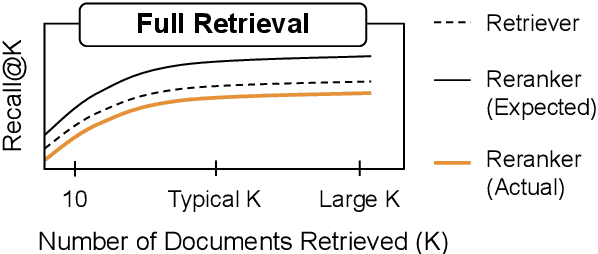
Rerankers, typically cross-encoders, are often used to re-score the documents retrieved by cheaper initial IR systems. This is because, though expensive, rerankers are assumed to be more effective. We challenge this assumption by measuring reranker performance for full retrieval, not just re-scoring first-stage retrieval. Our experiments reveal a surprising trend: the best existing rerankers provide diminishing returns when scoring progressively more documents and actually degrade quality beyond a certain limit. In fact, in this setting, rerankers can frequently assign high scores to documents with no lexical or semantic overlap with the query. We hope that our findings will spur future research to improve reranking.