 Add to Chrome
 Add to Firefox
 Add to Edge
Unequal Trips, Unequal Places: Diagnosing and Mitigating Delay Inequity in Autonomous Vehicle Fleet Coordination
Jul 27, 2026
City-scale autonomous vehicle fleet coordinators are typically optimized for aggregate travel time, yet fleet averages conceal how delay is distributed across trips and regions. We conduct a distributional audit on three real-city road-network and taxi-demand datasets from Manhattan, Chicago, and San Francisco. The audit reveals pervasive trip-length inequity whose direction depends on the city and coordinator. After accounting for trip length, spatial inequity becomes more pronounced as demand grows and is consistently stronger when trips are grouped by origin rather than destination. These findings motivate SPatially Aware RErouting (SPARE), a budgeted online coordination framework that assigns limited replanning capacity to delayed vehicles and redirects them using recently observed waiting pressure. SPARE provides a per-review decision guarantee and explicitly bounds online route updates. Experiments on all three datasets against six representative baselines show that SPARE delivers the strongest joint efficiency-fairness performance while retaining city-scale scalability. The results demonstrate that bounded congestion-responsive rerouting improves performance and equity without full-fleet replanning.

Securing Retrieval-Augmented Generation: A Taxonomy of Attacks, Defenses, and Future Directions
Apr 09, 2026Retrieval-augmented generation (RAG) significantly enhances large language models (LLMs) but introduces novel security risks through external knowledge access. While existing studies cover various RAG vulnerabilities, they often conflate inherent LLM risks with those specifically introduced by RAG. In this paper, we propose that secure RAG is fundamentally about the security of the external knowledge-access pipeline. We establish an operational boundary to separate inherent LLM flaws from RAG-introduced or RAG-amplified threats. Guided by this perspective, we abstract the RAG workflow into six stages and organize the literature around three trust boundaries and four primary security surfaces, including pre-retrieval knowledge corruption, retrieval-time access manipulation, downstream context exploitation, and knowledge exfiltration. By systematically reviewing the corresponding attacks, defenses, remediation mechanisms, and evaluation benchmarks, we reveal that current defenses remain largely reactive and fragmented. Finally, we discuss these gaps and highlight future directions toward layered, boundary-aware protection across the entire knowledge-access lifecycle.
ClinicalAgents: Multi-Agent Orchestration for Clinical Decision Making with Dual-Memory
Mar 27, 2026While Large Language Models (LLMs) have demonstrated potential in healthcare, they often struggle with the complex, non-linear reasoning required for accurate clinical diagnosis. Existing methods typically rely on static, linear mappings from symptoms to diagnoses, failing to capture the iterative, hypothesis-driven reasoning inherent to human clinicians. To bridge this gap, we introduce ClinicalAgents, a novel multi-agent framework designed to simulate the cognitive workflow of expert clinicians. Unlike rigid sequential chains, ClinicalAgents employs a dynamic orchestration mechanism modeled as a Monte Carlo Tree Search (MCTS) process. This allows an Orchestrator to iteratively generate hypotheses, actively verify evidence, and trigger backtracking when critical information is missing. Central to this framework is a Dual-Memory architecture: a mutable Working Memory that maintains the evolving patient state for context-aware reasoning, and a static Experience Memory that retrieves clinical guidelines and historical cases via an active feedback loop. Extensive experiments demonstrate that ClinicalAgents achieves state-of-the-art performance, significantly enhancing both diagnostic accuracy and explainability compared to strong single-agent and multi-agent baselines.
A Survey of Large Language Models in Mental Health Disorder Detection on Social Media
Apr 03, 2025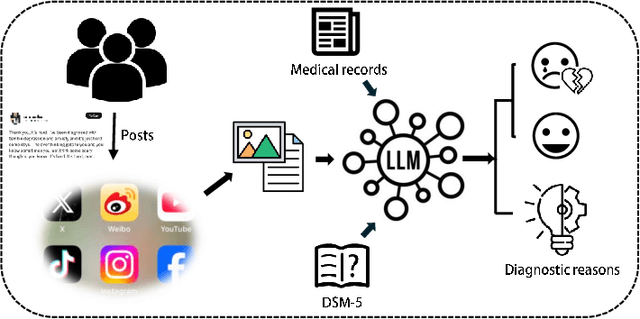
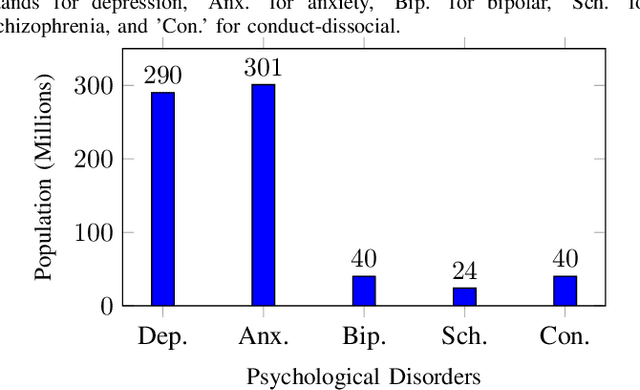
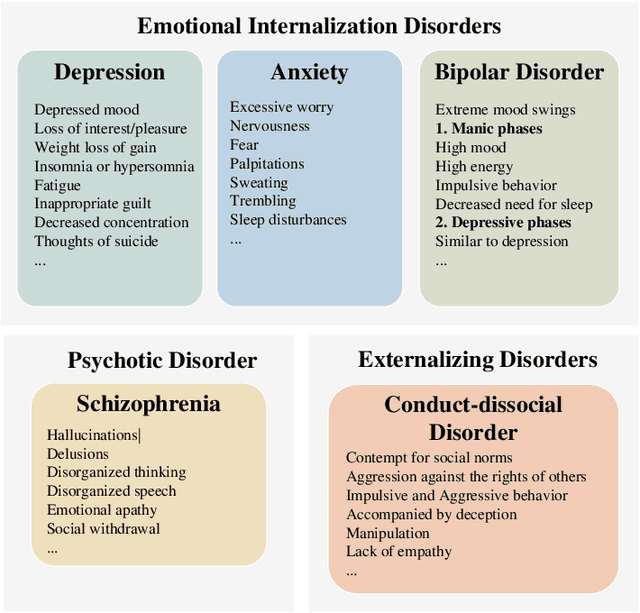
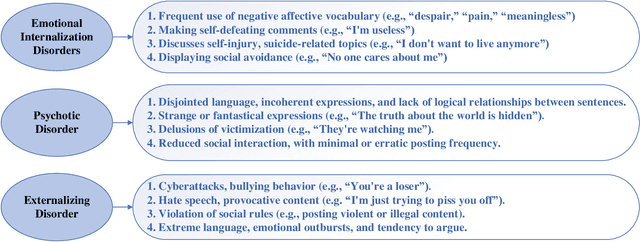
The detection and intervention of mental health issues represent a critical global research focus, and social media data has been recognized as an important resource for mental health research. However, how to utilize Large Language Models (LLMs) for mental health problem detection on social media poses significant challenges. Hence, this paper aims to explore the potential of LLM applications in social media data analysis, focusing not only on the most common psychological disorders such as depression and anxiety but also incorporating psychotic disorders and externalizing disorders, summarizing the application methods of LLM from different dimensions, such as text data analysis and detection of mental disorders, and revealing the major challenges and shortcomings of current research. In addition, the paper provides an overview of popular datasets, and evaluation metrics. The survey in this paper provides a comprehensive frame of reference for researchers in the field of mental health, while demonstrating the great potential of LLMs in mental health detection to facilitate the further application of LLMs in future mental health interventions.
A Survey on Large Language Model Acceleration based on KV Cache Management
Dec 27, 2024Large Language Models (LLMs) have revolutionized a wide range of domains such as natural language processing, computer vision, and multi-modal tasks due to their ability to comprehend context and perform logical reasoning. However, the computational and memory demands of LLMs, particularly during inference, pose significant challenges when scaling them to real-world, long-context, and real-time applications. Key-Value (KV) cache management has emerged as a critical optimization technique for accelerating LLM inference by reducing redundant computations and improving memory utilization. This survey provides a comprehensive overview of KV cache management strategies for LLM acceleration, categorizing them into token-level, model-level, and system-level optimizations. Token-level strategies include KV cache selection, budget allocation, merging, quantization, and low-rank decomposition, while model-level optimizations focus on architectural innovations and attention mechanisms to enhance KV reuse. System-level approaches address memory management, scheduling, and hardware-aware designs to improve efficiency across diverse computing environments. Additionally, the survey provides an overview of both text and multimodal datasets and benchmarks used to evaluate these strategies. By presenting detailed taxonomies and comparative analyses, this work aims to offer useful insights for researchers and practitioners to support the development of efficient and scalable KV cache management techniques, contributing to the practical deployment of LLMs in real-world applications. The curated paper list for KV cache management is in: \href{https://github.com/TreeAI-Lab/Awesome-KV-Cache-Management}{https://github.com/TreeAI-Lab/Awesome-KV-Cache-Management}.