 Add to Chrome
 Add to Firefox
 Add to Edge
Parameter Exploration for RLVR via Variational Learning
Aug 10, 2026
Exploration has been a focus of reinforcement learning research for a long time. Recently, there has been growing evidence that it is also an important ingredient in LLM reinforcement learning recipes that can significantly impact downstream performance. Many existing methods control exploration in the action-space, for example, using temperature scaling. However, these methods cannot reorder tokens but only influence the variance in the output distribution. This limits exploration and can lead to divergence or stalled training. Here, we investigate parameter-space exploration, where rollouts are generated by sampling different policies from a posterior that may each explore different rollouts. Sampling less or more diverse policies is then a complementary control lever over exploration. We introduce a family of methods called Perturbed Parameter Policy Optimization (3PO) which use different sampling strategies and different rollout grouping for reward estimation. Experiments on OLMo-3-1025-7B and Qwen2.5-Math-7B across mathematical reasoning and code generation tasks show that these approaches consistently improve average downstream performance over standard GRPO at a near-identical FLOPs cost. Moreover, using multiple parameter samples consistently produces fewer zero-advantage groups and malformed or incorrect rollouts during training than GRPO and action-space baselines. Overall, our work presents evidence that parameter-space exploration can improve reinforcement learning for LLMs.

Uncertainty-Aware Generation and Decision-Making Under Ambiguity
Jun 29, 2026With rapidly improving capabilities, Large Language Models (LLMs) are increasingly used in many complex real-world tasks. Beyond requiring in-depth knowledge and reasoning skills, many of these tasks exhibit a high degree of subjectivity and require that the outputs of the model can be trusted. While a lot of progress has been made to train better models, decision-making algorithms have received less attention. In this work, we present and evaluate various uncertainty-aware decision-making algorithms based on Bayesian decision theory and risk-averse decision making on the tasks of tutoring and automatic peer reviewing. Concretely, we take uncertainty over tutoring strategies and review scores into account when generating a tutor response or review and use conformal prediction to provide guarantees over strategy and score. We find empirically that these algorithms can improve the utility of the generations but need to be carefully implemented when ambiguity is high. For example, risk-averse rules can degrade performance by optimizing for generic outputs, while Bayesian methods tend to perform better. Our work uses techniques from decision theory to improve LLM-based decision-making and outlines open challenges for the community.
Quantifying the Agreement Between Data-Influence and Data-Similarity to Understand LLM Behavior
Jun 22, 2026One way to understand LLM behavior is to trace its output back to the training data. Two types of measures are commonly used for output tracing: data-similarity and data-influence. The former is cheaper while the latter is believed to be more accurate. Even though many works have compared them for ground-truth tasks, no such comparisons exist for output tracing. Here, we fill this gap and precisely quantify the commonalities and differences between the two measures. We do this by first ranking the training documents according to each measure and then computing the overlap between the two rankings. Our main finding is that the two rankings agree significantly, but there is an asymmetry between them: The top documents of data-similarity are assigned more consistent ranks by data-influence than the other way around. This result is valid across a range of experiments involving OLMo2-1B, Qwen3-1.7B, LlaMa3.2-1B, Gemma3-1B, and GPT2. We exploit the asymmetry to obtain a favorable cost-accuracy trade-off by using the costly data-influence to refine the results of data-similarity.
SOAP-Bubbles: Structured Weight Uncertainty for Neural Networks
Jun 22, 2026Structured weight-uncertainty can improve many aspects of deep learning, but it remains costly to estimate and difficult to implement. Here, we show that these issues can be addressed by adapting the SOAP optimizer. Our key idea is to run IVON, an existing diagonal-covariance variational method, in the eigenspace of SOAP's preconditioner and then use the preconditioner to transform the diagonal estimate into a non-diagonal covariance. The resulting method has costs similar to those of SOAP and requires no drastic changes to training pipelines. We call the posteriors obtained in this way SOAP-Bubbles and our new optimizer Eigenspace-VON (EVON). We show that, for logistic regression, EVON recovers the exact Gaussian covariance and that, for language model pretraining, it yields significantly better results than existing diagonal-covariance methods. Our work makes it easier to estimate more expressive posterior distributions for deep learning at scale.
'Your AI Text is not Mine': Redefining and Evaluating AI-generated Text Detection under Realistic Assumptions
Jun 03, 2026Although it is generally agreed that AI-generated text poses a broad societal risk, there is no common understanding in the AI-generated text detection literature on what constitutes harmful use. Rather, existing datasets and approaches often define their own criteria and make their own assumptions, sometimes implicitly, and often only loosely related to real-world needs and applications. To address this gap, we here systematically define various notions of AI-generated text and their characteristics. To study these, we collect AITDNA - a new benchmark of human-machine co-constructed texts that is annotated with detailed genesis information, such as the entire edit and AI-interaction history. We benchmark various machine-generated text detectors and find that they often only perform well for specific notions but not as broad detectors. We release code and data publicly.
Improving LoRA with Variational Learning
Jun 17, 2025Bayesian methods have recently been used to improve LoRA finetuning and, although they improve calibration, their effect on other metrics (such as accuracy) is marginal and can sometimes even be detrimental. Moreover, Bayesian methods also increase computational overheads and require additional tricks for them to work well. Here, we fix these issues by using a recently proposed variational algorithm called IVON. We show that IVON is easy to implement and has similar costs to AdamW, and yet it can also drastically improve many metrics by using a simple posterior pruning technique. We present extensive results on billion-scale LLMs (Llama and Qwen series) going way beyond the scale of existing applications of IVON. For example, we finetune a Llama-3.2-3B model on a set of commonsense reasoning tasks and improve accuracy over AdamW by 1.3% and reduce ECE by 5.4%, outperforming AdamW and other recent Bayesian methods like Laplace-LoRA and BLoB. Overall, our results show that variational learning with IVON can effectively improve LoRA finetuning.
From Problem-Solving to Teaching Problem-Solving: Aligning LLMs with Pedagogy using Reinforcement Learning
May 21, 2025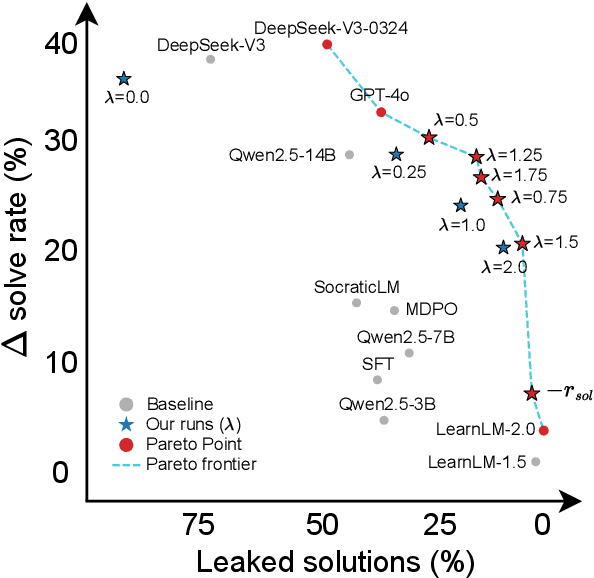
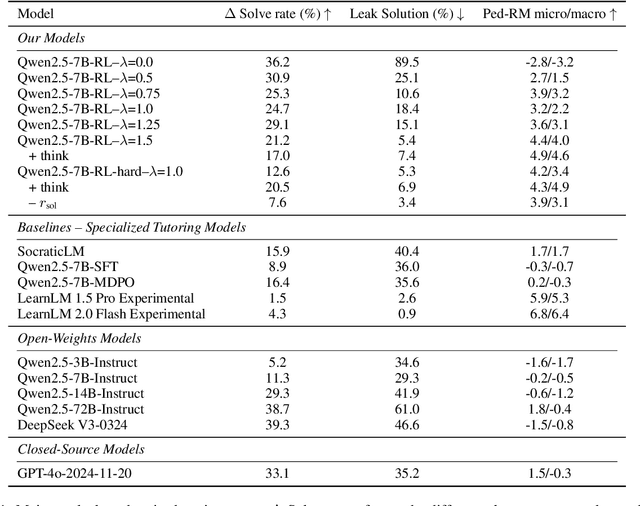
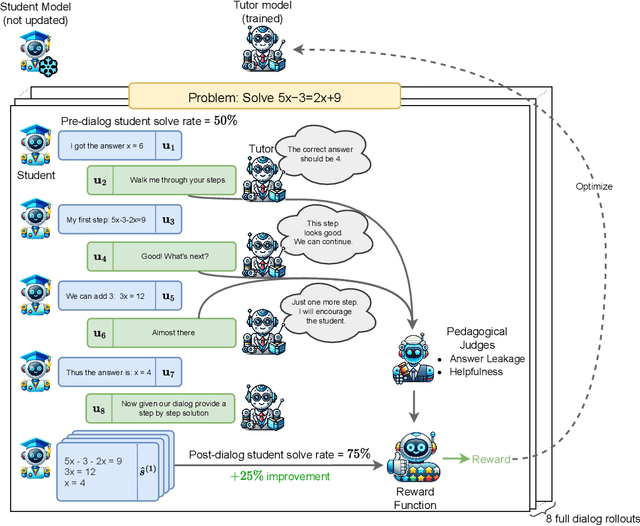
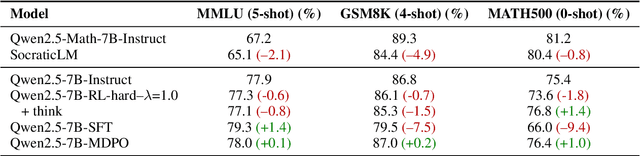
Large language models (LLMs) can transform education, but their optimization for direct question-answering often undermines effective pedagogy which requires strategically withholding answers. To mitigate this, we propose an online reinforcement learning (RL)-based alignment framework that can quickly adapt LLMs into effective tutors using simulated student-tutor interactions by emphasizing pedagogical quality and guided problem-solving over simply giving away answers. We use our method to train a 7B parameter tutor model without human annotations which reaches similar performance to larger proprietary models like LearnLM. We introduce a controllable reward weighting to balance pedagogical support and student solving accuracy, allowing us to trace the Pareto frontier between these two objectives. Our models better preserve reasoning capabilities than single-turn SFT baselines and can optionally enhance interpretability through thinking tags that expose the model's instructional planning.
A Head to Predict and a Head to Question: Pre-trained Uncertainty Quantification Heads for Hallucination Detection in LLM Outputs
May 13, 2025Large Language Models (LLMs) have the tendency to hallucinate, i.e., to sporadically generate false or fabricated information. This presents a major challenge, as hallucinations often appear highly convincing and users generally lack the tools to detect them. Uncertainty quantification (UQ) provides a framework for assessing the reliability of model outputs, aiding in the identification of potential hallucinations. In this work, we introduce pre-trained UQ heads: supervised auxiliary modules for LLMs that substantially enhance their ability to capture uncertainty compared to unsupervised UQ methods. Their strong performance stems from the powerful Transformer architecture in their design and informative features derived from LLM attention maps. Experimental evaluation shows that these heads are highly robust and achieve state-of-the-art performance in claim-level hallucination detection across both in-domain and out-of-domain prompts. Moreover, these modules demonstrate strong generalization to languages they were not explicitly trained on. We pre-train a collection of UQ heads for popular LLM series, including Mistral, Llama, and Gemma 2. We publicly release both the code and the pre-trained heads.
Token Weighting for Long-Range Language Modeling
Mar 12, 2025
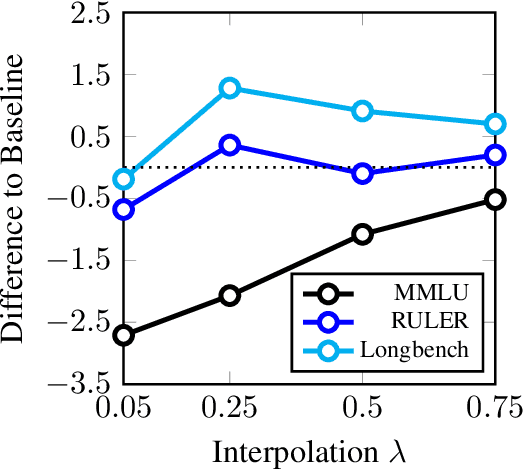
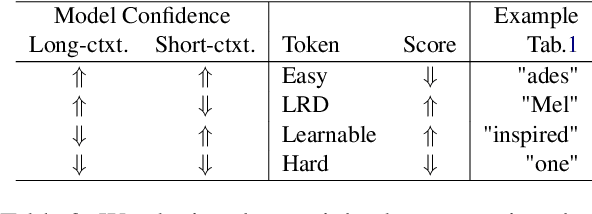
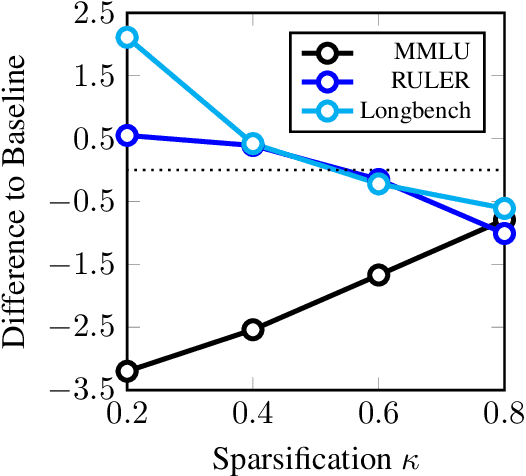
Many applications of large language models (LLMs) require long-context understanding, but models continue to struggle with such tasks. We hypothesize that conventional next-token prediction training could contribute to this, because each token is assigned equal weight. Yet, intuitively, the amount of context needed to predict the next token accurately varies greatly across different data. To reflect this, we propose various novel token-weighting schemes that assign different weights to each training token in the loss, thereby generalizing existing works. For this, we categorize token-weighting methods using a two-step framework which compares the confidences of a long-context and short-context model to score tokens. We evaluate all methods on multiple long-context understanding tasks and show that non-uniform loss weights are helpful to improve the long-context abilities of LLMs. Different short-context models can be used effectively for token scoring, including models that are much smaller than the long-context model that is trained. All in all, this work contributes to a better understanding of the trade-offs long-context language modeling faces and provides guidelines for model steering via loss-weighting based on empirical evidence. The code can be found on Github.
Uncertainty-Aware Decoding with Minimum Bayes Risk
Mar 07, 2025Despite their outstanding performance in the majority of scenarios, contemporary language models still occasionally generate undesirable outputs, for example, hallucinated text. While such behaviors have previously been linked to uncertainty, there is a notable lack of methods that actively consider uncertainty during text generation. In this work, we show how Minimum Bayes Risk (MBR) decoding, which selects model generations according to an expected risk, can be generalized into a principled uncertainty-aware decoding method. In short, we account for model uncertainty during decoding by incorporating a posterior over model parameters into MBR's computation of expected risk. We show that this modified expected risk is useful for both choosing outputs and deciding when to abstain from generation and can provide improvements without incurring overhead. We benchmark different methods for learning posteriors and show that performance improves with prediction diversity. We release our code publicly.