 Add to Chrome
 Add to Firefox
 Add to Edge
OctoLong: Mid-Training On Cross-Repository Code Contexts Enhances Long-Context Modeling
Aug 05, 2026
Context lengths of language models (LMs) have dramatically increased, driven by the demands for in-context learning, self-improvement, and long-horizon agentic workflows. Existing long-context corpora, however, are dominated by books, academic articles, and code repositories, which are finite resources and often scarce in long-distance dependencies. In this work, we introduce OctoLong, a context engineering pipeline that instruments an AST parser, a language server backend, and a package manager to facilitate the recursive retrieval of code references, enabling the curation of dependency-rich code contexts of millions of tokens in length. We then train OctoLong-Instruct, a suite of capable long-context open LMs, derived from base models ranging in size from 600M to 14B parameters, via context-extension mid-training on a ~50B-token mixture containing ~6.2B tokens of OctoLong code contexts, followed by ~10B tokens of instruction tuning. Our training ablations and experimental evaluations against 18 state-of-the-art open-weight long-context LMs show that supplanting just 12% of traditional context-extension corpora with OctoLong data yields substantial gains in long-range retrieval, long-term state tracking, repository-level code understanding, and downstream agentic tasks, while also enhancing API usage in short-context coding scenarios.

Token Weighting for Long-Range Language Modeling
Mar 12, 2025
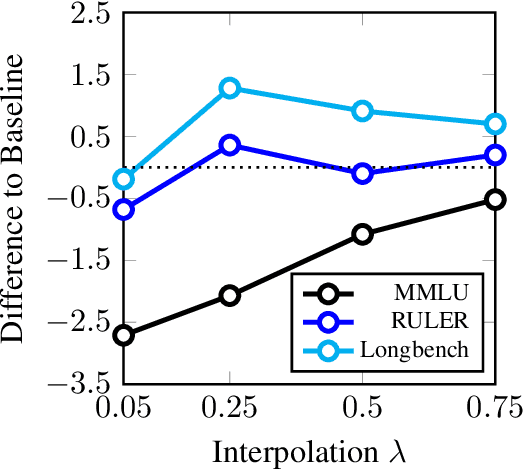
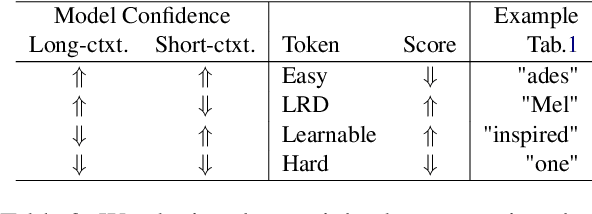
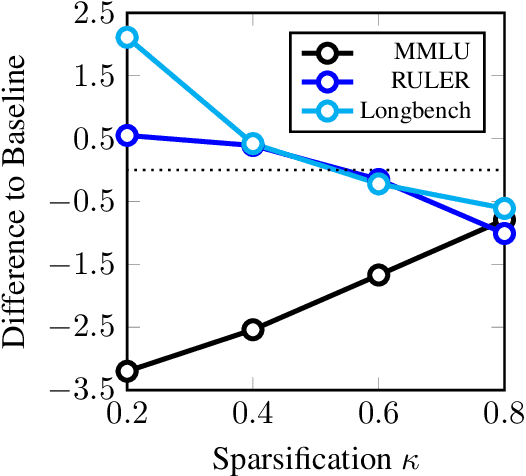
Many applications of large language models (LLMs) require long-context understanding, but models continue to struggle with such tasks. We hypothesize that conventional next-token prediction training could contribute to this, because each token is assigned equal weight. Yet, intuitively, the amount of context needed to predict the next token accurately varies greatly across different data. To reflect this, we propose various novel token-weighting schemes that assign different weights to each training token in the loss, thereby generalizing existing works. For this, we categorize token-weighting methods using a two-step framework which compares the confidences of a long-context and short-context model to score tokens. We evaluate all methods on multiple long-context understanding tasks and show that non-uniform loss weights are helpful to improve the long-context abilities of LLMs. Different short-context models can be used effectively for token scoring, including models that are much smaller than the long-context model that is trained. All in all, this work contributes to a better understanding of the trade-offs long-context language modeling faces and provides guidelines for model steering via loss-weighting based on empirical evidence. The code can be found on Github.