 Add to Chrome
 Add to Firefox
 Add to Edge
TokEval: A Tokenizer Evaluation Suite
Aug 18, 2026
Language model tokenizers are typically selected with minimal evaluation, despite the fact that their design choices directly impact model capabilities. This can be partly attributed to a limited understanding of which tokenizer properties affect which aspects of downstream performance. We introduce TokEval, a framework of tokenizer evaluation metrics that goes beyond standard measures like fertility and compression rate to capture linguistically and structurally meaningful properties, e.g., UTF-8 character boundary integrity and digit place-value boundary alignment for mathematics. To validate whether these metrics are predictive of downstream model performance, we conduct controlled language model pretraining experiments, varying solely the tokenizers' training data mixture, pretokenization strategy, and training algorithm. We evaluate the resulting models on bits-per-byte (a tokenizer-agnostic version of perplexity) and several benchmarks, spanning linguistic understanding, mathematical reasoning, and code generation. Our experiments suggest that different intrinsic properties have different impacts on model abilities: information-theoretic metrics predict language modeling abilities (Spearman rho up to 0.80), while structure-sensitive metrics, such as those measuring digit and line-break handling, correlate with task accuracy. We hope TokEval enables more principled tokenizer evaluation, replacing pretraining sweeps with intrinsic measurement wherever the two agree.

Explicit Boundary Markers for Subword Vocabularies
Aug 12, 2026Subword tokenizers represent many common words twice in space-using writing systems, once with a leading space and once without. The two entries have separate embeddings in models, so occurrences of one word are divided across rows that are trained independently, and the two forms need not even segment the string the same way: " together" may be a single entry while the same word without a preceding space is tokenized as "to|gether". Capitalization divides a word further, into as many as six forms. We introduce an alternative to standard whitespace conventions using an explicit word boundary marker, which prevents such duplication. Words are delimited by the boundary markers, and spaces between words are represented as pairs of such markers. Two shift codes do the same for title case and upper case, allowing one internal representation of a word to be re-used across different settings. Switching to this convention mitigates the duplicate-entry issue, but does not improve tokenization compression: for both vocabulary-learning algorithms, the best marker scheme stays within one percent of the baseline in characters per token, averaged across six languages. It does result in better language modeling performance. Every marker scheme tested downstream reaches lower bits per byte than the baseline, suggesting that duplication carries a cost that compression does not capture.
LangMAP: A Language-Adaptive Approach to Tokenization
Jun 23, 2026Language-specific tokenizers improve tokenization quality and the downstream performance of models on those languages. However, using such a tokenizer comes at a cost: either a new model must be trained from scratch, or the vocabulary of an existing pretrained model must be adapted. We propose Language-adaptive Maximum a Posteriori (LangMAP) Tokenization, a tokenization scheme that extends the UnigramLM algorithm to the multilingual setting, producing language-specific tokenization from a single shared vocabulary. Notably, LangMAP can be used when training a multilingual language model from scratch or to adapt a pretrained model's tokenizer to individual languages without changing its vocabulary. While language labels are required at training time, a key feature of the algorithm is that it then performs language-specific tokenization at inference without knowledge of the input's language. Across 14 open-source tokenizers, 9 natural languages, and 9 programming languages, LangMAP improves morphological boundary alignment and, for all coding languages tested, alignment with abstract syntax tree (AST) leaf boundaries. In fine-tuning experiments, results are mixed: LangMAP improves target-language grammatical acceptability (MultiBLiMP) on the languages tested; its benefits are less consistent on knowledge-related tasks (Global-PIQA, Belebele).
What Language is This? Ask Your Tokenizer
Feb 19, 2026Language Identification (LID) is an important component of many multilingual natural language processing pipelines, where it facilitates corpus curation, training data analysis, and cross-lingual evaluation of large language models. Despite near-perfect performance on high-resource languages, existing systems remain brittle in low-resource and closely related language settings. We introduce UniLID, a simple and efficient LID method based on the UnigramLM tokenization algorithm, leveraging its probabilistic framing, parameter estimation technique and inference strategy. In short, we learn language-conditional unigram distributions over a shared tokenizer vocabulary but treat segmentation as a language-specific phenomenon. Our formulation is data- and compute-efficient, supports incremental addition of new languages without retraining existing models, and can naturally be integrated into existing language model tokenization pipelines. Empirical evaluations against widely used baselines, including fastText, GlotLID, and CLD3, show that UniLID achieves competitive performance on standard benchmarks, substantially improves sample efficiency in low-resource settings - surpassing 70% accuracy with as few as five labeled samples per language - and delivers large gains on fine-grained dialect identification.
Parity-Aware Byte-Pair Encoding: Improving Cross-lingual Fairness in Tokenization
Aug 06, 2025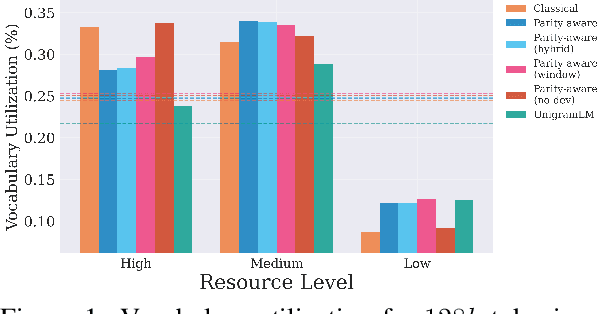
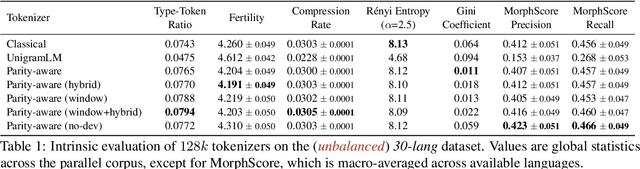
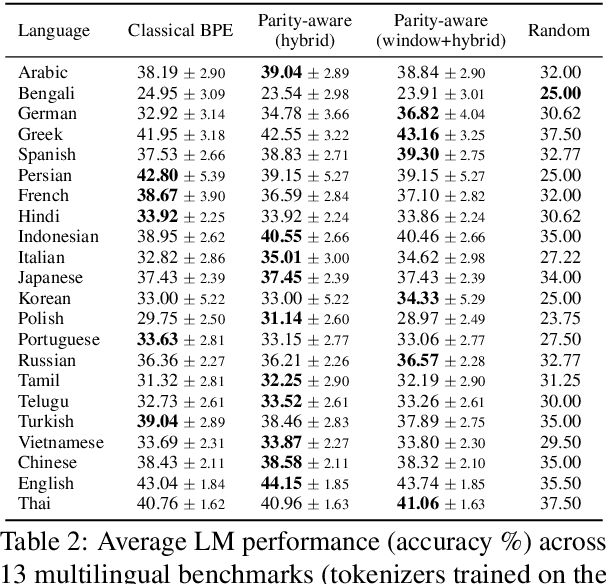
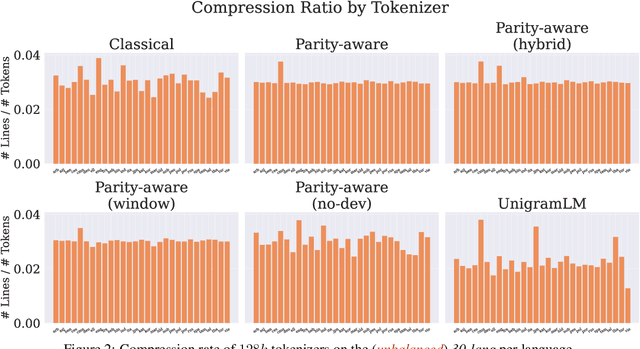
Tokenization is the first -- and often least scrutinized -- step of most NLP pipelines. Standard algorithms for learning tokenizers rely on frequency-based objectives, which favor languages dominant in the training data and consequently leave lower-resource languages with tokenizations that are disproportionately longer, morphologically implausible, or even riddled with <UNK> placeholders. This phenomenon ultimately amplifies computational and financial inequalities between users from different language backgrounds. To remedy this, we introduce Parity-aware Byte Pair Encoding (BPE), a variant of the widely-used BPE algorithm. At every merge step, Parity-aware BPE maximizes the compression gain of the currently worst-compressed language, trading a small amount of global compression for cross-lingual parity. We find empirically that Parity-aware BPE leads to more equitable token counts across languages, with negligible impact on global compression rate and no substantial effect on language-model performance in downstream tasks.
Uncertainty-Aware Decoding with Minimum Bayes Risk
Mar 07, 2025Despite their outstanding performance in the majority of scenarios, contemporary language models still occasionally generate undesirable outputs, for example, hallucinated text. While such behaviors have previously been linked to uncertainty, there is a notable lack of methods that actively consider uncertainty during text generation. In this work, we show how Minimum Bayes Risk (MBR) decoding, which selects model generations according to an expected risk, can be generalized into a principled uncertainty-aware decoding method. In short, we account for model uncertainty during decoding by incorporating a posterior over model parameters into MBR's computation of expected risk. We show that this modified expected risk is useful for both choosing outputs and deciding when to abstain from generation and can provide improvements without incurring overhead. We benchmark different methods for learning posteriors and show that performance improves with prediction diversity. We release our code publicly.
Towards a Similarity-adjusted Surprisal Theory
Oct 23, 2024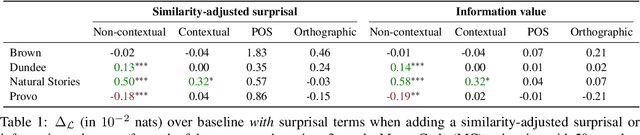
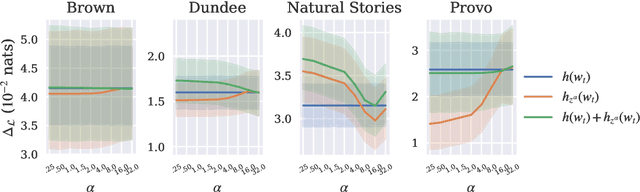


Surprisal theory posits that the cognitive effort required to comprehend a word is determined by its contextual predictability, quantified as surprisal. Traditionally, surprisal theory treats words as distinct entities, overlooking any potential similarity between them. Giulianelli et al. (2023) address this limitation by introducing information value, a measure of predictability designed to account for similarities between communicative units. Our work leverages Ricotta and Szeidl's (2006) diversity index to extend surprisal into a metric that we term similarity-adjusted surprisal, exposing a mathematical relationship between surprisal and information value. Similarity-adjusted surprisal aligns with information value when considering graded similarities and reduces to standard surprisal when words are treated as distinct. Experimental results with reading time data indicate that similarity-adjusted surprisal adds predictive power beyond standard surprisal for certain datasets, suggesting it serves as a complementary measure of comprehension effort.
How to Compute the Probability of a Word
Jun 20, 2024Language models (LMs) estimate the probability distribution over sequences of natural language; these distributions are crucial for computing perplexity and surprisal in linguistics research. While we are usually concerned with measuring these values for words, most LMs operate over subwords. Despite seemingly straightforward, accurately computing probabilities over one unit given probabilities over the other requires care. Indeed, we show here that many recent linguistic studies have been incorrectly computing these values. This paper derives the correct methods for computing word probabilities, highlighting issues when relying on language models that use beginning-of-word (bow)-marking tokenisers, e.g., the GPT family. Empirically, we show that correcting the widespread bug in probability computations affects measured outcomes in sentence comprehension and lexical optimisation analyses.
Causal Estimation of Memorisation Profiles
Jun 06, 2024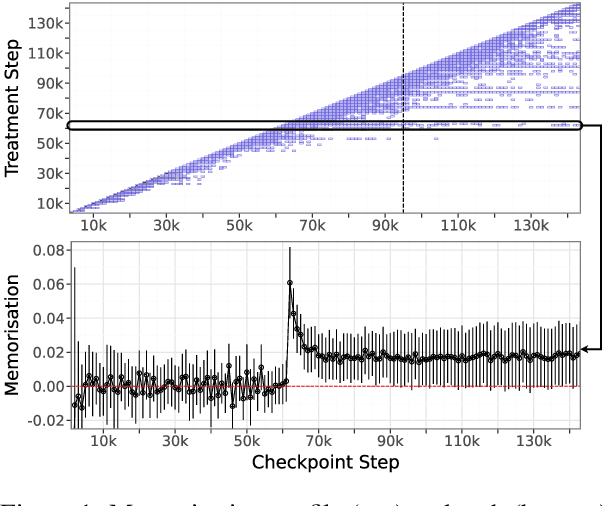
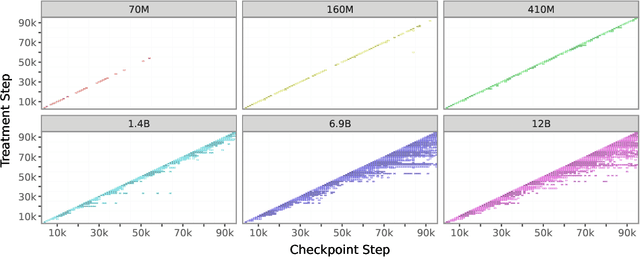
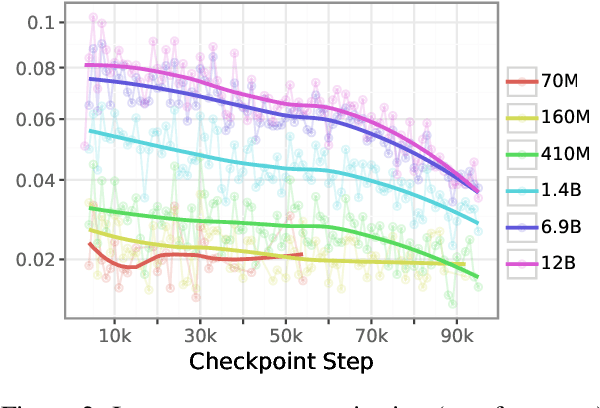
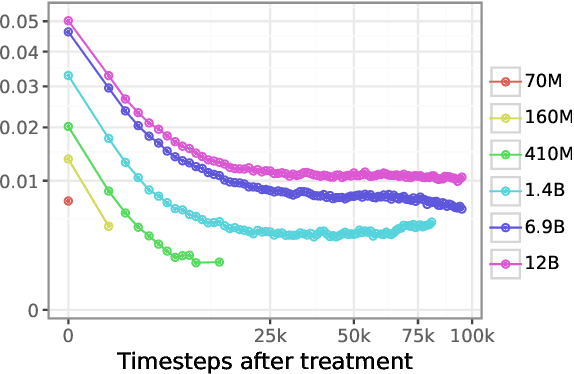
Understanding memorisation in language models has practical and societal implications, e.g., studying models' training dynamics or preventing copyright infringements. Prior work defines memorisation as the causal effect of training with an instance on the model's ability to predict that instance. This definition relies on a counterfactual: the ability to observe what would have happened had the model not seen that instance. Existing methods struggle to provide computationally efficient and accurate estimates of this counterfactual. Further, they often estimate memorisation for a model architecture rather than for a specific model instance. This paper fills an important gap in the literature, proposing a new, principled, and efficient method to estimate memorisation based on the difference-in-differences design from econometrics. Using this method, we characterise a model's memorisation profile--its memorisation trends across training--by only observing its behaviour on a small set of instances throughout training. In experiments with the Pythia model suite, we find that memorisation (i) is stronger and more persistent in larger models, (ii) is determined by data order and learning rate, and (iii) has stable trends across model sizes, thus making memorisation in larger models predictable from smaller ones.
The Role of $n$-gram Smoothing in the Age of Neural Networks
Mar 25, 2024For nearly three decades, language models derived from the $n$-gram assumption held the state of the art on the task. The key to their success lay in the application of various smoothing techniques that served to combat overfitting. However, when neural language models toppled $n$-gram models as the best performers, $n$-gram smoothing techniques became less relevant. Indeed, it would hardly be an understatement to suggest that the line of inquiry into $n$-gram smoothing techniques became dormant. This paper re-opens the role classical $n$-gram smoothing techniques may play in the age of neural language models. First, we draw a formal equivalence between label smoothing, a popular regularization technique for neural language models, and add-$\lambda$ smoothing. Second, we derive a generalized framework for converting \emph{any} $n$-gram smoothing technique into a regularizer compatible with neural language models. Our empirical results find that our novel regularizers are comparable to and, indeed, sometimes outperform label smoothing on language modeling and machine translation.