 Add to Chrome
 Add to Firefox
 Add to Edge
AgentBeats: Agentifying Agent Assessment for Openness, Standardization, and Reproducibility
Jun 11, 2026
Agent systems are advancing quickly across domains, but their evaluation remains fragmented. Most benchmarks rely on fixed, LLM-centric harnesses that require heavy integration, create test-production mismatch, and limit fair comparison across diverse agent designs. The root problem is the lack of an open, agent-agnostic assessment interface. We advocate Agentified Agent Assessment (AAA), where evaluation is performed by judge agents and all participants interact through standardized protocols: A2A for task management and MCP for tool access. Conventional benchmarking defines two separate interfaces, one for the benchmark and one for the agent, while AAA only needs one; this yields a generic, unified framework that separates assessment logic from agent implementation and enables reproducible, interoperable, and multi-agent evaluation. We further introduce AgentBeats as a concrete realization of AAA: we identify five practical operation modes that make standardized assessment compatible with real-world constraints on openness, privacy, and reproducibility. To evaluate our design at scale, we conduct two studies: a five-month open competition that drew 298 judge agents across 12 categories together with 467 subject agents from independent participants, showing that AAA applies across a heterogeneous range of benchmarks; and a case study on coding agents that confirms agentified evaluation preserves fidelity with the public record while surfacing previously missing head-to-head results, yielding research insights about agent design. Combining a community-scale field study and a controlled coding case study, we verify that AAA delivers coverage, practicality, and fidelity across heterogeneous scenarios at scale. Together, AAA and AgentBeats offer a clear path toward open, standardized, and reproducible agent assessment.

Towards Efficient Data Valuation Based on the Shapley Value
Feb 27, 2019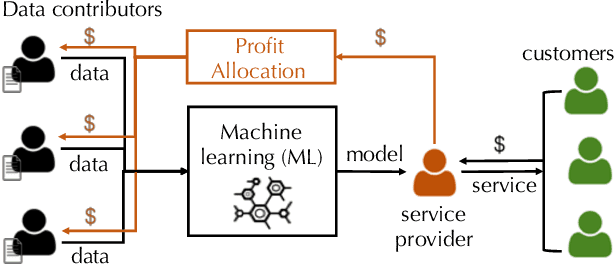

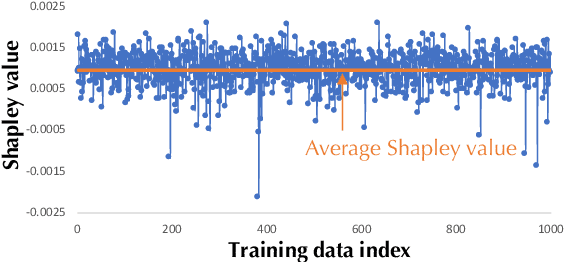
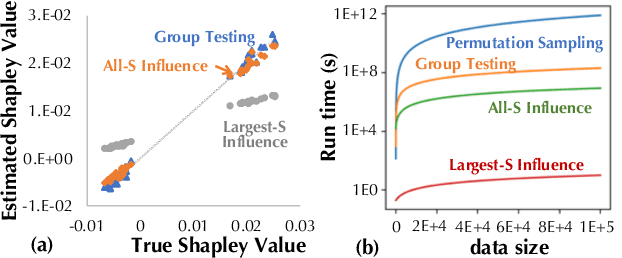
"How much is my data worth?" is an increasingly common question posed by organizations and individuals alike. An answer to this question could allow, for instance, fairly distributing profits among multiple data contributors and determining prospective compensation when data breaches happen. In this paper, we study the problem of data valuation by utilizing the Shapley value, a popular notion of value which originated in coopoerative game theory. The Shapley value defines a unique payoff scheme that satisfies many desiderata for the notion of data value. However, the Shapley value often requires exponential time to compute. To meet this challenge, we propose a repertoire of efficient algorithms for approximating the Shapley value. We also demonstrate the value of each training instance for various benchmark datasets.
Efficient Deep Learning on Multi-Source Private Data
Jul 17, 2018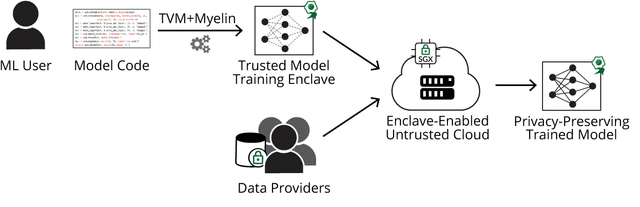
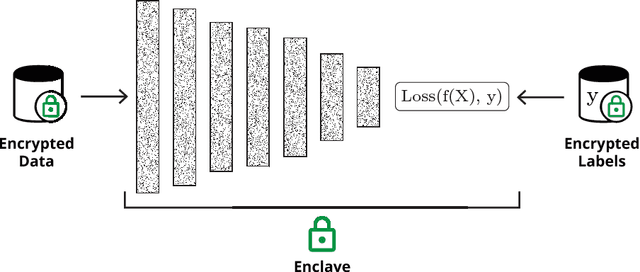
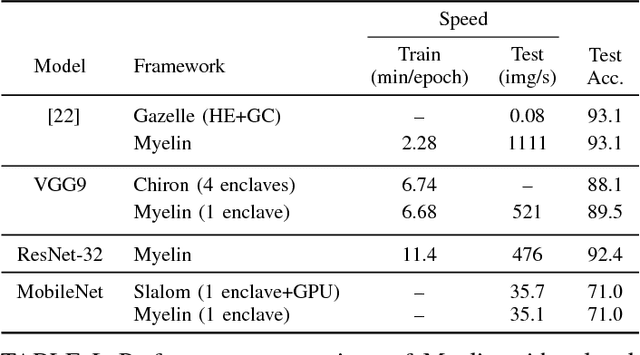
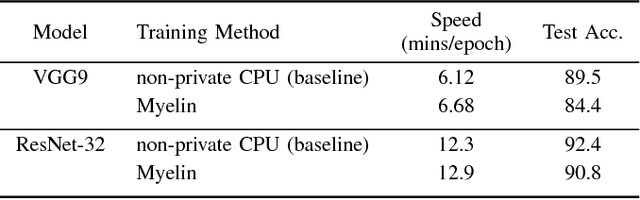
Machine learning models benefit from large and diverse datasets. Using such datasets, however, often requires trusting a centralized data aggregator. For sensitive applications like healthcare and finance this is undesirable as it could compromise patient privacy or divulge trade secrets. Recent advances in secure and privacy-preserving computation, including trusted hardware enclaves and differential privacy, offer a way for mutually distrusting parties to efficiently train a machine learning model without revealing the training data. In this work, we introduce Myelin, a deep learning framework which combines these privacy-preservation primitives, and use it to establish a baseline level of performance for fully private machine learning.