 Add to Chrome
 Add to Firefox
 Add to Edge
AgentBeats: Agentifying Agent Assessment for Openness, Standardization, and Reproducibility
Jun 11, 2026
Agent systems are advancing quickly across domains, but their evaluation remains fragmented. Most benchmarks rely on fixed, LLM-centric harnesses that require heavy integration, create test-production mismatch, and limit fair comparison across diverse agent designs. The root problem is the lack of an open, agent-agnostic assessment interface. We advocate Agentified Agent Assessment (AAA), where evaluation is performed by judge agents and all participants interact through standardized protocols: A2A for task management and MCP for tool access. Conventional benchmarking defines two separate interfaces, one for the benchmark and one for the agent, while AAA only needs one; this yields a generic, unified framework that separates assessment logic from agent implementation and enables reproducible, interoperable, and multi-agent evaluation. We further introduce AgentBeats as a concrete realization of AAA: we identify five practical operation modes that make standardized assessment compatible with real-world constraints on openness, privacy, and reproducibility. To evaluate our design at scale, we conduct two studies: a five-month open competition that drew 298 judge agents across 12 categories together with 467 subject agents from independent participants, showing that AAA applies across a heterogeneous range of benchmarks; and a case study on coding agents that confirms agentified evaluation preserves fidelity with the public record while surfacing previously missing head-to-head results, yielding research insights about agent design. Combining a community-scale field study and a controlled coding case study, we verify that AAA delivers coverage, practicality, and fidelity across heterogeneous scenarios at scale. Together, AAA and AgentBeats offer a clear path toward open, standardized, and reproducible agent assessment.

SCOPE: Sign Language Contextual Processing with Embedding from LLMs
Sep 02, 2024
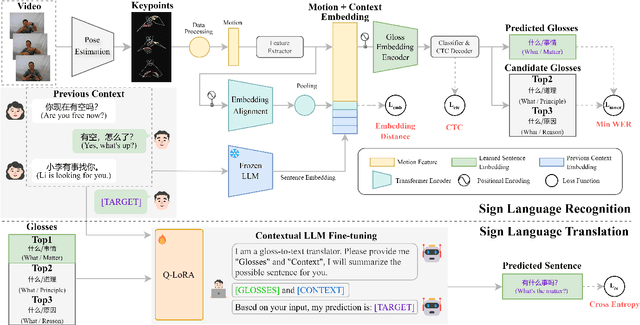
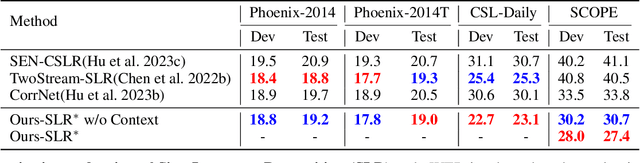
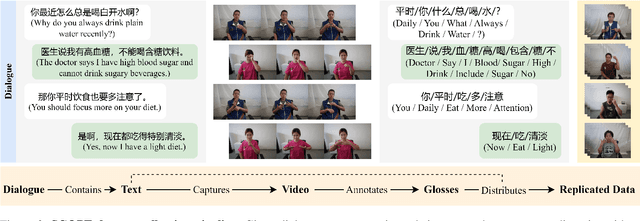
Sign languages, used by around 70 million Deaf individuals globally, are visual languages that convey visual and contextual information. Current methods in vision-based sign language recognition (SLR) and translation (SLT) struggle with dialogue scenes due to limited dataset diversity and the neglect of contextually relevant information. To address these challenges, we introduce SCOPE (Sign language Contextual Processing with Embedding from LLMs), a novel context-aware vision-based SLR and SLT framework. For SLR, we utilize dialogue contexts through a multi-modal encoder to enhance gloss-level recognition. For subsequent SLT, we further fine-tune a Large Language Model (LLM) by incorporating prior conversational context. We also contribute a new sign language dataset that contains 72 hours of Chinese sign language videos in contextual dialogues across various scenarios. Experimental results demonstrate that our SCOPE framework achieves state-of-the-art performance on multiple datasets, including Phoenix-2014T, CSL-Daily, and our SCOPE dataset. Moreover, surveys conducted with participants from the Deaf community further validate the robustness and effectiveness of our approach in real-world applications. Both our dataset and code will be open-sourced to facilitate further research.
OMG: Towards Open-vocabulary Motion Generation via Mixture of Controllers
Dec 18, 2023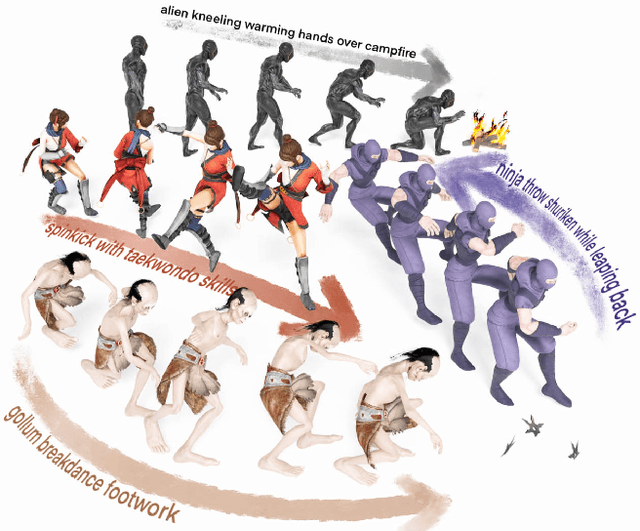
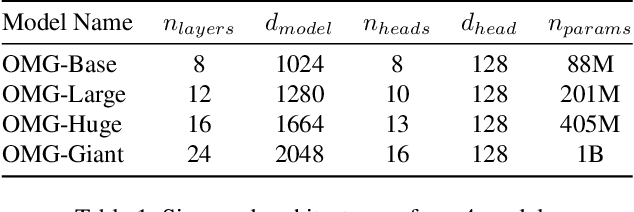
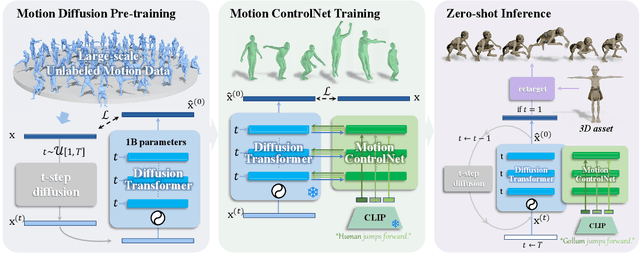
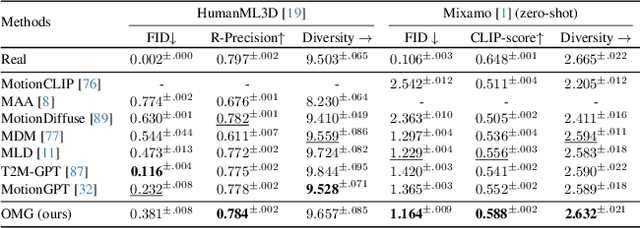
We have recently seen tremendous progress in realistic text-to-motion generation. Yet, the existing methods often fail or produce implausible motions with unseen text inputs, which limits the applications. In this paper, we present OMG, a novel framework, which enables compelling motion generation from zero-shot open-vocabulary text prompts. Our key idea is to carefully tailor the pretrain-then-finetune paradigm into the text-to-motion generation. At the pre-training stage, our model improves the generation ability by learning the rich out-of-domain inherent motion traits. To this end, we scale up a large unconditional diffusion model up to 1B parameters, so as to utilize the massive unlabeled motion data up to over 20M motion instances. At the subsequent fine-tuning stage, we introduce motion ControlNet, which incorporates text prompts as conditioning information, through a trainable copy of the pre-trained model and the proposed novel Mixture-of-Controllers (MoC) block. MoC block adaptively recognizes various ranges of the sub-motions with a cross-attention mechanism and processes them separately with the text-token-specific experts. Such a design effectively aligns the CLIP token embeddings of text prompts to various ranges of compact and expressive motion features. Extensive experiments demonstrate that our OMG achieves significant improvements over the state-of-the-art methods on zero-shot text-to-motion generation. Project page: https://tr3e.github.io/omg-page.