 Add to Chrome
 Add to Firefox
 Add to Edge
AgentBeats: Agentifying Agent Assessment for Openness, Standardization, and Reproducibility
Jun 11, 2026
Agent systems are advancing quickly across domains, but their evaluation remains fragmented. Most benchmarks rely on fixed, LLM-centric harnesses that require heavy integration, create test-production mismatch, and limit fair comparison across diverse agent designs. The root problem is the lack of an open, agent-agnostic assessment interface. We advocate Agentified Agent Assessment (AAA), where evaluation is performed by judge agents and all participants interact through standardized protocols: A2A for task management and MCP for tool access. Conventional benchmarking defines two separate interfaces, one for the benchmark and one for the agent, while AAA only needs one; this yields a generic, unified framework that separates assessment logic from agent implementation and enables reproducible, interoperable, and multi-agent evaluation. We further introduce AgentBeats as a concrete realization of AAA: we identify five practical operation modes that make standardized assessment compatible with real-world constraints on openness, privacy, and reproducibility. To evaluate our design at scale, we conduct two studies: a five-month open competition that drew 298 judge agents across 12 categories together with 467 subject agents from independent participants, showing that AAA applies across a heterogeneous range of benchmarks; and a case study on coding agents that confirms agentified evaluation preserves fidelity with the public record while surfacing previously missing head-to-head results, yielding research insights about agent design. Combining a community-scale field study and a controlled coding case study, we verify that AAA delivers coverage, practicality, and fidelity across heterogeneous scenarios at scale. Together, AAA and AgentBeats offer a clear path toward open, standardized, and reproducible agent assessment.

QuadSync: Quadrifocal Tensor Synchronization via Tucker Decomposition
Feb 26, 2026In structure from motion, quadrifocal tensors capture more information than their pairwise counterparts (essential matrices), yet they have often been thought of as impractical and only of theoretical interest. In this work, we challenge such beliefs by providing a new framework to recover $n$ cameras from the corresponding collection of quadrifocal tensors. We form the block quadrifocal tensor and show that it admits a Tucker decomposition whose factor matrices are the stacked camera matrices, and which thus has a multilinear rank of (4,~4,~4,~4) independent of $n$. We develop the first synchronization algorithm for quadrifocal tensors, using Tucker decomposition, alternating direction method of multipliers, and iteratively reweighted least squares. We further establish relationships between the block quadrifocal, trifocal, and bifocal tensors, and introduce an algorithm that jointly synchronizes these three entities. Numerical experiments demonstrate the effectiveness of our methods on modern datasets, indicating the potential and importance of using higher-order information in synchronization.
Tensor-Based Synchronization and the Low-Rankness of the Block Trifocal Tensor
Sep 14, 2024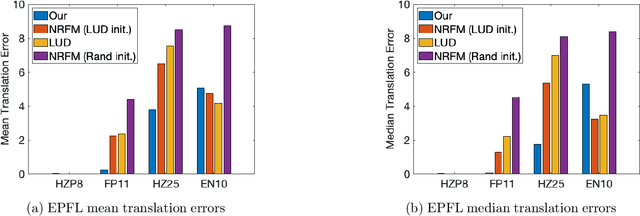
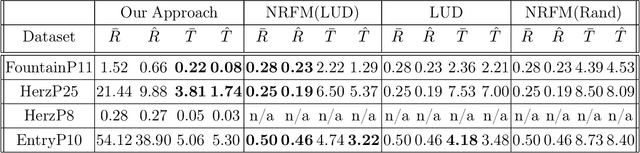
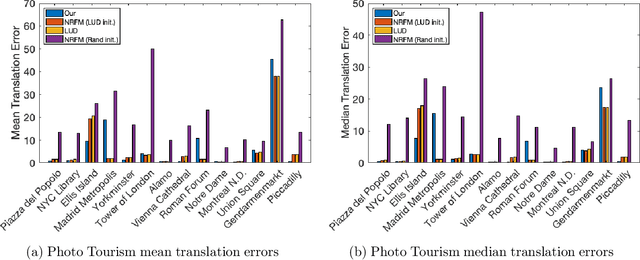
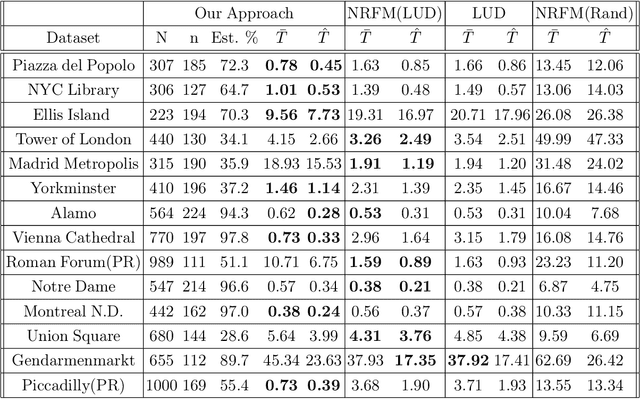
The block tensor of trifocal tensors provides crucial geometric information on the three-view geometry of a scene. The underlying synchronization problem seeks to recover camera poses (locations and orientations up to a global transformation) from the block trifocal tensor. We establish an explicit Tucker factorization of this tensor, revealing a low multilinear rank of $(6,4,4)$ independent of the number of cameras under appropriate scaling conditions. We prove that this rank constraint provides sufficient information for camera recovery in the noiseless case. The constraint motivates a synchronization algorithm based on the higher-order singular value decomposition of the block trifocal tensor. Experimental comparisons with state-of-the-art global synchronization methods on real datasets demonstrate the potential of this algorithm for significantly improving location estimation accuracy. Overall this work suggests that higher-order interactions in synchronization problems can be exploited to improve performance, beyond the usual pairwise-based approaches.