 Add to Chrome
 Add to Firefox
 Add to Edge
Beyond the Global Scores: Fine-Grained Token Grounding as a Robust Detector of LVLM Hallucinations
Apr 06, 2026
Large vision-language models (LVLMs) achieve strong performance on visual reasoning tasks but remain highly susceptible to hallucination. Existing detection methods predominantly rely on coarse, whole-image measures of how an object token relates to the input image. This global strategy is limited: hallucinated tokens may exhibit weak but widely scattered correlations across many local regions, which aggregate into deceptively high overall relevance, thus evading the current global hallucination detectors. We begin with a simple yet critical observation: a faithful object token must be strongly grounded in a specific image region. Building on this insight, we introduce a patch-level hallucination detection framework that examines fine-grained token-level interactions across model layers. Our analysis uncovers two characteristic signatures of hallucinated tokens: (i) they yield diffuse, non-localized attention patterns, in contrast to the compact, well-focused attention seen in faithful tokens; and (ii) they fail to exhibit meaningful semantic alignment with any visual region. Guided by these findings, we develop a lightweight and interpretable detection method that leverages patch-level statistical features, combined with hidden-layer representations. Our approach achieves up to 90% accuracy in token-level hallucination detection, demonstrating the superiority of fine-grained structural analysis for detecting hallucinations.

Revisiting SLO and Goodput Metrics in LLM Serving
Oct 18, 2024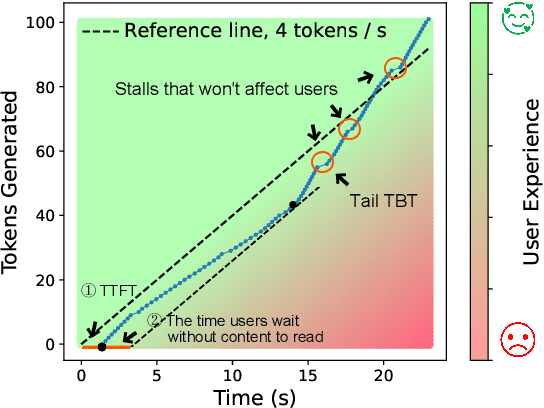

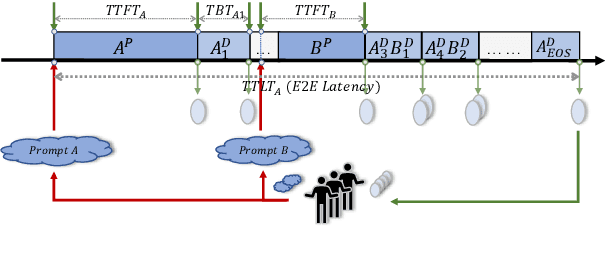
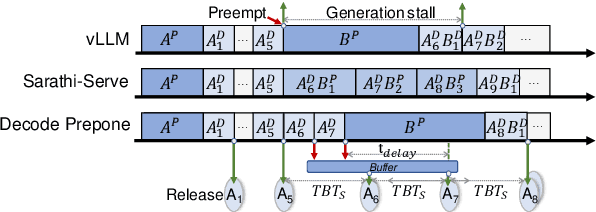
Large language models (LLMs) have achieved remarkable performance and are widely deployed in various applications, while the serving of LLM inference has raised concerns about user experience and serving throughput. Accordingly, service level objectives (SLOs) and goodput-the number of requests that meet SLOs per second-are introduced to evaluate the performance of LLM serving. However, existing metrics fail to capture the nature of user experience. We observe two ridiculous phenomena in existing metrics: 1) delaying token delivery can smooth the tail time between tokens (tail TBT) of a request and 2) dropping the request that fails to meet the SLOs midway can improve goodput. In this paper, we revisit SLO and goodput metrics in LLM serving and propose a unified metric framework smooth goodput including SLOs and goodput to reflect the nature of user experience in LLM serving. The framework can adapt to specific goals of different tasks by setting parameters. We re-evaluate the performance of different LLM serving systems under multiple workloads based on this unified framework and provide possible directions for future optimization of existing strategies. We hope that this framework can provide a unified standard for evaluating LLM serving and foster researches in the field of LLM serving optimization to move in a cohesive direction.
Diversify Question Generation with Retrieval-Augmented Style Transfer
Oct 23, 2023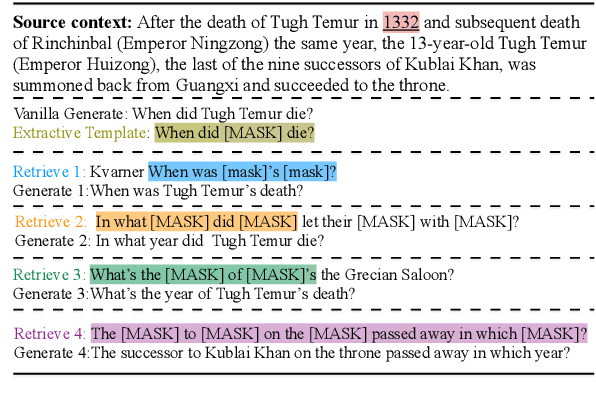
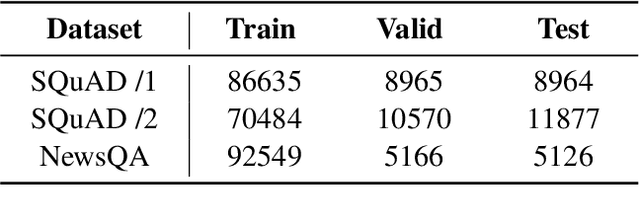
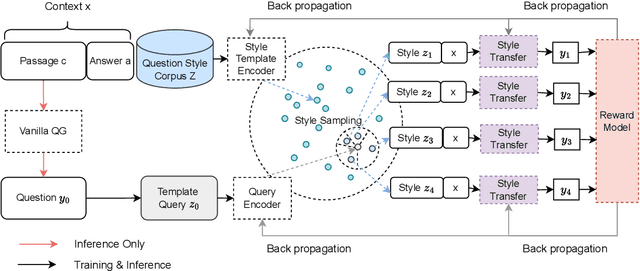
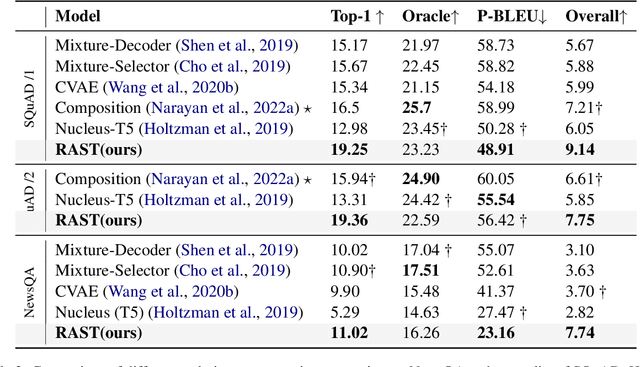
Given a textual passage and an answer, humans are able to ask questions with various expressions, but this ability is still challenging for most question generation (QG) systems. Existing solutions mainly focus on the internal knowledge within the given passage or the semantic word space for diverse content planning. These methods, however, have not considered the potential of external knowledge for expression diversity. To bridge this gap, we propose RAST, a framework for Retrieval-Augmented Style Transfer, where the objective is to utilize the style of diverse templates for question generation. For training RAST, we develop a novel Reinforcement Learning (RL) based approach that maximizes a weighted combination of diversity reward and consistency reward. Here, the consistency reward is computed by a Question-Answering (QA) model, whereas the diversity reward measures how much the final output mimics the retrieved template. Experimental results show that our method outperforms previous diversity-driven baselines on diversity while being comparable in terms of consistency scores. Our code is available at https://github.com/gouqi666/RAST.