 Add to Chrome
 Add to Firefox
 Add to Edge
Kwai Keye-VL-2.0 Technical Report
Jun 09, 2026
We introduce Kwai Keye-VL-2.0-30B-A3B, an open-source Mixture-of-Experts (MoE) multimodal foundation model designed to advance long-video understanding and agentic intelligence. To address the challenges of ultra-long contexts, information redundancy, and prohibitive computational costs inherent in hour-level videos, Keye-VL-2.0 is the first to adapt DeepSeek Sparse Attention (DSA) to GQA-based multimodal architectures, enabling lossless 256K context processing while capturing critical frames and long-range temporal dependencies. This architecture is underpinned by a highly optimized training and inference infrastructure, including scalable video I/O, heterogeneous ViT-LM parallelism, and custom DSA kernels that significantly maximize throughput and minimize computational overhead. Furthermore, to overcome the algorithmic dilemma of catastrophic forgetting during multi-task alignment, we introduce Cross-Modal Multi-Teacher On-Policy Distillation (MOPD) paired with Context-RL and Video-RL. By distilling dense token-level teacher feedback from on-policy rollouts back into the MoE backbone, which activates only 3B parameters, Keye-VL-2.0 natively empowers advanced agent collaboration across Code, Tool, and Search scenarios with multimodal self-correction. Extensive evaluations across video understanding, temporal grounding, reasoning, STEM, and agent benchmarks demonstrate that Keye-VL-2.0-30B-A3B achieves state-of-the-art performance among models of similar scale, particularly excelling in fine-grained temporal localization on TimeLens and long-video comprehension on Video-MME-v2 and LongVideoBench. We release our model checkpoints to accelerate community progress toward scalable and robust multimodal agentic applications.

EpiAgent: An Agent-Centric System for Ancient Inscription Restoration
Apr 10, 2026Ancient inscriptions, as repositories of cultural memory, have suffered from centuries of environmental and human-induced degradation. Restoring their intertwined visual and textual integrity poses one of the most demanding challenges in digital heritage preservation. However, existing AI-based approaches often rely on rigid pipelines, struggling to generalize across such complex and heterogeneous real-world degradations. Inspired by the skill-coordinated workflow of human epigraphers, we propose EpiAgent, an agent-centric system that formulates inscription restoration as a hierarchical planning problem. Following an Observe-Conceive-Execute-Reevaluate paradigm, an LLM-based central planner orchestrates collaboration among multimodal analysis, historical experience, specialized restoration tools, and iterative self-refinement. This agent-centric coordination enables a flexible and adaptive restoration process beyond conventional single-pass methods. Across real-world degraded inscriptions, EpiAgent achieves superior restoration quality and stronger generalization compared to existing methods. Our work marks an important step toward expert-level agent-driven restoration of cultural heritage. The code is available at https://github.com/blackprotoss/EpiAgent.
Baichuan-Omni-1.5 Technical Report
Jan 26, 2025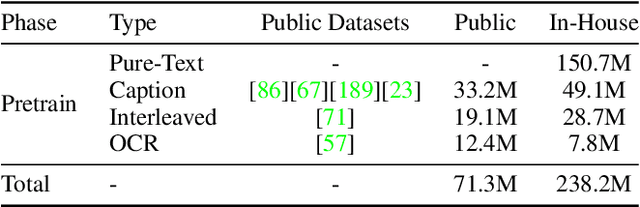
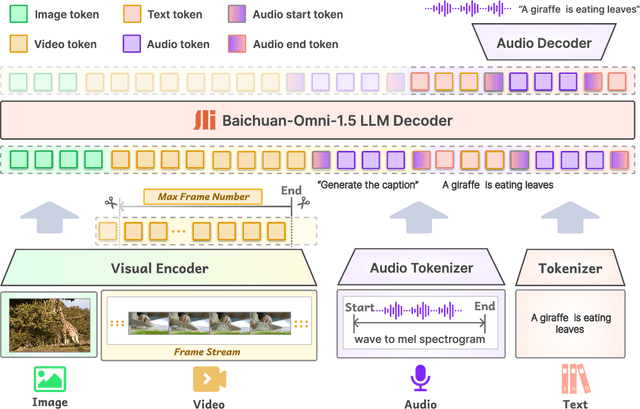
We introduce Baichuan-Omni-1.5, an omni-modal model that not only has omni-modal understanding capabilities but also provides end-to-end audio generation capabilities. To achieve fluent and high-quality interaction across modalities without compromising the capabilities of any modality, we prioritized optimizing three key aspects. First, we establish a comprehensive data cleaning and synthesis pipeline for multimodal data, obtaining about 500B high-quality data (text, audio, and vision). Second, an audio-tokenizer (Baichuan-Audio-Tokenizer) has been designed to capture both semantic and acoustic information from audio, enabling seamless integration and enhanced compatibility with MLLM. Lastly, we designed a multi-stage training strategy that progressively integrates multimodal alignment and multitask fine-tuning, ensuring effective synergy across all modalities. Baichuan-Omni-1.5 leads contemporary models (including GPT4o-mini and MiniCPM-o 2.6) in terms of comprehensive omni-modal capabilities. Notably, it achieves results comparable to leading models such as Qwen2-VL-72B across various multimodal medical benchmarks.