 Add to Chrome
 Add to Firefox
 Add to Edge
Human Decision-Making with Persuasive and Narrative LLM Explanations
May 22, 2026
Large language models (LLMs) have the potential to aid and improve human decision-making in classification tasks, not only by providing fairly accurate predictions, but also in their ability to generate cogent narrative explanations of those predictions. Prior work has demonstrated that people generally find AI narrative explanations to be understandable, trustworthy, and convincing for changing beliefs and opinions; however, less is known about the impact of narrative explanations on objective human decision-making performance. Here we conduct a large-scale human behavioral experiment to evaluate decision-making performance with LLM-generated narrative explanations of varying persuasiveness. We found the degree of persuasiveness, or lack thereof, for LLM-based explanations did not meaningfully impact decision accuracy over a simple AI prediction alone, in agreement with typical results with explainable AI based on feature importance. We found evidence that narratives increased reliance on AI, but both when the AI prediction was correct and incorrect. Exploratory analyses also indicated that the more persuasive narratives may have had a detrimental effect on decision response times and the ability to discriminate between a correct and incorrect AI prediction. Overall, this work indicates that including narrative explanations with AI predictions may involve tradeoffs for decision-making performance, and more work is needed to determine how and when narrative explanations impact human decision-making.

Robust and Explainable Divide-and-Conquer Learning for Intrusion Detection
May 03, 2026Machine learning-based intrusion detection requires complex models to capture patterns in high-dimensional, noisy, and class-imbalanced raw network traffic, yet deploying such models remains impractical on resource-constrained devices with limited processing power and memory. In this paper, we present a correlation-aware divide-and-conquer learning technique that decomposes a complex learning problem into smaller, more manageable subproblems. This enables lightweight models as simple as decision trees to be trained on focused subtasks, yielding up to 43.3% higher local accuracy and up to 257 times reduction in model size on real-world network intrusion detection datasets, while also improving adversarial robustness and explainability.
VERI-DPO: Evidence-Aware Alignment for Clinical Summarization via Claim Verification and Direct Preference Optimization
Mar 11, 2026Brief Hospital Course (BHC) narratives must be clinically useful yet faithful to fragmented EHR evidence. LLM-based clinical summarizers still introduce unsupported statements, and alignment can encourage omissions ("say-less" degeneration). We introduce VERI-DPO, which uses claim verification to mine preferences and distill them into the summarizer with Direct Preference Optimization (DPO). On MIMIC-III-Ext-VeriFact-BHC (100 ICU patients; patient-level splits), we train a retrieval-augmented verifier to label claim-evidence pairs as Supported, Not Supported, or Not Addressed via a single-token format. The verifier scores sentence-level claims from sampled BHC candidates and aggregates margins into a coverage-aware utility to mine length-controlled, contradiction-anchored preference pairs. On held-out patients, verifier-mined preferences separate candidates by contradiction density, and VERI-DPO reduces Not Supported claim rates from 10.7% to 1.9% (local verifier judge) and from 11.6% to 6.4% (GPT-4o judge), while improving validity from 76.7% to 82.5% and maintaining informative length.
SPRINT: Semi-supervised Prototypical Representation for Few-Shot Class-Incremental Tabular Learning
Mar 04, 2026Real-world systems must continuously adapt to novel concepts from limited data without forgetting previously acquired knowledge. While Few-Shot Class-Incremental Learning (FSCIL) is established in computer vision, its application to tabular domains remains largely unexplored. Unlike images, tabular streams (e.g., logs, sensors) offer abundant unlabeled data, a scarcity of expert annotations and negligible storage costs, features ignored by existing vision-based methods that rely on restrictive buffers. We introduce SPRINT, the first FSCIL framework tailored for tabular distributions. SPRINT introduces a mixed episodic training strategy that leverages confidence-based pseudo-labeling to enrich novel class representations and exploits low storage costs to retain base class history. Extensive evaluation across six diverse benchmarks spanning cybersecurity, healthcare, and ecological domains, demonstrates SPRINT's cross-domain robustness. It achieves a state-of-the-art average accuracy of 77.37% (5-shot), outperforming the strongest incremental baseline by 4.45%.
CourtGuard: A Model-Agnostic Framework for Zero-Shot Policy Adaptation in LLM Safety
Feb 26, 2026Current safety mechanisms for Large Language Models (LLMs) rely heavily on static, fine-tuned classifiers that suffer from adaptation rigidity, the inability to enforce new governance rules without expensive retraining. To address this, we introduce CourtGuard, a retrieval-augmented multi-agent framework that reimagines safety evaluation as Evidentiary Debate. By orchestrating an adversarial debate grounded in external policy documents, CourtGuard achieves state-of-the-art performance across 7 safety benchmarks, outperforming dedicated policy-following baselines without fine-tuning. Beyond standard metrics, we highlight two critical capabilities: (1) Zero-Shot Adaptability, where our framework successfully generalized to an out-of-domain Wikipedia Vandalism task (achieving 90\% accuracy) by swapping the reference policy; and (2) Automated Data Curation and Auditing, where we leveraged CourtGuard to curate and audit nine novel datasets of sophisticated adversarial attacks. Our results demonstrate that decoupling safety logic from model weights offers a robust, interpretable, and adaptable path for meeting current and future regulatory requirements in AI governance.
Beyond Refusal: Probing the Limits of Agentic Self-Correction for Semantic Sensitive Information
Feb 25, 2026While defenses for structured PII are mature, Large Language Models (LLMs) pose a new threat: Semantic Sensitive Information (SemSI), where models infer sensitive identity attributes, generate reputation-harmful content, or hallucinate potentially wrong information. The capacity of LLMs to self-regulate these complex, context-dependent sensitive information leaks without destroying utility remains an open scientific question. To address this, we introduce SemSIEdit, an inference-time framework where an agentic "Editor" iteratively critiques and rewrites sensitive spans to preserve narrative flow rather than simply refusing to answer. Our analysis reveals a Privacy-Utility Pareto Frontier, where this agentic rewriting reduces leakage by 34.6% across all three SemSI categories while incurring a marginal utility loss of 9.8%. We also uncover a Scale-Dependent Safety Divergence: large reasoning models (e.g., GPT-5) achieve safety through constructive expansion (adding nuance), whereas capacity-constrained models revert to destructive truncation (deleting text). Finally, we identify a Reasoning Paradox: while inference-time reasoning increases baseline risk by enabling the model to make deeper sensitive inferences, it simultaneously empowers the defense to execute safe rewrites.
Bypassing AI Control Protocols via Agent-as-a-Proxy Attacks
Feb 04, 2026As AI agents automate critical workloads, they remain vulnerable to indirect prompt injection (IPI) attacks. Current defenses rely on monitoring protocols that jointly evaluate an agent's Chain-of-Thought (CoT) and tool-use actions to ensure alignment with user intent. We demonstrate that these monitoring-based defenses can be bypassed via a novel Agent-as-a-Proxy attack, where prompt injection attacks treat the agent as a delivery mechanism, bypassing both agent and monitor simultaneously. While prior work on scalable oversight has focused on whether small monitors can supervise large agents, we show that even frontier-scale monitors are vulnerable. Large-scale monitoring models like Qwen2.5-72B can be bypassed by agents with similar capabilities, such as GPT-4o mini and Llama-3.1-70B. On the AgentDojo benchmark, we achieve a high attack success rate against AlignmentCheck and Extract-and-Evaluate monitors under diverse monitoring LLMs. Our findings suggest current monitoring-based agentic defenses are fundamentally fragile regardless of model scale.
Optimal Transport-Guided Adversarial Attacks on Graph Neural Network-Based Bot Detection
Jan 30, 2026The rise of bot accounts on social media poses significant risks to public discourse. To address this threat, modern bot detectors increasingly rely on Graph Neural Networks (GNNs). However, the effectiveness of these GNN-based detectors in real-world settings remains poorly understood. In practice, attackers continuously adapt their strategies as well as must operate under domain-specific and temporal constraints, which can fundamentally limit the applicability of existing attack methods. As a result, there is a critical need for robust GNN-based bot detection methods under realistic, constraint-aware attack scenarios. To address this gap, we introduce BOCLOAK to systematically evaluate the robustness of GNN-based social bot detection via both edge editing and node injection adversarial attacks under realistic constraints. BOCLOAK constructs a probability measure over spatio-temporal neighbor features and learns an optimal transport geometry that separates human and bot behaviors. It then decodes transport plans into sparse, plausible edge edits that evade detection while obeying real-world constraints. We evaluate BOCLOAK across three social bot datasets, five state-of-the-art bot detectors, three adversarial defenses, and compare it against four leading graph adversarial attack baselines. BOCLOAK achieves up to 80.13% higher attack success rates while using 99.80% less GPU memory under realistic real-world constraints. Most importantly, BOCLOAK shows that optimal transport provides a lightweight, principled framework for bridging the gap between adversarial attacks and real-world bot detection.
PROVCREATOR: Synthesizing Complex Heterogenous Graphs with Node and Edge Attributes
Jul 28, 2025The rise of graph-structured data has driven interest in graph learning and synthetic data generation. While successful in text and image domains, synthetic graph generation remains challenging -- especially for real-world graphs with complex, heterogeneous schemas. Existing research has focused mostly on homogeneous structures with simple attributes, limiting their usefulness and relevance for application domains requiring semantic fidelity. In this research, we introduce ProvCreator, a synthetic graph framework designed for complex heterogeneous graphs with high-dimensional node and edge attributes. ProvCreator formulates graph synthesis as a sequence generation task, enabling the use of transformer-based large language models. It features a versatile graph-to-sequence encoder-decoder that 1. losslessly encodes graph structure and attributes, 2. efficiently compresses large graphs for contextual modeling, and 3. supports end-to-end, learnable graph generation. To validate our research, we evaluate ProvCreator on two challenging domains: system provenance graphs in cybersecurity and knowledge graphs from IntelliGraph Benchmark Dataset. In both cases, ProvCreator captures intricate dependencies between structure and semantics, enabling the generation of realistic and privacy-aware synthetic datasets.
Graph Generative Models Evaluation with Masked Autoencoder
Mar 17, 2025
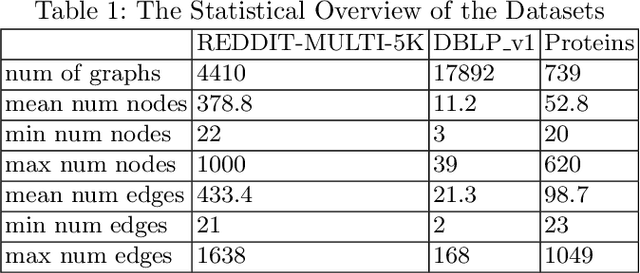
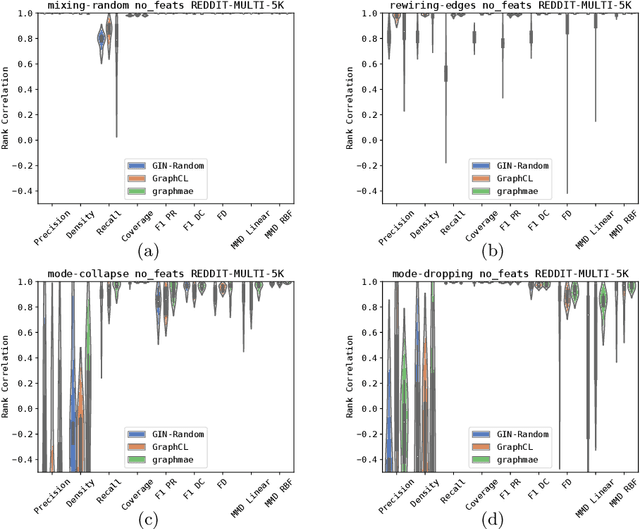
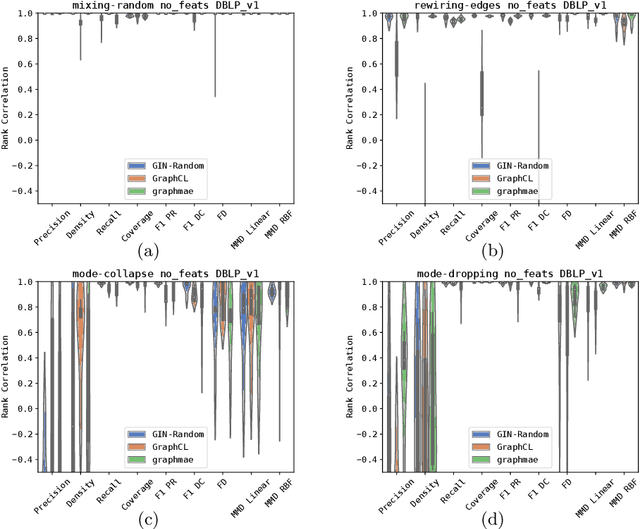
In recent years, numerous graph generative models (GGMs) have been proposed. However, evaluating these models remains a considerable challenge, primarily due to the difficulty in extracting meaningful graph features that accurately represent real-world graphs. The traditional evaluation techniques, which rely on graph statistical properties like node degree distribution, clustering coefficients, or Laplacian spectrum, overlook node features and lack scalability. There are newly proposed deep learning-based methods employing graph random neural networks or contrastive learning to extract graph features, demonstrating superior performance compared to traditional statistical methods, but their experimental results also demonstrate that these methods do not always working well across different metrics. Although there are overlaps among these metrics, they are generally not interchangeable, each evaluating generative models from a different perspective. In this paper, we propose a novel method that leverages graph masked autoencoders to effectively extract graph features for GGM evaluations. We conduct extensive experiments on graphs and empirically demonstrate that our method can be more reliable and effective than previously proposed methods across a number of GGM evaluation metrics, such as "Fr\'echet Distance (FD)" and "MMD Linear". However, no single method stands out consistently across all metrics and datasets. Therefore, this study also aims to raise awareness of the significance and challenges associated with GGM evaluation techniques, especially in light of recent advances in generative models.