 Add to Chrome
 Add to Firefox
 Add to Edge
Robust and Explainable Divide-and-Conquer Learning for Intrusion Detection
May 03, 2026
Machine learning-based intrusion detection requires complex models to capture patterns in high-dimensional, noisy, and class-imbalanced raw network traffic, yet deploying such models remains impractical on resource-constrained devices with limited processing power and memory. In this paper, we present a correlation-aware divide-and-conquer learning technique that decomposes a complex learning problem into smaller, more manageable subproblems. This enables lightweight models as simple as decision trees to be trained on focused subtasks, yielding up to 43.3% higher local accuracy and up to 257 times reduction in model size on real-world network intrusion detection datasets, while also improving adversarial robustness and explainability.

SPRINT: Semi-supervised Prototypical Representation for Few-Shot Class-Incremental Tabular Learning
Mar 04, 2026Real-world systems must continuously adapt to novel concepts from limited data without forgetting previously acquired knowledge. While Few-Shot Class-Incremental Learning (FSCIL) is established in computer vision, its application to tabular domains remains largely unexplored. Unlike images, tabular streams (e.g., logs, sensors) offer abundant unlabeled data, a scarcity of expert annotations and negligible storage costs, features ignored by existing vision-based methods that rely on restrictive buffers. We introduce SPRINT, the first FSCIL framework tailored for tabular distributions. SPRINT introduces a mixed episodic training strategy that leverages confidence-based pseudo-labeling to enrich novel class representations and exploits low storage costs to retain base class history. Extensive evaluation across six diverse benchmarks spanning cybersecurity, healthcare, and ecological domains, demonstrates SPRINT's cross-domain robustness. It achieves a state-of-the-art average accuracy of 77.37% (5-shot), outperforming the strongest incremental baseline by 4.45%.
Resilience and Security of Deep Neural Networks Against Intentional and Unintentional Perturbations: Survey and Research Challenges
Aug 03, 2024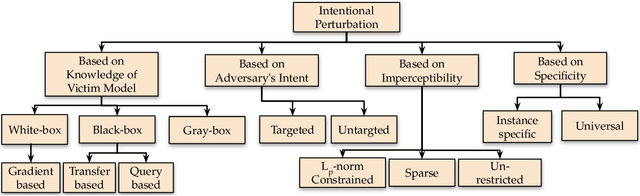
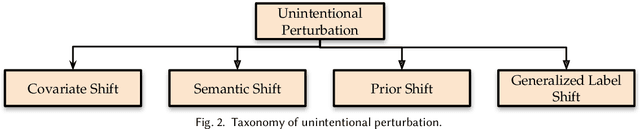
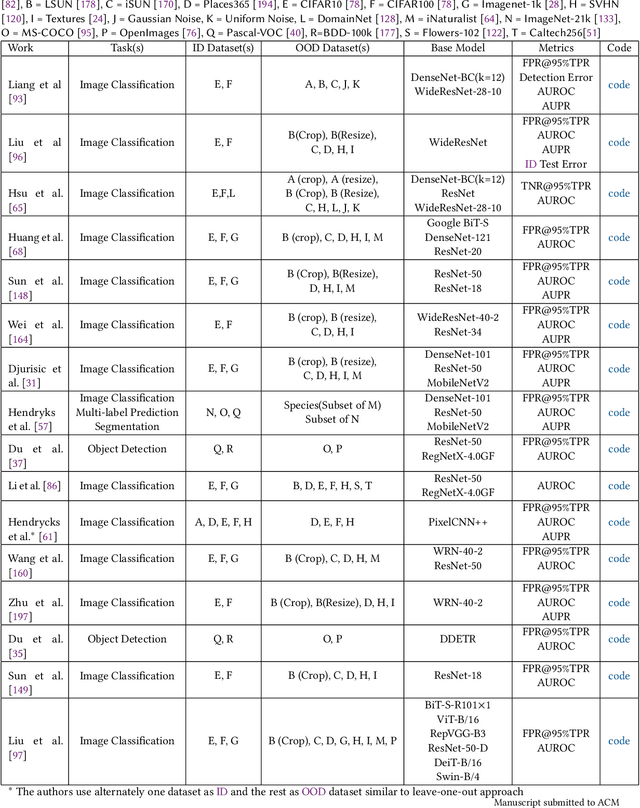
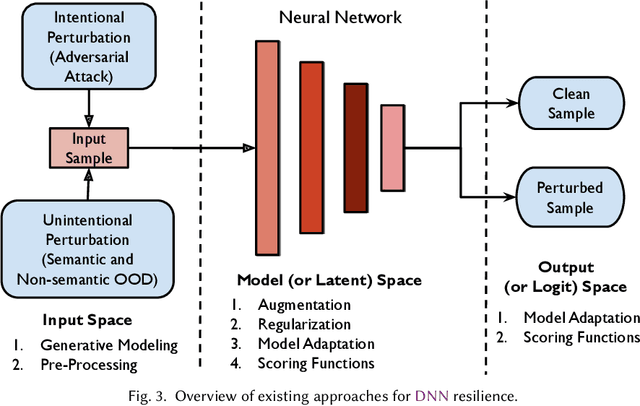
In order to deploy deep neural networks (DNNs) in high-stakes scenarios, it is imperative that DNNs provide inference robust to external perturbations - both intentional and unintentional. Although the resilience of DNNs to intentional and unintentional perturbations has been widely investigated, a unified vision of these inherently intertwined problem domains is still missing. In this work, we fill this gap by providing a survey of the state of the art and highlighting the similarities of the proposed approaches.We also analyze the research challenges that need to be addressed to deploy resilient and secure DNNs. As there has not been any such survey connecting the resilience of DNNs to intentional and unintentional perturbations, we believe this work can help advance the frontier in both domains by enabling the exchange of ideas between the two communities.