 Add to Chrome
 Add to Firefox
 Add to Edge
The Recurrent Transformer: Greater Effective Depth and Efficient Decoding
Apr 23, 2026
Transformers process tokens in parallel but are temporally shallow: at position $t$, each layer attends to key-value pairs computed based on the previous layer, yielding a depth capped by the number of layers. Recurrent models offer unbounded temporal depth but suffer from optimization instability and historically underutilize modern accelerators. We introduce the Recurrent Transformer, a simple architectural change where each layer attends to key-value pairs computed off its own activations, yielding layerwise recurrent memory while preserving standard autoregressive decoding cost. We show that the architecture can emulate both (i) a conventional Transformer and (ii) token-to-token recurrent updates under mild assumptions, while avoiding optimization instability. Naively, prefill/training appears bandwidth-bound with effective arithmetic intensity near $1$ because keys and values are revealed sequentially; we give an exact tiling-based algorithm that preserves the mathematical computation while reducing HBM traffic from $Θ(N^2)$ to $Θ(N\log N)$, increasing effective arithmetic intensity to $Θ(N/\log N)$ for sequence length $N$. On 150M and 300M parameter C4 pretraining, Recurrent Transformers improve cross-entropy over a parameter-matched Transformer baseline and achieve the improvement with fewer layers (fixed parameters), suggesting that recurrence can trade depth for width, thus reducing KV cache memory footprint and inference latency.

Matching Features, Not Tokens: Energy-Based Fine-Tuning of Language Models
Mar 12, 2026Cross-entropy (CE) training provides dense and scalable supervision for language models, but it optimizes next-token prediction under teacher forcing rather than sequence-level behavior under model rollouts. We introduce a feature-matching objective for language-model fine-tuning that targets sequence-level statistics of the completion distribution, providing dense semantic feedback without requiring a task-specific verifier or preference model. To optimize this objective efficiently, we propose energy-based fine-tuning (EBFT), which uses strided block-parallel sampling to generate multiple rollouts from nested prefixes concurrently, batches feature extraction over these rollouts, and uses the resulting embeddings to perform an on-policy policy-gradient update. We present a theoretical perspective connecting EBFT to KL-regularized feature-matching and energy-based modeling. Empirically, across Q&A coding, unstructured coding, and translation, EBFT matches RLVR and outperforms SFT on downstream accuracy while achieving a lower validation cross-entropy than both methods.
Characterization and Mitigation of Training Instabilities in Microscaling Formats
Jun 25, 2025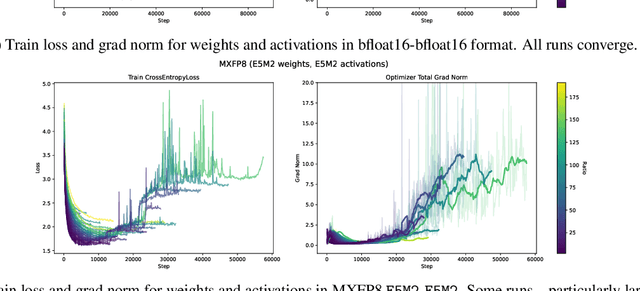
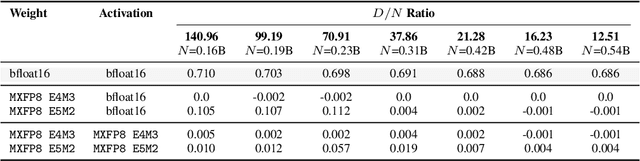
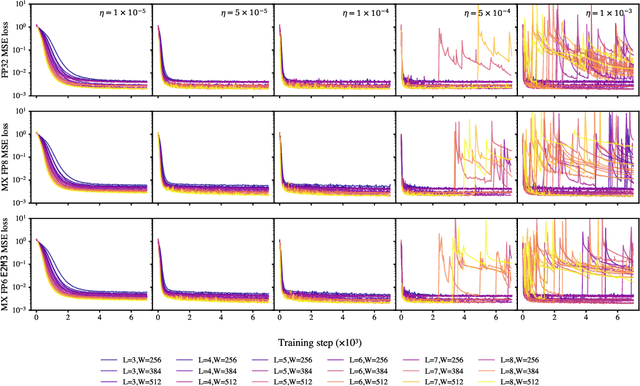
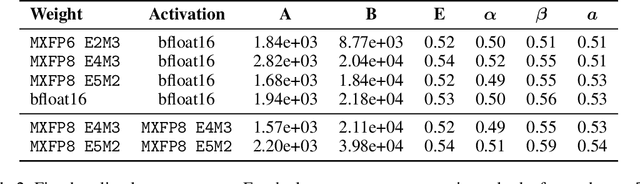
Training large language models is an expensive, compute-bound process that must be repeated as models scale, algorithms improve, and new data is collected. To address this, next-generation hardware accelerators increasingly support lower-precision arithmetic formats, such as the Microscaling (MX) formats introduced in NVIDIA's Blackwell architecture. These formats use a shared scale within blocks of parameters to extend representable range and perform forward/backward GEMM operations in reduced precision for efficiency gains. In this work, we investigate the challenges and viability of block-scaled precision formats during model training. Across nearly one thousand language models trained from scratch -- spanning compute budgets from $2 \times 10^{17}$ to $4.8 \times 10^{19}$ FLOPs and sweeping over a broad range of weight-activation precision combinations -- we consistently observe that training in MX formats exhibits sharp, stochastic instabilities in the loss, particularly at larger compute scales. To explain this phenomenon, we conduct controlled experiments and ablations on a smaller proxy model that exhibits similar behavior as the language model, sweeping across architectural settings, hyperparameters, and precision formats. These experiments motivate a simple model in which multiplicative gradient bias introduced by the quantization of layer-norm affine parameters and a small fraction of activations can trigger runaway divergence. Through \emph{in situ} intervention experiments on our proxy model, we demonstrate that instabilities can be averted or delayed by modifying precision schemes mid-training. Guided by these findings, we evaluate stabilization strategies in the LLM setting and show that certain hybrid configurations recover performance competitive with full-precision training. We release our code at https://github.com/Hither1/systems-scaling.
Decomposing Elements of Problem Solving: What "Math" Does RL Teach?
May 28, 2025Mathematical reasoning tasks have become prominent benchmarks for assessing the reasoning capabilities of LLMs, especially with reinforcement learning (RL) methods such as GRPO showing significant performance gains. However, accuracy metrics alone do not support fine-grained assessment of capabilities and fail to reveal which problem-solving skills have been internalized. To better understand these capabilities, we propose to decompose problem solving into fundamental capabilities: Plan (mapping questions to sequences of steps), Execute (correctly performing solution steps), and Verify (identifying the correctness of a solution). Empirically, we find that GRPO mainly enhances the execution skill-improving execution robustness on problems the model already knows how to solve-a phenomenon we call temperature distillation. More importantly, we show that RL-trained models struggle with fundamentally new problems, hitting a 'coverage wall' due to insufficient planning skills. To explore RL's impact more deeply, we construct a minimal, synthetic solution-tree navigation task as an analogy for mathematical problem-solving. This controlled setup replicates our empirical findings, confirming RL primarily boosts execution robustness. Importantly, in this setting, we identify conditions under which RL can potentially overcome the coverage wall through improved exploration and generalization to new solution paths. Our findings provide insights into the role of RL in enhancing LLM reasoning, expose key limitations, and suggest a path toward overcoming these barriers. Code is available at https://github.com/cfpark00/RL-Wall.