 Add to Chrome
 Add to Firefox
 Add to Edge
Bowel Obstruction Detection and Localization on Abdominal CT with Deep Learning
Jul 24, 2026
Bowel obstruction is a common and potentially life-threatening gastrointestinal condition. In the face of rising diagnostic workloads, the automated diagnosis of bowel obstruction on CT scans supports radiologists by accelerating detection and improving patient outcomes. In this work, we propose a deep learning framework with a multi-task objective that jointly detects bowel obstruction and localizes its transition zone. Additionally, we extend the method with an inherently interpretable classification method that locates the suspected transition point within a slice. It does so by learning a probabilistic selection mask that faithfully bases the classifier's prediction solely on a small image region. The proposed method is evaluated on an internal dataset comprising 1,427 abdominal CTs. Here, the model achieves an obstruction detection test accuracy of 93% and a Hit@10 transition zone localization of 95%. As the first method to reliably localize the transition zone, this marks a significant step towards the automated identification of this critical clinical landmark.

Beyond Independent Frames: Latent Attention Masked Autoencoders for Multi-View Echocardiography
Apr 16, 2026Echocardiography is a widely used modality for cardiac assessment due to its non-invasive and cost-effective nature, but the sparse and heterogeneous spatiotemporal views of the heart pose distinct challenges. Existing masked autoencoder (MAE) approaches typically process images or short clips independently, failing to capture the inherent multi-view structure required for coherent cardiac representation. We introduce Latent Attention Masked Autoencoder (LAMAE), a foundation model architecture tailored to the multi-view nature of medical imaging. LAMAE augments the standard MAE with a latent attention module that enables information exchange across frames and views directly in latent space. This allows the model to aggregate variable-length sequences and distinct views, reconstructing a holistic representation of cardiac function from partial observations. We pretrain LAMAE on MIMIC-IV-ECHO, a large-scale, uncurated dataset reflecting real-world clinical variability. To the best of our knowledge, we present the first results for predicting ICD-10 codes from MIMIC-IV-ECHO videos. Furthermore, we empirically demonstrate that representations learned from adult data transfer effectively to pediatric cohorts despite substantial anatomical differences. These results provide evidence that incorporating structural priors, such as multi-view attention, yields significantly more robust and transferable representations.
Foundation Model for Cardiac Time Series via Masked Latent Attention
Mar 27, 2026Electrocardiograms (ECGs) are among the most widely available clinical signals and play a central role in cardiovascular diagnosis. While recent foundation models (FMs) have shown promise for learning transferable ECG representations, most existing pretraining approaches treat leads as independent channels and fail to explicitly leverage their strong structural redundancy. We introduce the latent attention masked autoencoder (LAMAE) FM that directly exploits this structure by learning cross-lead connection mechanisms during self-supervised pretraining. Our approach models higher-order interactions across leads through latent attention, enabling permutation-invariant aggregation and adaptive weighting of lead-specific representations. We provide empirical evidence on the Mimic-IV-ECG database that leveraging the cross-lead connection constitutes an effective form of structural supervision, improving representation quality and transferability. Our method shows strong performance in predicting ICD-10 codes, outperforming independent-lead masked modeling and alignment-based baselines.
* First two authors are co-first. Last two authors are co-senior
Rethinking Machine Unlearning: Models Designed to Forget via Key Deletion
Mar 16, 2026Machine unlearning is rapidly becoming a practical requirement, driven by privacy regulations, data errors, and the need to remove harmful or corrupted training samples. Despite this, most existing methods tackle the problem purely from a post-hoc perspective. They attempt to erase the influence of targeted training samples through parameter updates that typically require access to the full training data. This creates a mismatch with real deployment scenarios where unlearning requests can be anticipated, revealing a fundamental limitation of post-hoc approaches. We propose \textit{unlearning by design}, a novel paradigm in which models are directly trained to support forgetting as an inherent capability. We instantiate this idea with Machine UNlearning via KEY deletion (MUNKEY), a memory augmented transformer that decouples instance-specific memorization from model weights. Here, unlearning corresponds to removing the instance-identifying key, enabling direct zero-shot forgetting without weight updates or access to the original samples or labels. Across natural image benchmarks, fine-grained recognition, and medical datasets, MUNKEY outperforms all post-hoc baselines. Our results establish that unlearning by design enables fast, deployment-oriented unlearning while preserving predictive performance.
Multimodal Generative Recommendation for Fusing Semantic and Collaborative Signals
Feb 03, 2026Sequential recommender systems rank relevant items by modeling a user's interaction history and computing the inner product between the resulting user representation and stored item embeddings. To avoid the significant memory overhead of storing large item sets, the generative recommendation paradigm instead models each item as a series of discrete semantic codes. Here, the next item is predicted by an autoregressive model that generates the code sequence corresponding to the predicted item. However, despite promising ranking capabilities on small datasets, these methods have yet to surpass traditional sequential recommenders on large item sets, limiting their adoption in the very scenarios they were designed to address. To resolve this, we propose MSCGRec, a Multimodal Semantic and Collaborative Generative Recommender. MSCGRec incorporates multiple semantic modalities and introduces a novel self-supervised quantization learning approach for images based on the DINO framework. Additionally, MSCGRec fuses collaborative and semantic signals by extracting collaborative features from sequential recommenders and treating them as a separate modality. Finally, we propose constrained sequence learning that restricts the large output space during training to the set of permissible tokens. We empirically demonstrate on three large real-world datasets that MSCGRec outperforms both sequential and generative recommendation baselines and provide an extensive ablation study to validate the impact of each component.
From Pixels to Perception: Interpretable Predictions via Instance-wise Grouped Feature Selection
May 09, 2025Understanding the decision-making process of machine learning models provides valuable insights into the task, the data, and the reasons behind a model's failures. In this work, we propose a method that performs inherently interpretable predictions through the instance-wise sparsification of input images. To align the sparsification with human perception, we learn the masking in the space of semantically meaningful pixel regions rather than on pixel-level. Additionally, we introduce an explicit way to dynamically determine the required level of sparsity for each instance. We show empirically on semi-synthetic and natural image datasets that our inherently interpretable classifier produces more meaningful, human-understandable predictions than state-of-the-art benchmarks.
Measuring Leakage in Concept-Based Methods: An Information Theoretic Approach
Apr 13, 2025Concept Bottleneck Models (CBMs) aim to enhance interpretability by structuring predictions around human-understandable concepts. However, unintended information leakage, where predictive signals bypass the concept bottleneck, compromises their transparency. This paper introduces an information-theoretic measure to quantify leakage in CBMs, capturing the extent to which concept embeddings encode additional, unintended information beyond the specified concepts. We validate the measure through controlled synthetic experiments, demonstrating its effectiveness in detecting leakage trends across various configurations. Our findings highlight that feature and concept dimensionality significantly influence leakage, and that classifier choice impacts measurement stability, with XGBoost emerging as the most reliable estimator. Additionally, preliminary investigations indicate that the measure exhibits the anticipated behavior when applied to soft joint CBMs, suggesting its reliability in leakage quantification beyond fully synthetic settings. While this study rigorously evaluates the measure in controlled synthetic experiments, future work can extend its application to real-world datasets.
RadVLM: A Multitask Conversational Vision-Language Model for Radiology
Feb 05, 2025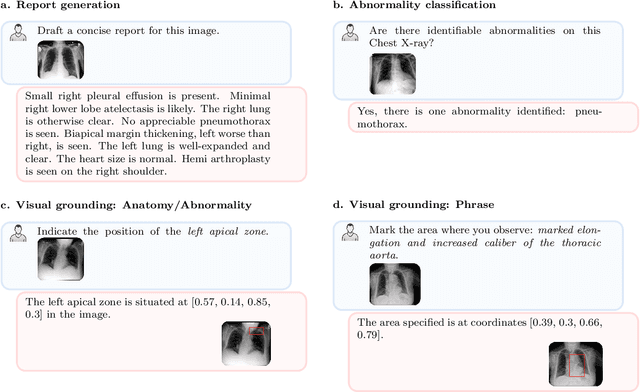

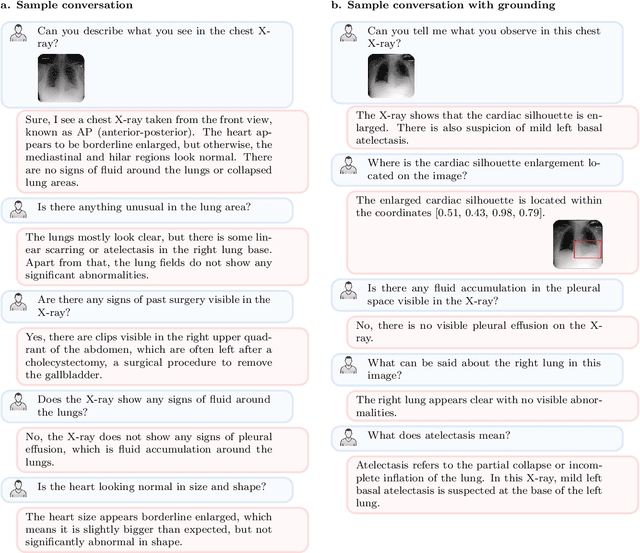

The widespread use of chest X-rays (CXRs), coupled with a shortage of radiologists, has driven growing interest in automated CXR analysis and AI-assisted reporting. While existing vision-language models (VLMs) show promise in specific tasks such as report generation or abnormality detection, they often lack support for interactive diagnostic capabilities. In this work we present RadVLM, a compact, multitask conversational foundation model designed for CXR interpretation. To this end, we curate a large-scale instruction dataset comprising over 1 million image-instruction pairs containing both single-turn tasks -- such as report generation, abnormality classification, and visual grounding -- and multi-turn, multi-task conversational interactions. After fine-tuning RadVLM on this instruction dataset, we evaluate it across different tasks along with re-implemented baseline VLMs. Our results show that RadVLM achieves state-of-the-art performance in conversational capabilities and visual grounding while remaining competitive in other radiology tasks. Ablation studies further highlight the benefit of joint training across multiple tasks, particularly for scenarios with limited annotated data. Together, these findings highlight the potential of RadVLM as a clinically relevant AI assistant, providing structured CXR interpretation and conversational capabilities to support more effective and accessible diagnostic workflows.
Exploiting Interpretable Capabilities with Concept-Enhanced Diffusion and Prototype Networks
Oct 24, 2024Concept-based machine learning methods have increasingly gained importance due to the growing interest in making neural networks interpretable. However, concept annotations are generally challenging to obtain, making it crucial to leverage all their prior knowledge. By creating concept-enriched models that incorporate concept information into existing architectures, we exploit their interpretable capabilities to the fullest extent. In particular, we propose Concept-Guided Conditional Diffusion, which can generate visual representations of concepts, and Concept-Guided Prototype Networks, which can create a concept prototype dataset and leverage it to perform interpretable concept prediction. These results open up new lines of research by exploiting pre-existing information in the quest for rendering machine learning more human-understandable.
Hierarchical Clustering for Conditional Diffusion in Image Generation
Oct 22, 2024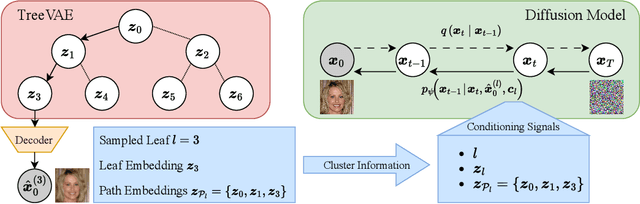
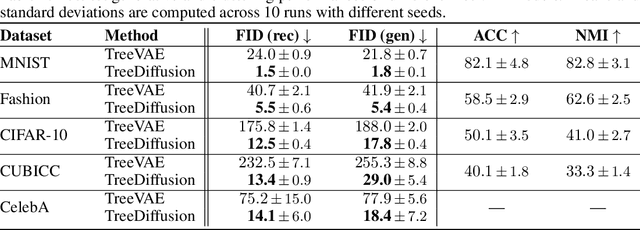

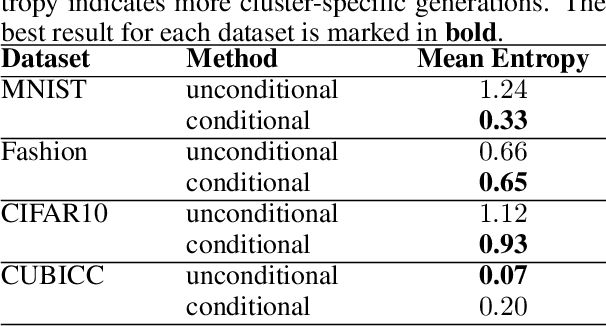
Finding clusters of data points with similar characteristics and generating new cluster-specific samples can significantly enhance our understanding of complex data distributions. While clustering has been widely explored using Variational Autoencoders, these models often lack generation quality in real-world datasets. This paper addresses this gap by introducing TreeDiffusion, a deep generative model that conditions Diffusion Models on hierarchical clusters to obtain high-quality, cluster-specific generations. The proposed pipeline consists of two steps: a VAE-based clustering model that learns the hierarchical structure of the data, and a conditional diffusion model that generates realistic images for each cluster. We propose this two-stage process to ensure that the generated samples remain representative of their respective clusters and enhance image fidelity to the level of diffusion models. A key strength of our method is its ability to create images for each cluster, providing better visualization of the learned representations by the clustering model, as demonstrated through qualitative results. This method effectively addresses the generative limitations of VAE-based approaches while preserving their clustering performance. Empirically, we demonstrate that conditioning diffusion models on hierarchical clusters significantly enhances generative performance, thereby advancing the state of generative clustering models.