 Add to Chrome
 Add to Firefox
 Add to Edge
Foundation Model for Cardiac Time Series via Masked Latent Attention
Mar 27, 2026
Electrocardiograms (ECGs) are among the most widely available clinical signals and play a central role in cardiovascular diagnosis. While recent foundation models (FMs) have shown promise for learning transferable ECG representations, most existing pretraining approaches treat leads as independent channels and fail to explicitly leverage their strong structural redundancy. We introduce the latent attention masked autoencoder (LAMAE) FM that directly exploits this structure by learning cross-lead connection mechanisms during self-supervised pretraining. Our approach models higher-order interactions across leads through latent attention, enabling permutation-invariant aggregation and adaptive weighting of lead-specific representations. We provide empirical evidence on the Mimic-IV-ECG database that leveraging the cross-lead connection constitutes an effective form of structural supervision, improving representation quality and transferability. Our method shows strong performance in predicting ICD-10 codes, outperforming independent-lead masked modeling and alignment-based baselines.
* First two authors are co-first. Last two authors are co-senior

RadVLM: A Multitask Conversational Vision-Language Model for Radiology
Feb 05, 2025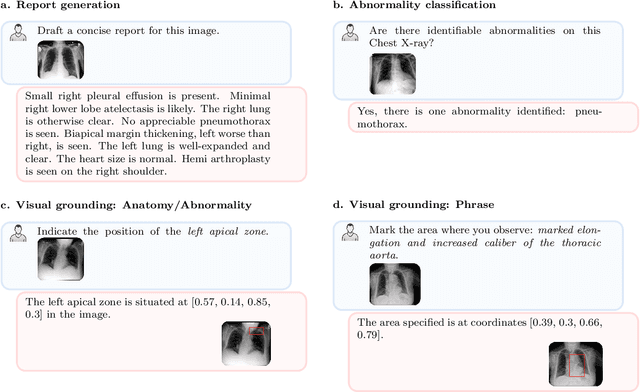

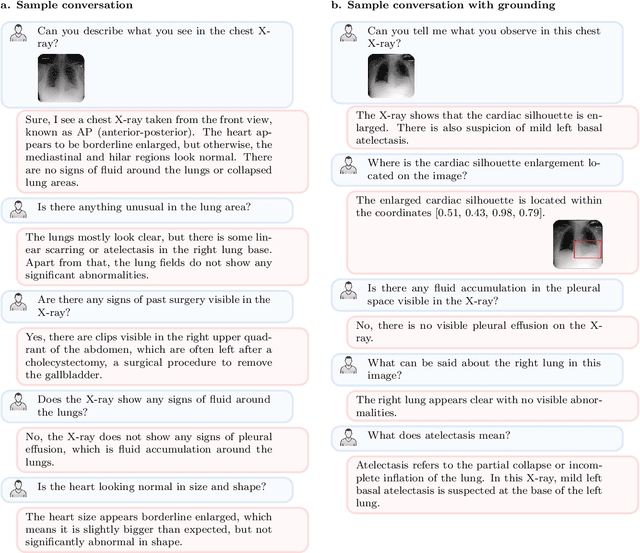

The widespread use of chest X-rays (CXRs), coupled with a shortage of radiologists, has driven growing interest in automated CXR analysis and AI-assisted reporting. While existing vision-language models (VLMs) show promise in specific tasks such as report generation or abnormality detection, they often lack support for interactive diagnostic capabilities. In this work we present RadVLM, a compact, multitask conversational foundation model designed for CXR interpretation. To this end, we curate a large-scale instruction dataset comprising over 1 million image-instruction pairs containing both single-turn tasks -- such as report generation, abnormality classification, and visual grounding -- and multi-turn, multi-task conversational interactions. After fine-tuning RadVLM on this instruction dataset, we evaluate it across different tasks along with re-implemented baseline VLMs. Our results show that RadVLM achieves state-of-the-art performance in conversational capabilities and visual grounding while remaining competitive in other radiology tasks. Ablation studies further highlight the benefit of joint training across multiple tasks, particularly for scenarios with limited annotated data. Together, these findings highlight the potential of RadVLM as a clinically relevant AI assistant, providing structured CXR interpretation and conversational capabilities to support more effective and accessible diagnostic workflows.