 Add to Chrome
 Add to Firefox
 Add to Edge
Expander Sparse Autoencoders: Parameter-Efficient Dictionaries for Mechanistic Interpretability
Jul 02, 2026
Sparse autoencoders (SAEs) decompose internal activations of neural networks into sparse linear combinations of learned features by fitting an overcomplete dictionary $\mathbf{W}\in\mathbb{R}^{m\times n}$ with $m<n$, and inferring a sparse code $\mathbf{x}\in\mathbb{R}^n$ from $\mathbf{h}\approx\mathbf{W}\mathbf{x}$. This inference problem closely resembles the canonical setup of compressed sensing, but dense decoders requires $O(mn)$ learned values, which becomes costly at large feature counts. We introduce Expander SAEs: TopK SAEs whose decoder and tied encoder are supported on a left-$d$-regular expander mask with $d\ll m$, learning only $dn$ decoder values while keeping the sparse-coding problem $(m,n,k)$ fixed. The same structure reduces storage and turns the matching-pursuit correlation step $\mathbf{W}^\top \mathbf{r}$ in OMP into an $O(dn)$ gather-and-reduce operation. Our experiments show that across Pythia-70M/160M, Qwen2.5-3B, and Llama-3.2-1B residual-stream activations, varying $d$ traces a consistent storage--fidelity frontier, and that at the most compressed modern-LM setting, Qwen2.5-3B with $d=7$ uses $293\times$ fewer learned decoder values than the full dense decoder while retaining $84$% of dense CE-loss recovered. Control experiments show that the improved storage--fidelity tradeoff is driven by sparse, diverse decoder support structure rather than by fewer learned decoder values, and that when sparse and dense decoders are compared at matched parameter count, part of the remaining gap comes from encoder amortisation. On the theoretical side, we show that expansion and column flatness are sufficient for identifiability of noiseless $k$-sparse codes, and we derive complementary sufficient conditions under which OMP recovers the support exactly.

Geometric Measurements of the Axiom of Choice in Neural Proof Embeddings
Jun 26, 2026The axiom of choice has divided the foundations of mathematics for over a century, but the distinction between classical and constructive proofs has remained a philosophical and methodological one. We use Lean 4's kernel-level tracking of axiom dependence to show that the axiom of choice has a measurable geometric correlate in proof space that obeys a one-parameter mixture law and has operational consequences for neural theorem provers. To do this, we partition $471{,}260$ declarations of Mathlib by transitive dependence on the axiom of choice and represent a filtered population of $42{,}355$ traced theorems by their sequences of tactic invocations. We use the constructive proofs in this dataset to train a self-supervised proof encoder and show that when using it to measure classical proofs, three complementary measurements (anomaly score, reconstruction loss, and density-superlevel containment) exhibit a common decline with the proof's distance from the axiom in the dependency graph, from sharp separation at the shallow boundary (AUC $0.847$ at distance $2$) to indistinguishability at distance~$9{+}$. Robustness controls show that the signature survives length, file, author, and topic controls, and replicates under full-source encoders trained on normalised proof source. Operationally, we show that on an evaluation sample of $251$ Mathlib theorems, Lean's \texttt{aesop} tactic solves constructive theorems at $13\times$ the rate of classical ones, and a neural-guided hybrid using the ReProver tactic generator compresses the gap to $5\times$. The geometric anomaly score predicts \texttt{aesop} failure beyond proof length, providing an operational link between the geometric signature and prover performance.
Impermanent: A Live Benchmark for Temporal Generalization in Time Series Forecasting
Mar 10, 2026Recent advances in time-series forecasting increasingly rely on pre-trained foundation-style models. While these models often claim broad generalization, existing evaluation protocols provide limited evidence. Indeed, most current benchmarks use static train-test splits that can easily lead to contamination as foundation models can inadvertently train on test data or perform model selection using test scores, which can inflate performance. We introduce Impermanent, a live benchmark that evaluates forecasting models under open-world temporal change by scoring forecasts sequentially over time on continuously updated data streams, enabling the study of temporal robustness, distributional shift, and performance stability rather than one-off accuracy on a frozen test set. Impermanent is instantiated on GitHub open-source activity, providing a naturally live and highly non-stationary dataset shaped by releases, shifting contributor behavior, platform/tooling changes, and external events. We focus on the top 400 repositories by star count and construct time series from issues opened, pull requests opened, push events, and new stargazers, evaluated over a rolling window with daily updates, alongside standardized protocols and leaderboards for reproducible, ongoing comparison. By shifting evaluation from static accuracy to sustained performance, Impermanent takes a concrete step toward assessing when and whether foundation-level generalization in time-series forecasting can be meaningfully claimed. Code and a live dashboard are available at https://github.com/TimeCopilot/impermanent and https://impermanent.timecopilot.dev.
Federated PCA with Adaptive Rank Estimation
Jul 18, 2019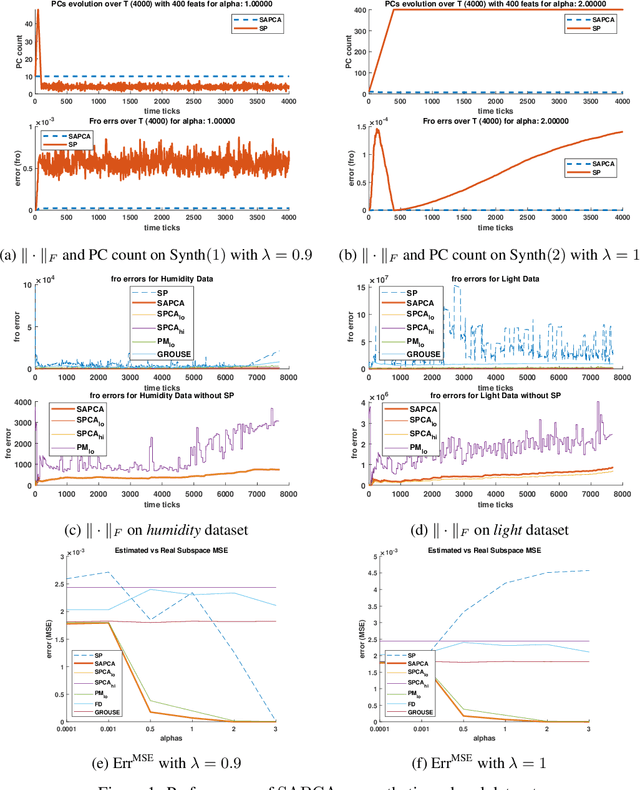

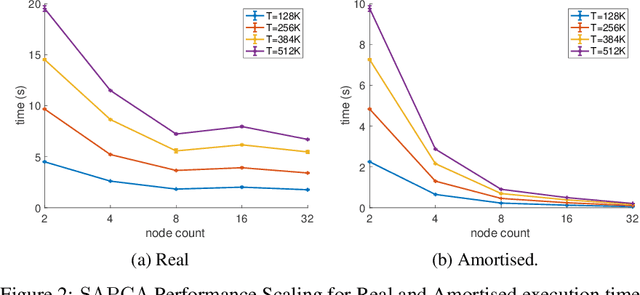
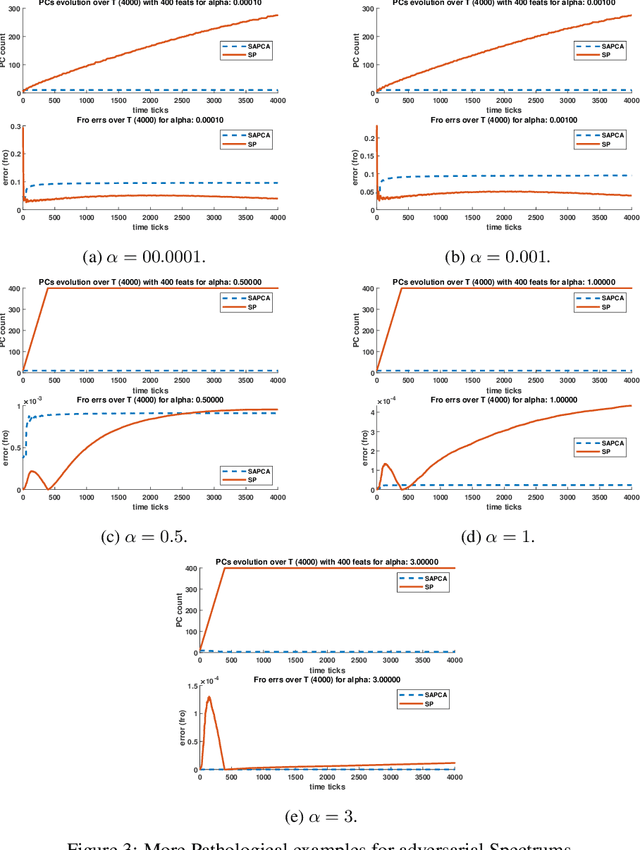
In many online machine learning and data science tasks such as data summarisation and feature compression, $d$-dimensional vectors are usually distributed across a large number of clients in a decentralised network and collected in a streaming fashion. This is increasingly common in modern applications due to the sheer volume of data generated and the clients' constrained resources. In this setting, some clients are required to compute an update to a centralised target model independently using local data while other clients aggregate these updates with a low-complexity merging algorithm. However, some clients with limited storage might not be able to store all of the data samples if $d$ is large, nor compute procedures requiring at least $\Omega(d^2)$ storage-complexity such as Principal Component Analysis, Subspace Tracking, or general Feature Correlation. In this work, we present a novel federated algorithm for PCA that is able to adaptively estimate the rank $r$ of the dataset and compute its $r$ leading principal components when only $O(dr)$ memory is available. This inherent adaptability implies that $r$ does not have to be supplied as a fixed hyper-parameter which is beneficial when the underlying data distribution is not known in advance, such as in a streaming setting. Numerical simulations show that, while using limited-memory, our algorithm exhibits state-of-the-art performance that closely matches or outperforms traditional non-federated algorithms, and in the absence of communication latency, it exhibits attractive horizontal scalability.