 Add to Chrome
 Add to Firefox
 Add to Edge
Toto 2.0: Time Series Forecasting Enters the Scaling Era
May 19, 2026
We show that time series foundation models scale: a single training recipe produces reliable forecast-quality improvements from 4M to 2.5B parameters. We release Toto 2.0, a family of five open-weights forecasting models trained under this recipe. The Toto 2.0 family sets a new state of the art on three forecasting benchmarks: BOOM, our observability benchmark; GIFT-Eval, the standard general-purpose benchmark; and the recent contamination-resistant TIME benchmark. This report describes our experimental results and details the design decisions behind Toto 2.0: its architecture and training recipe, training data, and the u-muP hyperparameter transfer pipeline. All five base checkpoints are released under Apache 2.0.

ARFBench: Benchmarking Time Series Question Answering Ability for Software Incident Response
Apr 23, 2026Time series question-answering (TSQA), in which we ask natural language questions to infer and reason about properties of time series, is a promising yet underexplored capability of foundation models. In this work, we present ARFBench, a TSQA benchmark that evaluates the understanding of multimodal foundation models (FMs) on time series anomalies prevalent in software incident data. ARFBench consists of 750 questions across 142 time series and 5.38M data points from 63 production incidents sourced exclusively from internal telemetry at Datadog. We evaluate leading proprietary and open-source LLMs, VLMs, and time series FMs and observe that frontier VLMs perform markedly better than existing baselines; the leading model (GPT-5) achieves a 62.7% accuracy and 51.9% F1. We next demonstrate the promise of specialized multimodal approaches. We develop a novel TSFM + VLM hybrid prototype which we post-train on a small set of synthetic and real data that yields comparable overall F1 and accuracy with frontier models. Lastly, we find models and human domain experts exhibit complementary strengths. We define a model-expert oracle, a best-of-2 oracle selector over model and expert answers, yielding 82.8% F1 and 87.2% accuracy and establishing a new superhuman frontier for future TSQA models. The benchmark is available at https://huggingface.co/datasets/Datadog/ARFBench.
This Time is Different: An Observability Perspective on Time Series Foundation Models
May 20, 2025We introduce Toto, a time series forecasting foundation model with 151 million parameters. Toto uses a modern decoder-only architecture coupled with architectural innovations designed to account for specific challenges found in multivariate observability time series data. Toto's pre-training corpus is a mixture of observability data, open datasets, and synthetic data, and is 4-10$\times$ larger than those of leading time series foundation models. Additionally, we introduce BOOM, a large-scale benchmark consisting of 350 million observations across 2,807 real-world time series. For both Toto and BOOM, we source observability data exclusively from Datadog's own telemetry and internal observability metrics. Extensive evaluations demonstrate that Toto achieves state-of-the-art performance on both BOOM and on established general purpose time series forecasting benchmarks. Toto's model weights, inference code, and evaluation scripts, as well as BOOM's data and evaluation code, are all available as open source under the Apache 2.0 License available at https://huggingface.co/Datadog/Toto-Open-Base-1.0 and https://github.com/DataDog/toto.
Toto: Time Series Optimized Transformer for Observability
Jul 11, 2024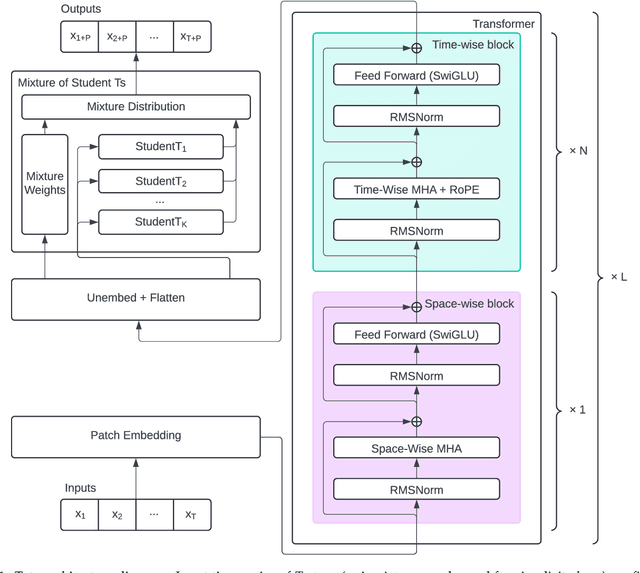

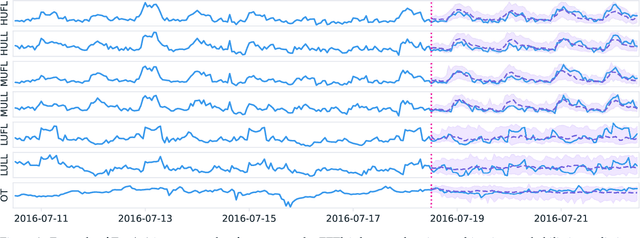

This technical report describes the Time Series Optimized Transformer for Observability (Toto), a new state of the art foundation model for time series forecasting developed by Datadog. In addition to advancing the state of the art on generalized time series benchmarks in domains such as electricity and weather, this model is the first general-purpose time series forecasting foundation model to be specifically tuned for observability metrics. Toto was trained on a dataset of one trillion time series data points, the largest among all currently published time series foundation models. Alongside publicly available time series datasets, 75% of the data used to train Toto consists of fully anonymous numerical metric data points from the Datadog platform. In our experiments, Toto outperforms existing time series foundation models on observability data. It does this while also excelling at general-purpose forecasting tasks, achieving state-of-the-art zero-shot performance on multiple open benchmark datasets.