 Add to Chrome
 Add to Firefox
 Add to Edge
Seeing Through Circuits: Faithful Mechanistic Interpretability for Vision Transformers
Apr 15, 2026
Transparency of neural networks' internal reasoning is at the heart of interpretability research, adding to trust, safety, and understanding of these models. The field of mechanistic interpretability has recently focused on studying task-specific computational graphs, defined by connections (edges) between model components. Such edge-based circuits have been defined in the context of large language models, yet vision-based approaches so far only consider neuron-based circuits. These tell which information is encoded, but not how it is routed through the complex wiring of a neural network. In this work, we investigate whether useful mechanistic circuits can be identified through computational graphs in vision transformers. We propose an effective method for Automatic Visual Circuit Discovery (Vi-CD) that recovers class-specific circuits for classification, identifies circuits underlying typographic attacks in CLIP, and discovers circuits that lend themselves for steering to correct harmful model behavior. Overall, we find that insightful and actionable edge-based circuits can be recovered from vision transformers, adding transparency to the internal computations of these models.

MICA: Multivariate Infini Compressive Attention for Time Series Forecasting
Apr 07, 2026Multivariate forecasting with Transformers faces a core scalability challenge: modeling cross-channel dependencies via attention compounds attention's quadratic sequence complexity with quadratic channel scaling, making full cross-channel attention impractical for high-dimensional time series. We propose Multivariate Infini Compressive Attention (MICA), an architectural design to extend channel-independent Transformers to channel-dependent forecasting. By adapting efficient attention techniques from the sequence dimension to the channel dimension, MICA adds a cross-channel attention mechanism to channel-independent backbones that scales linearly with channel count and context length. We evaluate channel-independent Transformer architectures with and without MICA across multiple forecasting benchmarks. MICA reduces forecast error over its channel-independent counterparts by 5.4% on average and up to 25.4% on individual datasets, highlighting the importance of explicit cross-channel modeling. Moreover, models with MICA rank first among deep multivariate Transformer and MLP baselines. MICA models also scale more efficiently with respect to both channel count and context length than Transformer baselines that compute attention across both the temporal and channel dimensions, establishing compressive attention as a practical solution for scalable multivariate forecasting.
Investigating Compositional Reasoning in Time Series Foundation Models
Feb 09, 2025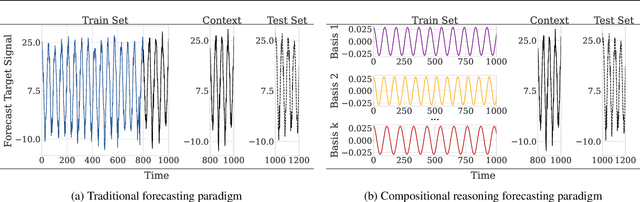
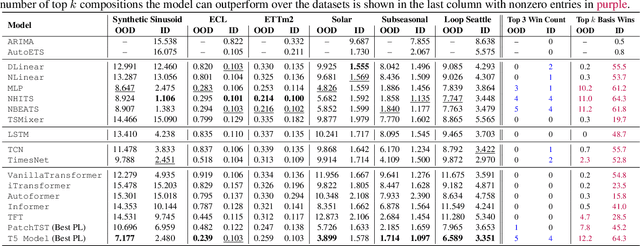
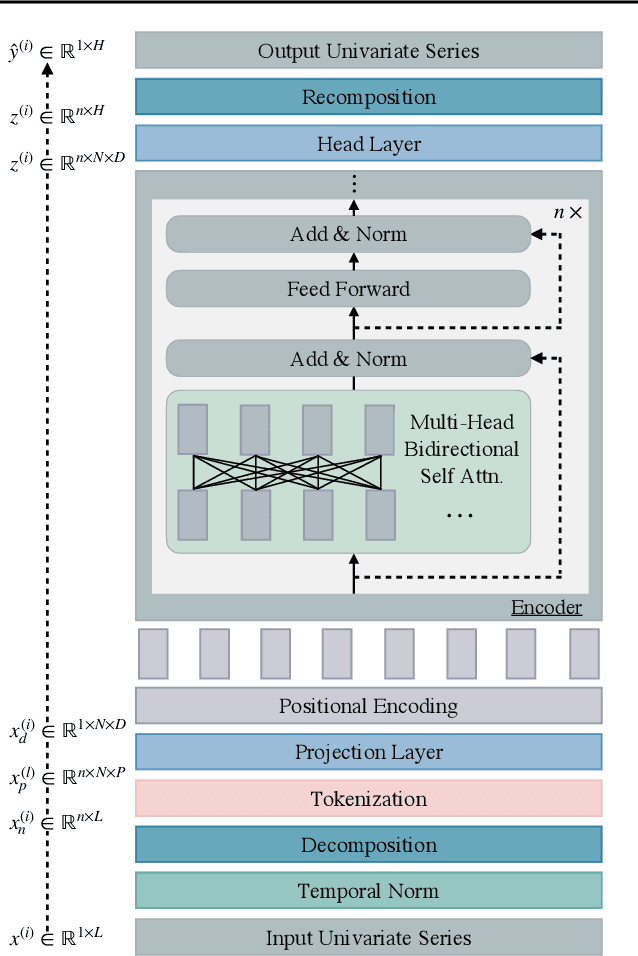
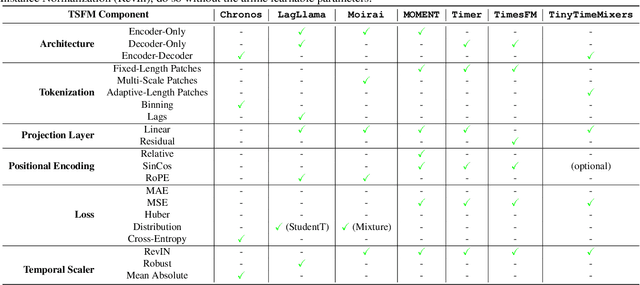
Large pre-trained time series foundation models (TSFMs) have demonstrated promising zero-shot performance across a wide range of domains. However, a question remains: Do TSFMs succeed solely by memorizing training patterns, or do they possess the ability to reason? While reasoning is a topic of great interest in the study of Large Language Models (LLMs), it is undefined and largely unexplored in the context of TSFMs. In this work, inspired by language modeling literature, we formally define compositional reasoning in forecasting and distinguish it from in-distribution generalization. We evaluate the reasoning and generalization capabilities of 23 popular deep learning forecasting models on multiple synthetic and real-world datasets. Additionally, through controlled studies, we systematically examine which design choices in TSFMs contribute to improved reasoning abilities. Our study yields key insights into the impact of TSFM architecture design on compositional reasoning and generalization. We find that patch-based Transformers have the best reasoning performance, closely followed by residualized MLP-based architectures, which are 97\% less computationally complex in terms of FLOPs and 86\% smaller in terms of the number of trainable parameters. Interestingly, in some zero-shot out-of-distribution scenarios, these models can outperform moving average and exponential smoothing statistical baselines trained on in-distribution data. Only a few design choices, such as the tokenization method, had a significant (negative) impact on Transformer model performance.
Implicit Reasoning in Deep Time Series Forecasting
Sep 18, 2024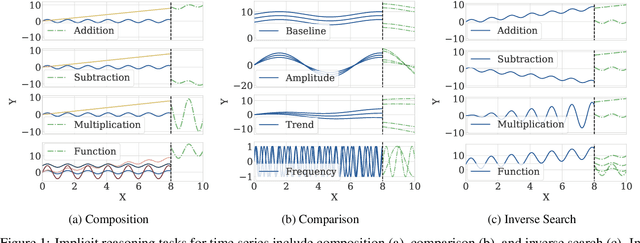
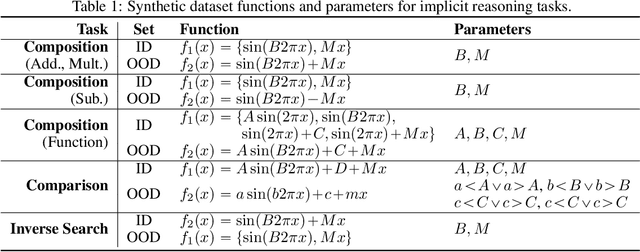


Recently, time series foundation models have shown promising zero-shot forecasting performance on time series from a wide range of domains. However, it remains unclear whether their success stems from a true understanding of temporal dynamics or simply from memorizing the training data. While implicit reasoning in language models has been studied, similar evaluations for time series models have been largely unexplored. This work takes an initial step toward assessing the reasoning abilities of deep time series forecasting models. We find that certain linear, MLP-based, and patch-based Transformer models generalize effectively in systematically orchestrated out-of-distribution scenarios, suggesting underexplored reasoning capabilities beyond simple pattern memorization.