 Add to Chrome
 Add to Firefox
 Add to Edge
CausalGuard: Conformal Inference under Graph Uncertainty
May 21, 2026
Estimating treatment effects from observational data requires choosing an adjustment set, but valid adjustment depends on an unknown causal graph. Graph misspecification can cause under-coverage, while graph-agnostic conformal wrappers may regain nominal coverage only through large padding. We introduce CausalGuard, a structure-weighted conformal framework that calibrates after aggregating graph-conditional doubly robust pseudo-outcomes. Candidate DAGs are proposed from an LLM-derived edge prior, pruned by conditional-independence tests, and reweighted by Bayesian Information Criterion. A composite nonconformity score then calibrates the posterior-weighted pseudo-outcome. CausalGuard provides distribution-free finite-sample marginal coverage for this aggregated pseudo-outcome; under causal identification, overlap, conditional-mean nuisance stability, and concentration on target-aligned valid adjustment strategies, its conditional mean converges to the true Conditional Average Treatment Effect. Across five benchmarks, CausalGuard attains mean coverage above the nominal 90% level for the directly evaluable target and reduces width when graph-agnostic conformal baselines require large padding. Stress tests show that CausalGuard suppresses invalid collider adjustment and remains stable under misspecified priors when the retained candidate set is data-supported.

Medical Image Spatial Grounding with Semantic Sampling
Mar 15, 2026Vision language models (VLMs) have shown significant promise in visual grounding for images as well as videos. In medical imaging research, VLMs represent a bridge between object detection and segmentation, and report understanding and generation. However, spatial grounding of anatomical structures in the three-dimensional space of medical images poses many unique challenges. In this study, we examine image modalities, slice directions, and coordinate systems as differentiating factors for vision components of VLMs, and the use of anatomical, directional, and relational terminology as factors for the language components. We then demonstrate that visual and textual prompting systems such as labels, bounding boxes, and mask overlays have varying effects on the spatial grounding ability of VLMs. To enable measurement and reproducibility, we introduce \textbf{MIS-Ground}, a benchmark that comprehensively tests a VLM for vulnerabilities against specific modes of \textbf{M}edical \textbf{I}mage \textbf{S}patial \textbf{Ground}ing. We release MIS-Ground to the public at \href{https://anonymous.4open.science/r/mis-ground}{\texttt{anonymous.4open.science/r/mis-ground}}. In addition, we present \textbf{MIS-SemSam}, a low-cost, inference-time, and model-agnostic optimization of VLMs that improve their spatial grounding ability with the use of \textbf{Sem}antic \textbf{Sam}pling. We find that MIS-SemSam improves the accuracy of Qwen3-VL-32B on MIS-Ground by 13.06\%.
Scorio.jl: A Julia package for ranking stochastic responses
Mar 14, 2026Scorio.jl is a Julia package for evaluating and ranking systems from repeated responses to shared tasks. It provides a common tensor-based interface for direct score-based, pairwise, psychometric, voting, graph, and listwise methods, so the same benchmark can be analyzed under multiple ranking assumptions. We describe the package design, position it relative to existing Julia tools, and report pilot experiments on synthetic rank recovery, stability under limited trials, and runtime scaling.
Ranking Reasoning LLMs under Test-Time Scaling
Mar 11, 2026Test-time scaling evaluates reasoning LLMs by sampling multiple outputs per prompt, but ranking models in this regime remains underexplored. We formalize dense benchmark ranking under test-time scaling and introduce Scorio, a library that implements statistical ranking methods such as paired-comparison models, item response theory (IRT) models, voting rules, and graph- and spectral-based methods. Across $20$ reasoning models on four Olympiad-style math benchmarks (AIME'24, AIME'25, HMMT'25, and BrUMO'25; up to $N=80$ trials), most full-trial rankings agree closely with the Bayesian gold standard $\mathrm{Bayes}_{\mathcal{U}}@80$ (mean Kendall's $τ_b = 0.93$--$0.95$), and $19$--$34$ methods recover exactly the same ordering. In the single-trial regime, the best methods reach $τ_b \approx 0.86$. Using greedy decoding as an empirical prior ($\mathrm{Bayes}_{\mathbf{R}_0}@N$) reduces variance at $N=1$ by $16$--$52\%$, but can bias rankings when greedy and stochastic sampling disagree. These results identify reliable ranking methods for both high- and low-budget test-time scaling. We release Scorio as an open-source library at https://github.com/mohsenhariri/scorio.
Don't Pass$\mathtt{@}k$: A Bayesian Framework for Large Language Model Evaluation
Oct 05, 2025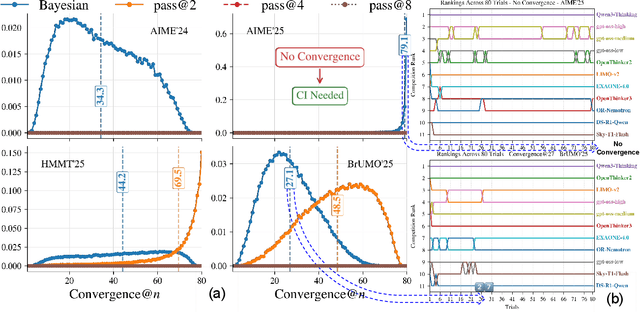

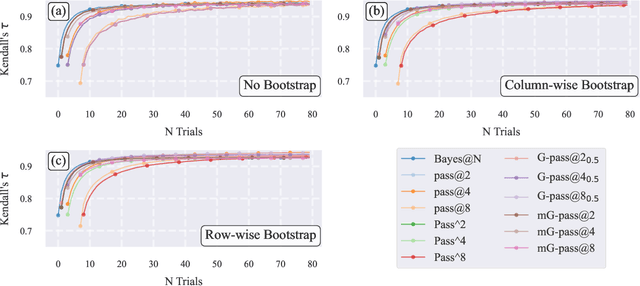
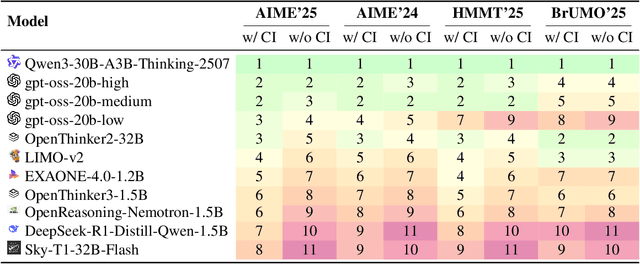
Pass$@k$ is widely used to report performance for LLM reasoning, but it often yields unstable, misleading rankings, especially when the number of trials (samples) is limited and compute is constrained. We present a principled Bayesian evaluation framework that replaces Pass$@k$ and average accuracy over $N$ trials (avg$@N$) with posterior estimates of a model's underlying success probability and credible intervals, yielding stable rankings and a transparent decision rule for differences. Evaluation outcomes are modeled as categorical (not just 0/1) with a Dirichlet prior, giving closed-form expressions for the posterior mean and uncertainty of any weighted rubric and enabling the use of prior evidence when appropriate. Theoretically, under a uniform prior, the Bayesian posterior mean is order-equivalent to average accuracy (Pass$@1$), explaining its empirical robustness while adding principled uncertainty. Empirically, in simulations with known ground-truth success rates and on AIME'24/'25, HMMT'25, and BrUMO'25, the Bayesian/avg procedure achieves faster convergence and greater rank stability than Pass$@k$ and recent variants, enabling reliable comparisons at far smaller sample counts. The framework clarifies when observed gaps are statistically meaningful (non-overlapping credible intervals) versus noise, and it naturally extends to graded, rubric-based evaluations. Together, these results recommend replacing Pass$@k$ for LLM evaluation and ranking with a posterior-based, compute-efficient protocol that unifies binary and non-binary evaluation while making uncertainty explicit. Code is available at https://mohsenhariri.github.io/bayes-kit
$K^4$: Online Log Anomaly Detection Via Unsupervised Typicality Learning
Jul 26, 2025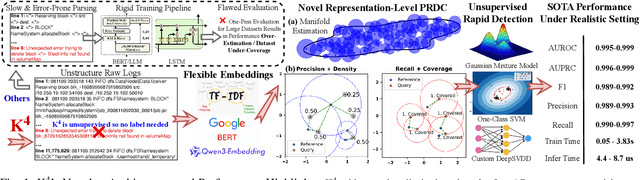
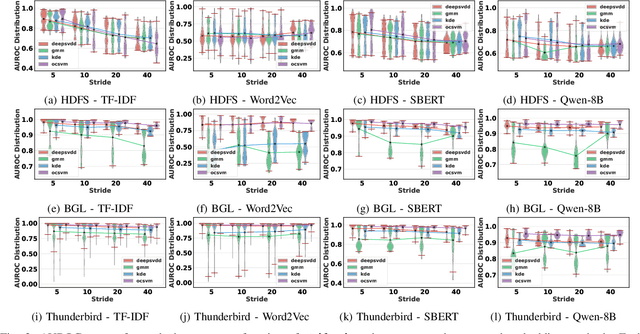
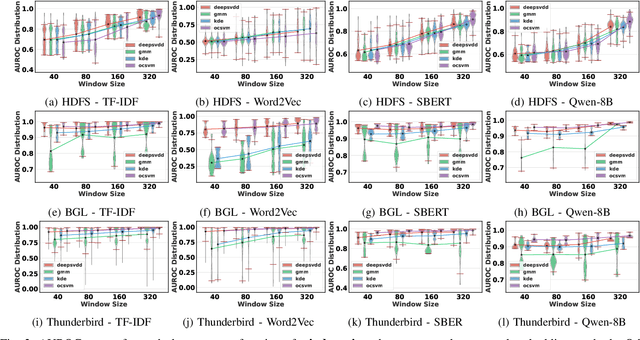
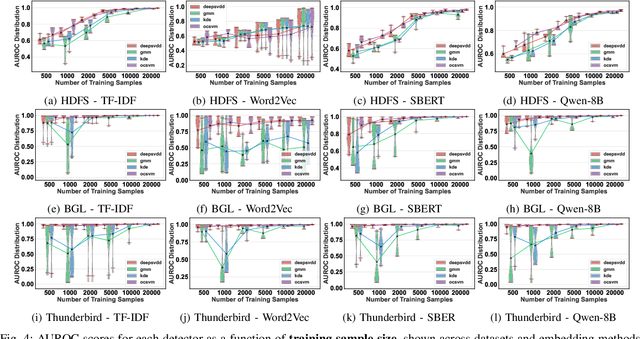
Existing Log Anomaly Detection (LogAD) methods are often slow, dependent on error-prone parsing, and use unrealistic evaluation protocols. We introduce $K^4$, an unsupervised and parser-independent framework for high-performance online detection. $K^4$ transforms arbitrary log embeddings into compact four-dimensional descriptors (Precision, Recall, Density, Coverage) using efficient k-nearest neighbor (k-NN) statistics. These descriptors enable lightweight detectors to accurately score anomalies without retraining. Using a more realistic online evaluation protocol, $K^4$ sets a new state-of-the-art (AUROC: 0.995-0.999), outperforming baselines by large margins while being orders of magnitude faster, with training under 4 seconds and inference as low as 4 $\mu$s.
More for Keys, Less for Values: Adaptive KV Cache Quantization
Feb 20, 2025This paper introduces an information-aware quantization framework that adaptively compresses the key-value (KV) cache in large language models (LLMs). Although prior work has underscored the distinct roles of key and value cache during inference, our systematic analysis -- examining singular value distributions, spectral norms, and Frobenius norms -- reveals, for the first time, that key matrices consistently exhibit higher norm values and are more sensitive to quantization than value matrices. Furthermore, our theoretical analysis shows that matrices with higher spectral norms amplify quantization errors more significantly. Motivated by these insights, we propose a mixed-precision quantization strategy, KV-AdaQuant, which allocates more bit-width for keys and fewer for values since key matrices have higher norm values. With the same total KV bit budget, this approach effectively mitigates error propagation across transformer layers while achieving significant memory savings. Our extensive experiments on multiple LLMs (1B--70B) demonstrate that our mixed-precision quantization scheme maintains high model accuracy even under aggressive compression. For instance, using 4-bit for Key and 2-bit for Value achieves an accuracy of 75.2%, whereas reversing the assignment (2-bit for Key and 4-bit for Value) yields only 54.7% accuracy. The code is available at https://tinyurl.com/kv-adaquant
Novel adaptation of video segmentation to 3D MRI: efficient zero-shot knee segmentation with SAM2
Aug 08, 2024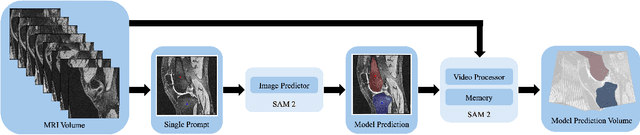
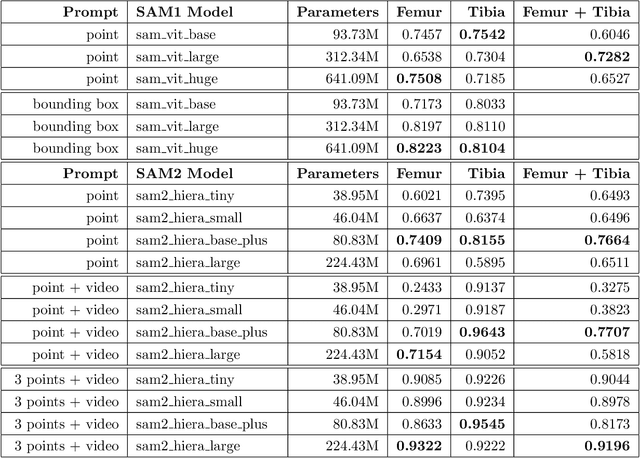
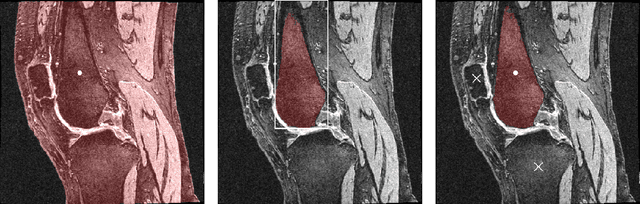
Intelligent medical image segmentation methods are rapidly evolving and being increasingly applied, yet they face the challenge of domain transfer, where algorithm performance degrades due to different data distributions between source and target domains. To address this, we introduce a method for zero-shot, single-prompt segmentation of 3D knee MRI by adapting Segment Anything Model 2 (SAM2), a general-purpose segmentation model designed to accept prompts and retain memory across frames of a video. By treating slices from 3D medical volumes as individual video frames, we leverage SAM2's advanced capabilities to generate motion- and spatially-aware predictions. We demonstrate that SAM2 can efficiently perform segmentation tasks in a zero-shot manner with no additional training or fine-tuning, accurately delineating structures in knee MRI scans using only a single prompt. Our experiments on the Osteoarthritis Initiative Zuse Institute Berlin (OAI-ZIB) dataset reveal that SAM2 achieves high accuracy on 3D knee bone segmentation, with a testing Dice similarity coefficient of 0.9643 on tibia. We also present results generated using different SAM2 model sizes, different prompt schemes, as well as comparative results from the SAM1 model deployed on the same dataset. This breakthrough has the potential to revolutionize medical image analysis by providing a scalable, cost-effective solution for automated segmentation, paving the way for broader clinical applications and streamlined workflows.