 Add to Chrome
 Add to Firefox
 Add to Edge
Medical Image Spatial Grounding with Semantic Sampling
Mar 15, 2026
Vision language models (VLMs) have shown significant promise in visual grounding for images as well as videos. In medical imaging research, VLMs represent a bridge between object detection and segmentation, and report understanding and generation. However, spatial grounding of anatomical structures in the three-dimensional space of medical images poses many unique challenges. In this study, we examine image modalities, slice directions, and coordinate systems as differentiating factors for vision components of VLMs, and the use of anatomical, directional, and relational terminology as factors for the language components. We then demonstrate that visual and textual prompting systems such as labels, bounding boxes, and mask overlays have varying effects on the spatial grounding ability of VLMs. To enable measurement and reproducibility, we introduce \textbf{MIS-Ground}, a benchmark that comprehensively tests a VLM for vulnerabilities against specific modes of \textbf{M}edical \textbf{I}mage \textbf{S}patial \textbf{Ground}ing. We release MIS-Ground to the public at \href{https://anonymous.4open.science/r/mis-ground}{\texttt{anonymous.4open.science/r/mis-ground}}. In addition, we present \textbf{MIS-SemSam}, a low-cost, inference-time, and model-agnostic optimization of VLMs that improve their spatial grounding ability with the use of \textbf{Sem}antic \textbf{Sam}pling. We find that MIS-SemSam improves the accuracy of Qwen3-VL-32B on MIS-Ground by 13.06\%.

Novel adaptation of video segmentation to 3D MRI: efficient zero-shot knee segmentation with SAM2
Aug 08, 2024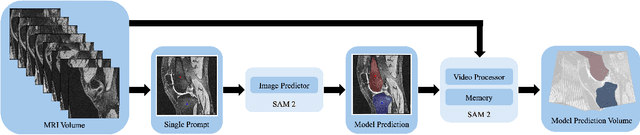
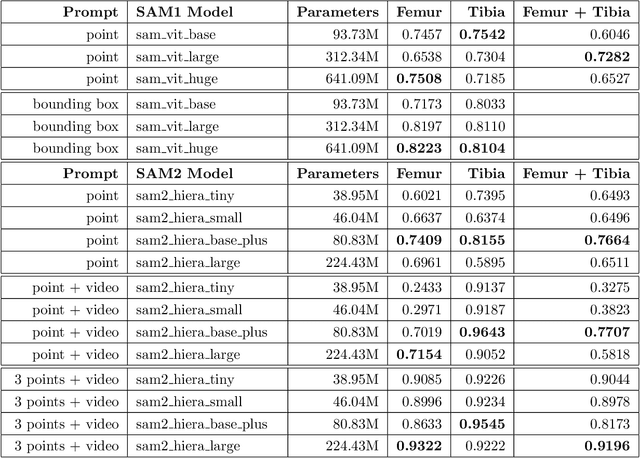
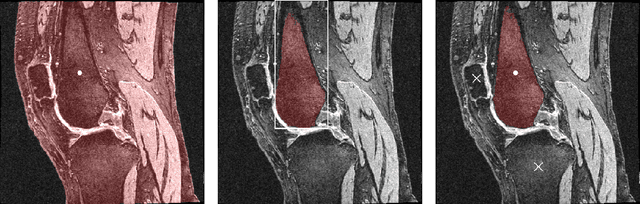
Intelligent medical image segmentation methods are rapidly evolving and being increasingly applied, yet they face the challenge of domain transfer, where algorithm performance degrades due to different data distributions between source and target domains. To address this, we introduce a method for zero-shot, single-prompt segmentation of 3D knee MRI by adapting Segment Anything Model 2 (SAM2), a general-purpose segmentation model designed to accept prompts and retain memory across frames of a video. By treating slices from 3D medical volumes as individual video frames, we leverage SAM2's advanced capabilities to generate motion- and spatially-aware predictions. We demonstrate that SAM2 can efficiently perform segmentation tasks in a zero-shot manner with no additional training or fine-tuning, accurately delineating structures in knee MRI scans using only a single prompt. Our experiments on the Osteoarthritis Initiative Zuse Institute Berlin (OAI-ZIB) dataset reveal that SAM2 achieves high accuracy on 3D knee bone segmentation, with a testing Dice similarity coefficient of 0.9643 on tibia. We also present results generated using different SAM2 model sizes, different prompt schemes, as well as comparative results from the SAM1 model deployed on the same dataset. This breakthrough has the potential to revolutionize medical image analysis by providing a scalable, cost-effective solution for automated segmentation, paving the way for broader clinical applications and streamlined workflows.