 Add to Chrome
 Add to Firefox
 Add to Edge
Test-Time Scaling in Reasoning LLMs: Inference Regimes, Evaluation, and Reproducibility
Aug 04, 2026
Large language models can solve substantially harder reasoning problems with more inference-time compute. The term "test-time scaling," however, now covers diverse inference algorithms that extend deliberation along a single trajectory, sample completed candidates and aggregate them through voting or verification, or search over unfinished partial states. These algorithms differ in their statistical structure, compute accounting, and failure modes. Treating these procedures as interchangeable under a single scalar "budget," or reporting accuracy without the inference protocol that produced it, makes results difficult to compare across studies. We develop a systematic account of test-time scaling along three axes. First, we formalize test-time scaling as budgeted inference over the implicit prefix tree of an autoregressive model and distinguish three structural regimes: single-trajectory sequential scaling, leaf-level scaling with terminal reduction, and prefix-level scaling. Second, we treat the evaluated object as the entire inference system and develop evaluation principles that separate end-to-end system performance from candidate-bank diagnostics. We introduce an evaluation profile whose coordinates and simple functionals recover or bound common repeated-sampling metrics, and prescribe protocol-matched reporting of compute and uncertainty. Third, we specify reproducibility requirements for inference protocols, distinguishing exact replay from distributional reproducibility and identifying the artifacts needed to support each. We also organize the open-weight reasoning ecosystem by model-side and interface mechanisms, apply these principles to broad-knowledge, symbolic-reasoning, and competition-mathematics benchmarks, and assemble over 2 billion full reasoning traces for release with progressively richer verifier and token-level signals.

Don't Pass$\mathtt{@}k$: A Bayesian Framework for Large Language Model Evaluation
Oct 05, 2025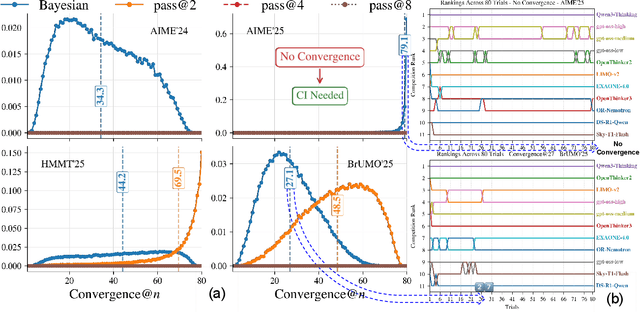

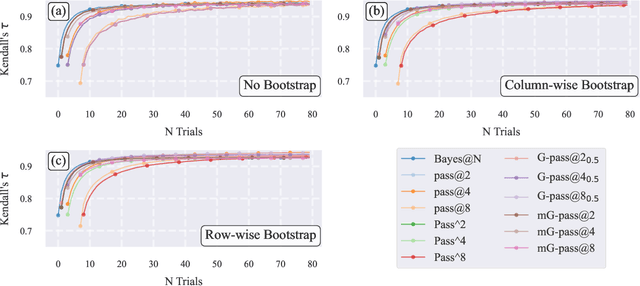
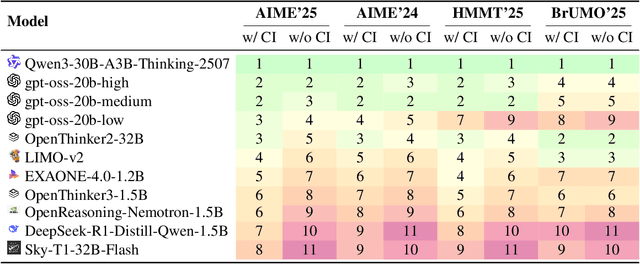
Pass$@k$ is widely used to report performance for LLM reasoning, but it often yields unstable, misleading rankings, especially when the number of trials (samples) is limited and compute is constrained. We present a principled Bayesian evaluation framework that replaces Pass$@k$ and average accuracy over $N$ trials (avg$@N$) with posterior estimates of a model's underlying success probability and credible intervals, yielding stable rankings and a transparent decision rule for differences. Evaluation outcomes are modeled as categorical (not just 0/1) with a Dirichlet prior, giving closed-form expressions for the posterior mean and uncertainty of any weighted rubric and enabling the use of prior evidence when appropriate. Theoretically, under a uniform prior, the Bayesian posterior mean is order-equivalent to average accuracy (Pass$@1$), explaining its empirical robustness while adding principled uncertainty. Empirically, in simulations with known ground-truth success rates and on AIME'24/'25, HMMT'25, and BrUMO'25, the Bayesian/avg procedure achieves faster convergence and greater rank stability than Pass$@k$ and recent variants, enabling reliable comparisons at far smaller sample counts. The framework clarifies when observed gaps are statistically meaningful (non-overlapping credible intervals) versus noise, and it naturally extends to graded, rubric-based evaluations. Together, these results recommend replacing Pass$@k$ for LLM evaluation and ranking with a posterior-based, compute-efficient protocol that unifies binary and non-binary evaluation while making uncertainty explicit. Code is available at https://mohsenhariri.github.io/bayes-kit