 Add to Chrome
 Add to Firefox
 Add to Edge
DBMol: Design of High-Affinity, Target-Specific Small Molecules through Structure Prediction Models
Jul 21, 2026
Designing small molecule ligands that bind with high affinity to specific protein pockets is a fundamental goal in drug discovery, as small molecules constitute a major fraction of approved therapeutics. Recent breakthroughs in structure prediction, such as AlphaFold-3 and Boltz-2, enable accurate biomolecular interaction prediction and show promise as foundation models for downstream tasks, including binding affinity prediction. We propose to leverage these models and introduce DBMol, a new structure predictor-guided framework for de novo small molecule design. DBMol formulates an alternating optimization and projection process. In the optimization stage, DBMol starts from an initial molecule and uses gradient-based optimization to improve pocket-specific interactions and predicted binding affinity using a structure prediction model. In the projection stage, a flow-matching model maps the optimized molecular graph to discrete and chemically valid molecules. Experiments show that DBMol effectively optimizes the Boltz-2 affinity proxy and generates molecules with strong predicted affinity and specificity under Boltz-2 evaluation. To reduce self-confirmation bias, we further evaluate generated molecules using held-out metrics, including AF3-based evaluation. DBMol substantially improves pocket coverage while maintaining molecular diversity over unconditional generation, and is competitive under held-out metrics despite the absence of reference-ligand supervision. These results support the promise of structure prediction models as effective optimization signals for de novo molecular design.

SynLaD: Latent Diffusion for Generating Synthesizable Molecules Conditioned on 3D Pharmacophore Profiles
Jul 01, 2026We present SynLaD, a latent diffusion framework for small-molecule generation that unifies ligand-based drug design objectives (what to make) with synthetic accessibility (how to make it). Current models typically optimize one objective at the expense of the other, creating a bottleneck for discovering high-scoring and synthesizable molecules. SynLaD combines reaction-constrained generation with pharmacophore-conditioned 3D design by learning a latent space that decodes to both 3D structures and synthesis pathways. An encoder maps molecules to a latent representation used by two decoder heads: (i) a geometric head that reconstructs atom types and coordinates and (ii) an autoregressive synthesis head that outputs synthetic routes in a serialized, reaction-based notation. A diffusion transformer generates novel latents in the learned space, conditioned on pharmacophore profiles. Across analogue generation tasks for bioactive ligands, SynLaD outperforms existing baselines in synthesizable and diverse hit generation, demonstrating that a single model can produce shape-aligned molecules with feasible synthesis plans.
General Multimodal Protein Design Enables DNA-Encoding of Chemistry
Apr 06, 2026Evolution is an extraordinary engine for enzymatic diversity, yet the chemistry it has explored remains a narrow slice of what DNA can encode. Deep generative models can design new proteins that bind ligands, but none have created enzymes without pre-specifying catalytic residues. We introduce DISCO (DIffusion for Sequence-structure CO-design), a multimodal model that co-designs protein sequence and 3D structure around arbitrary biomolecules, as well as inference-time scaling methods that optimize objectives across both modalities. Conditioned solely on reactive intermediates, DISCO designs diverse heme enzymes with novel active-site geometries. These enzymes catalyze new-to-nature carbene-transfer reactions, including alkene cyclopropanation, spirocyclopropanation, B-H, and C(sp$^3$)-H insertions, with high activities exceeding those of engineered enzymes. Random mutagenesis of a selected design further confirmed that enzyme activity can be improved through directed evolution. By providing a scalable route to evolvable enzymes, DISCO broadens the potential scope of genetically encodable transformations. Code is available at https://github.com/DISCO-design/DISCO.
Zatom-1: A Multimodal Flow Foundation Model for 3D Molecules and Materials
Feb 24, 2026General-purpose 3D chemical modeling encompasses molecules and materials, requiring both generative and predictive capabilities. However, most existing AI approaches are optimized for a single domain (molecules or materials) and a single task (generation or prediction), which limits representation sharing and transfer. We introduce Zatom-1, the first foundation model that unifies generative and predictive learning of 3D molecules and materials. Zatom-1 is a Transformer trained with a multimodal flow matching objective that jointly models discrete atom types and continuous 3D geometries. This approach supports scalable pretraining with predictable gains as model capacity increases, while enabling fast and stable sampling. We use joint generative pretraining as a universal initialization for downstream multi-task prediction of properties, energies, and forces. Empirically, Zatom-1 matches or outperforms specialized baselines on both generative and predictive benchmarks, while reducing the generative inference time by more than an order of magnitude. Our experiments demonstrate positive predictive transfer between chemical domains from joint generative pretraining: modeling materials during pretraining improves molecular property prediction accuracy.
SynCoGen: Synthesizable 3D Molecule Generation via Joint Reaction and Coordinate Modeling
Jul 16, 2025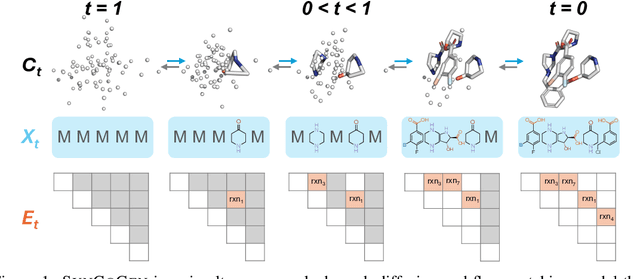
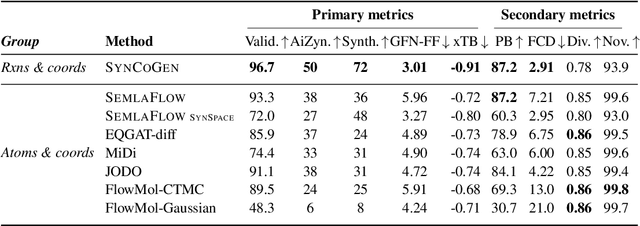
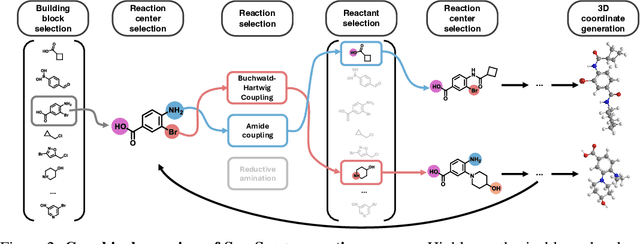
Ensuring synthesizability in generative small molecule design remains a major challenge. While recent developments in synthesizable molecule generation have demonstrated promising results, these efforts have been largely confined to 2D molecular graph representations, limiting the ability to perform geometry-based conditional generation. In this work, we present SynCoGen (Synthesizable Co-Generation), a single framework that combines simultaneous masked graph diffusion and flow matching for synthesizable 3D molecule generation. SynCoGen samples from the joint distribution of molecular building blocks, chemical reactions, and atomic coordinates. To train the model, we curated SynSpace, a dataset containing over 600K synthesis-aware building block graphs and 3.3M conformers. SynCoGen achieves state-of-the-art performance in unconditional small molecule graph and conformer generation, and the model delivers competitive performance in zero-shot molecular linker design for protein ligand generation in drug discovery. Overall, this multimodal formulation represents a foundation for future applications enabled by non-autoregressive molecular generation, including analog expansion, lead optimization, and direct structure conditioning.
TABASCO: A Fast, Simplified Model for Molecular Generation with Improved Physical Quality
Jul 01, 2025State-of-the-art models for 3D molecular generation are based on significant inductive biases, SE(3), permutation equivariance to respect symmetry and graph message-passing networks to capture local chemistry, yet the generated molecules still struggle with physical plausibility. We introduce TABASCO which relaxes these assumptions: The model has a standard non-equivariant transformer architecture, treats atoms in a molecule as sequences and reconstructs bonds deterministically after generation. The absence of equivariant layers and message passing allows us to significantly simplify the model architecture and scale data throughput. On the GEOM-Drugs benchmark TABASCO achieves state-of-the-art PoseBusters validity and delivers inference roughly 10x faster than the strongest baseline, while exhibiting emergent rotational equivariance despite symmetry not being hard-coded. Our work offers a blueprint for training minimalist, high-throughput generative models suited to specialised tasks such as structure- and pharmacophore-based drug design. We provide a link to our implementation at github.com/carlosinator/tabasco.
SynFlowNet: Towards Molecule Design with Guaranteed Synthesis Pathways
May 02, 2024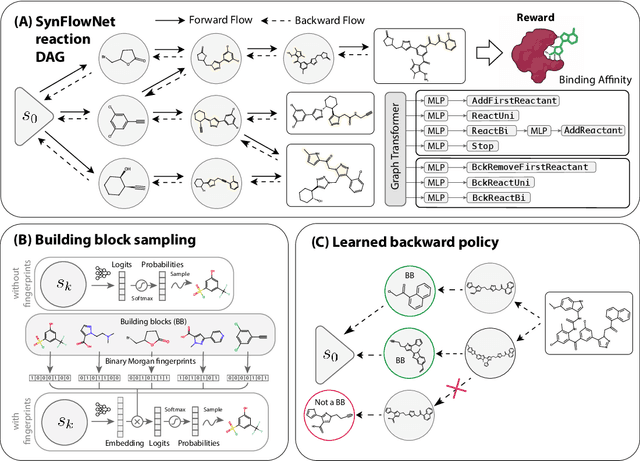


Recent breakthroughs in generative modelling have led to a number of works proposing molecular generation models for drug discovery. While these models perform well at capturing drug-like motifs, they are known to often produce synthetically inaccessible molecules. This is because they are trained to compose atoms or fragments in a way that approximates the training distribution, but they are not explicitly aware of the synthesis constraints that come with making molecules in the lab. To address this issue, we introduce SynFlowNet, a GFlowNet model whose action space uses chemically validated reactions and reactants to sequentially build new molecules. We evaluate our approach using synthetic accessibility scores and an independent retrosynthesis tool. SynFlowNet consistently samples synthetically feasible molecules, while still being able to find diverse and high-utility candidates. Furthermore, we compare molecules designed with SynFlowNet to experimentally validated actives, and find that they show comparable properties of interest, such as molecular weight, SA score and predicted protein binding affinity.