 Add to Chrome
 Add to Firefox
 Add to Edge
GoLongRL: Capability-Oriented Long Context Reinforcement Learning with Multitask Alignment
May 19, 2026
We present GoLongRL, a fully open-source, capability-oriented post-training recipe for long-context reinforcement learning with verifiable rewards (RLVR). Existing long-context RL methods often treat data construction as a matter of designing increasingly complex retrieval paths, leading to homogeneous task coverage and reward formulations that inadequately reflect practical long-context requirements. Our work offers two contributions. (1) Capability-oriented data construction with full open release. We openly release a dataset of 23K RLVR samples, the complete construction pipeline, and all training code. Guided by a taxonomy of long-context capabilities, the dataset spans 9 task types, each paired with its natural evaluation metric. It comprises curated open-source samples from established corpora and synthetic samples whose QA pairs are generated from real source documents such as books, academic papers, and multi-turn dialogues. Under the same vanilla GRPO setup, our dataset alone outperforms the closed-source QwenLong-L1.5 dataset. Moreover, our Qwen3-30B-A3B model trained on this data delivers long-context performance comparable to DeepSeek-R1-0528 and Qwen3-235B-A22B-Thinking-2507, suggesting that broader coverage and greater reward diversity substantially benefit long-context capability improvement. (2) TMN-Reweight for heterogeneous multitask optimization. To address optimization challenges from heterogeneous rewards, we propose TMN-Reweight, which combines task-level mean normalization for cross-task reward scale alignment with difficulty-adaptive weighting for more reliable advantage estimation. TMN-Reweight further improves average performance over vanilla GRPO, with general capabilities preserved or improved across reported evaluations.

Kwai Summary Attention Technical Report
Apr 27, 2026Long-context ability, has become one of the most important iteration direction of next-generation Large Language Models, particularly in semantic understanding/reasoning, code agentic intelligence and recommendation system. However, the standard softmax attention exhibits quadratic time complexity with respect to sequence length. As the sequence length increases, this incurs substantial overhead in long-context settings, leading the training and inference costs of extremely long sequences deteriorate rapidly. Existing solutions mitigate this issue through two technique routings: i) Reducing the KV cache per layer, such as from the head-level compression GQA, and the embedding dimension-level compression MLA, but the KV cache remains linearly dependent on the sequence length at a 1:1 ratio. ii) Interleaving with KV Cache friendly architecture, such as local attention SWA, linear kernel GDN, but often involve trade-offs among KV Cache and long-context modeling effectiveness. Besides the two technique routings, we argue that there exists an intermediate path not well explored: {Maintaining a linear relationship between the KV cache and sequence length, but performing semantic-level compression through a specific ratio $k$}. This $O(n/k)$ path does not pursue a ``minimum KV cache'', but rather trades acceptable memory costs for complete, referential, and interpretable retention of long distant dependency. Motivated by this, we propose Kwai Summary Attention (KSA), a novel attention mechanism that reduces sequence modeling cost by compressing historical contexts into learnable summary tokens.
Good Reasoning Makes Good Demonstrations: Implicit Reasoning Quality Supervision via In-Context Reinforcement Learning
Mar 10, 2026Reinforcement Learning with Verifiable Rewards (RLVR) improves reasoning in large language models but treats all correct solutions equally, potentially reinforcing flawed traces that get correct answers by chance. We observe that better reasoning are better teachers: high-quality solutions serve as more effective demonstrations than low-quality ones. We term this teaching ability Demonstration Utility, and show that the policy model's own in-context learning ability provides an efficient way to measure it, yielding a quality signal termed Evidence Gain. To employ this signal during training, we introduce In-Context RLVR. By Bayesian analysis, we show that this objective implicitly reweights rewards by Evidence Gain, assigning higher weights to high-quality traces and lower weights to low-quality ones, without requiring costly computation or external evaluators. Experiments on mathematical benchmarks show improvements in both accuracy and reasoning quality over standard RLVR.
Finedeep: Mitigating Sparse Activation in Dense LLMs via Multi-Layer Fine-Grained Experts
Feb 18, 2025
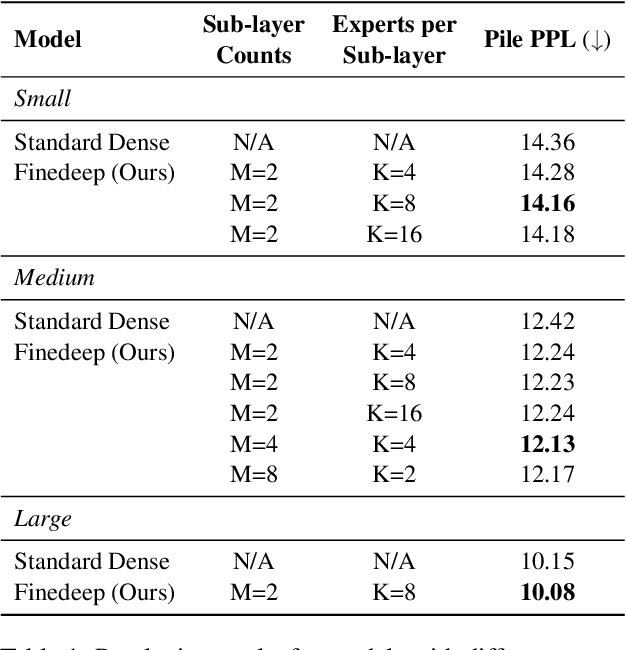


Large language models have demonstrated exceptional performance across a wide range of tasks. However, dense models usually suffer from sparse activation, where many activation values tend towards zero (i.e., being inactivated). We argue that this could restrict the efficient exploration of model representation space. To mitigate this issue, we propose Finedeep, a deep-layered fine-grained expert architecture for dense models. Our framework partitions the feed-forward neural network layers of traditional dense models into small experts, arranges them across multiple sub-layers. A novel routing mechanism is proposed to determine each expert's contribution. We conduct extensive experiments across various model sizes, demonstrating that our approach significantly outperforms traditional dense architectures in terms of perplexity and benchmark performance while maintaining a comparable number of parameters and floating-point operations. Moreover, we find that Finedeep achieves optimal results when balancing depth and width, specifically by adjusting the number of expert sub-layers and the number of experts per sub-layer. Empirical results confirm that Finedeep effectively alleviates sparse activation and efficiently utilizes representation capacity in dense models.
DSMoE: Matrix-Partitioned Experts with Dynamic Routing for Computation-Efficient Dense LLMs
Feb 18, 2025As large language models continue to scale, computational costs and resource consumption have emerged as significant challenges. While existing sparsification methods like pruning reduce computational overhead, they risk losing model knowledge through parameter removal. This paper proposes DSMoE (Dynamic Sparse Mixture-of-Experts), a novel approach that achieves sparsification by partitioning pre-trained FFN layers into computational blocks. We implement adaptive expert routing using sigmoid activation and straight-through estimators, enabling tokens to flexibly access different aspects of model knowledge based on input complexity. Additionally, we introduce a sparsity loss term to balance performance and computational efficiency. Extensive experiments on LLaMA models demonstrate that under equivalent computational constraints, DSMoE achieves superior performance compared to existing pruning and MoE approaches across language modeling and downstream tasks, particularly excelling in generation tasks. Analysis reveals that DSMoE learns distinctive layerwise activation patterns, providing new insights for future MoE architecture design.
CartesianMoE: Boosting Knowledge Sharing among Experts via Cartesian Product Routing in Mixture-of-Experts
Oct 21, 2024Large language models (LLM) have been attracting much attention from the community recently, due to their remarkable performance in all kinds of downstream tasks. According to the well-known scaling law, scaling up a dense LLM enhances its capabilities, but also significantly increases the computational complexity. Mixture-of-Experts (MoE) models address that by allowing the model size to grow without substantially raising training or inference costs. Yet MoE models face challenges regarding knowledge sharing among experts, making their performance somehow sensitive to routing accuracy. To tackle that, previous works introduced shared experts and combined their outputs with those of the top $K$ routed experts in an ``addition'' manner. In this paper, inspired by collective matrix factorization to learn shared knowledge among data, we propose CartesianMoE, which implements more effective knowledge sharing among experts in more like a ``multiplication'' manner. Extensive experimental results indicate that CartesianMoE outperforms previous MoE models for building LLMs, in terms of both perplexity and downstream task performance. And we also find that CartesianMoE achieves better expert routing robustness.
CT-GAT: Cross-Task Generative Adversarial Attack based on Transferability
Nov 05, 2023
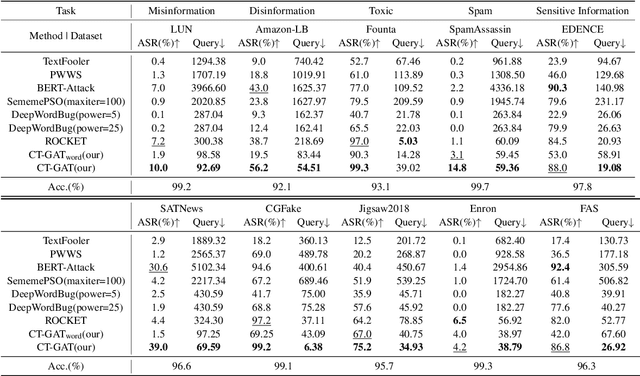
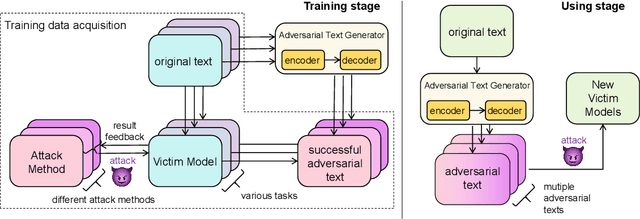
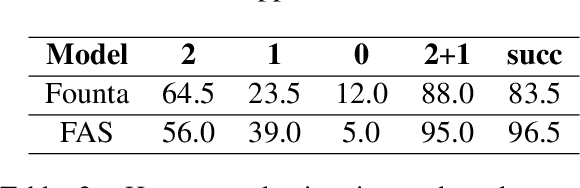
Neural network models are vulnerable to adversarial examples, and adversarial transferability further increases the risk of adversarial attacks. Current methods based on transferability often rely on substitute models, which can be impractical and costly in real-world scenarios due to the unavailability of training data and the victim model's structural details. In this paper, we propose a novel approach that directly constructs adversarial examples by extracting transferable features across various tasks. Our key insight is that adversarial transferability can extend across different tasks. Specifically, we train a sequence-to-sequence generative model named CT-GAT using adversarial sample data collected from multiple tasks to acquire universal adversarial features and generate adversarial examples for different tasks. We conduct experiments on ten distinct datasets, and the results demonstrate that our method achieves superior attack performance with small cost.
MeaeQ: Mount Model Extraction Attacks with Efficient Queries
Oct 21, 2023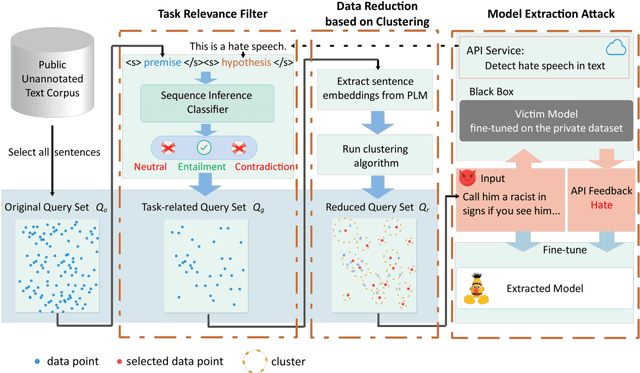
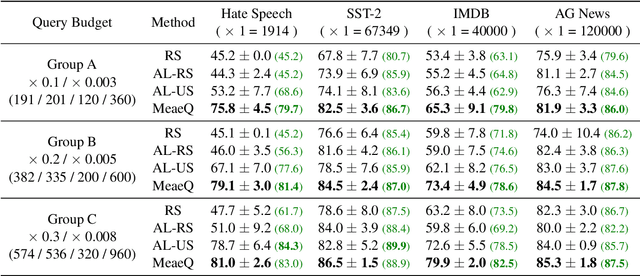
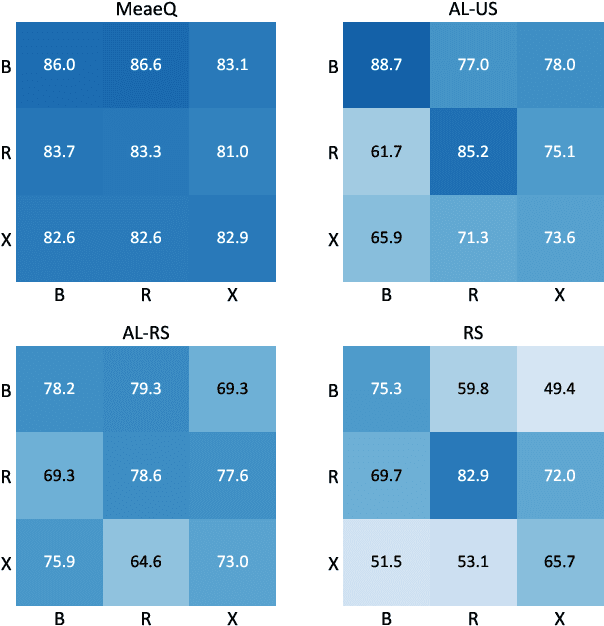
We study model extraction attacks in natural language processing (NLP) where attackers aim to steal victim models by repeatedly querying the open Application Programming Interfaces (APIs). Recent works focus on limited-query budget settings and adopt random sampling or active learning-based sampling strategies on publicly available, unannotated data sources. However, these methods often result in selected queries that lack task relevance and data diversity, leading to limited success in achieving satisfactory results with low query costs. In this paper, we propose MeaeQ (Model extraction attack with efficient Queries), a straightforward yet effective method to address these issues. Specifically, we initially utilize a zero-shot sequence inference classifier, combined with API service information, to filter task-relevant data from a public text corpus instead of a problem domain-specific dataset. Furthermore, we employ a clustering-based data reduction technique to obtain representative data as queries for the attack. Extensive experiments conducted on four benchmark datasets demonstrate that MeaeQ achieves higher functional similarity to the victim model than baselines while requiring fewer queries. Our code is available at https://github.com/C-W-D/MeaeQ.