 Add to Chrome
 Add to Firefox
 Add to Edge
HiFloat4 Format for Language Model Inference
Feb 13, 2026
This paper introduces HiFloat4 (HiF4), a block floating-point data format tailored for deep learning. Each HiF4 unit packs 64 4-bit elements with 32 bits of shared scaling metadata, averaging 4.5 bits per value. The metadata specifies a three-level scaling hierarchy, capturing inter- and intra-group dynamic range while improving the utilization of the representational space. In addition, the large 64-element group size enables matrix multiplications to be executed in a highly fixed-point manner, significantly reducing hardware area and power consumption. To evaluate the proposed format, we conducted inference experiments on several language models, including LLaMA, Qwen, Mistral, DeepSeek-V3.1 and LongCat. Results show that HiF4 achieves higher average accuracy than the state-of-the-art NVFP4 format across multiple models and diverse downstream tasks.

MedMimic: Physician-Inspired Multimodal Fusion for Early Diagnosis of Fever of Unknown Origin
Feb 07, 2025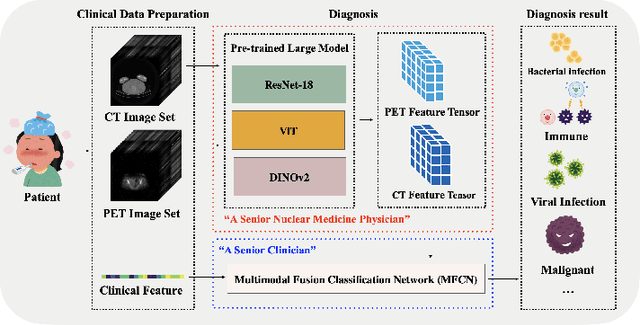
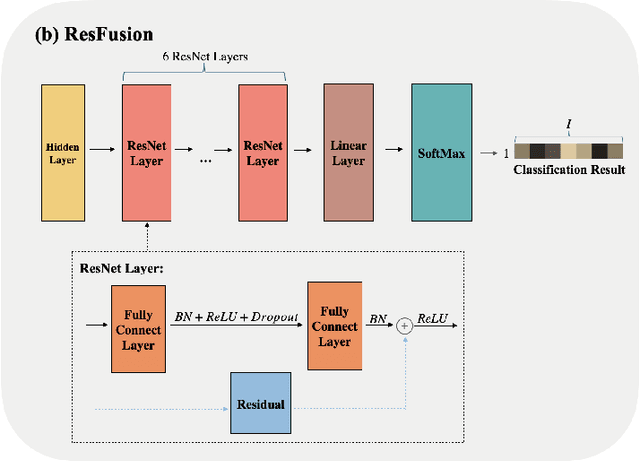
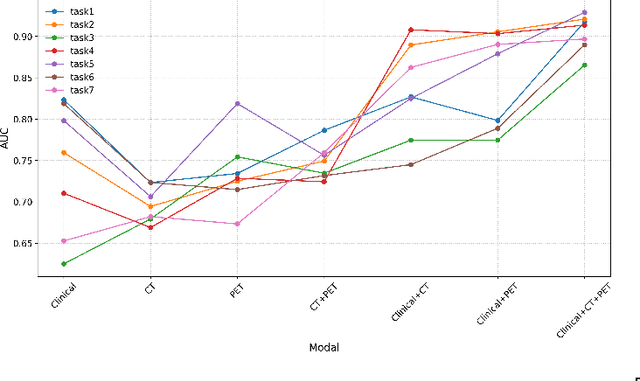
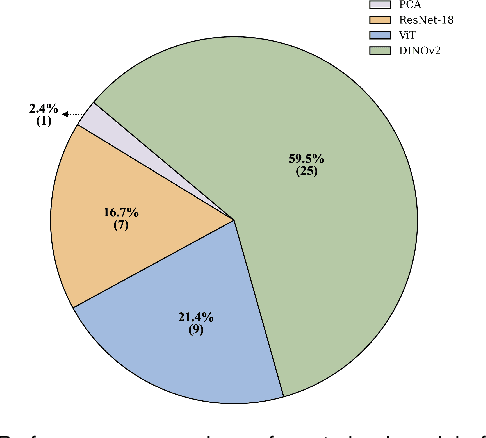
Fever of unknown origin FUO remains a diagnostic challenge. MedMimic is introduced as a multimodal framework inspired by real-world diagnostic processes. It uses pretrained models such as DINOv2, Vision Transformer, and ResNet-18 to convert high-dimensional 18F-FDG PET/CT imaging into low-dimensional, semantically meaningful features. A learnable self-attention-based fusion network then integrates these imaging features with clinical data for classification. Using 416 FUO patient cases from Sichuan University West China Hospital from 2017 to 2023, the multimodal fusion classification network MFCN achieved macro-AUROC scores ranging from 0.8654 to 0.9291 across seven tasks, outperforming conventional machine learning and single-modality deep learning methods. Ablation studies and five-fold cross-validation further validated its effectiveness. By combining the strengths of pretrained large models and deep learning, MedMimic offers a promising solution for disease classification.
Ascend HiFloat8 Format for Deep Learning
Sep 26, 2024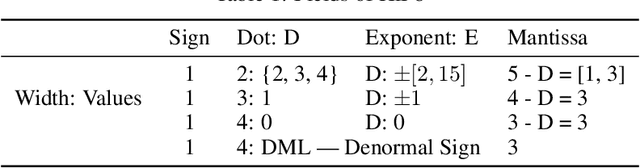

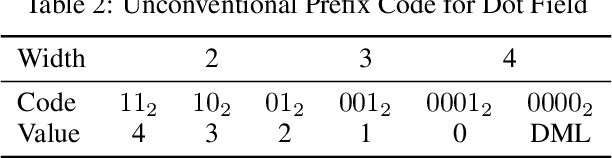

This preliminary white paper proposes a novel 8-bit floating-point data format HiFloat8 (abbreviated as HiF8) for deep learning. HiF8 features tapered precision. For normal value encoding, it provides 7 exponent values with 3-bit mantissa, 8 exponent values with 2-bit mantissa, and 16 exponent values with 1-bit mantissa. For denormal value encoding, it extends the dynamic range by 7 extra powers of 2, from 31 to 38 binades (notice that FP16 covers 40 binades). Meanwhile, HiF8 encodes all the special values except that positive zero and negative zero are represented by only one bit-pattern. Thanks to the better balance between precision and dynamic range, HiF8 can be simultaneously used in both forward and backward passes of AI training. In this paper, we will describe the definition and rounding methods of HiF8, as well as the tentative training and inference solutions. To demonstrate the efficacy of HiF8, massive simulation results on various neural networks, including traditional neural networks and large language models (LLMs), will also be presented.