 Add to Chrome
 Add to Firefox
 Add to Edge
Hyrax: An Extensible Framework for Rapid ML Experimentation and Unsupervised Discovery in the Era of Rubin, Roman, and Euclid
May 18, 2026
The NSF-DOE Vera C. Rubin Observatory, Roman Space Telescope, Euclid, and other next-generation surveys will deliver imaging, spectroscopic, and time-domain data at scales that increasingly shift the bottleneck in astronomical machine learning (ML) projects from model design to infrastructure. We present Hyrax, an open-source, modular, GPU-enabled Python framework that supports the full ML lifecycle in astronomy: from data acquisition and training to inference and experiment comparison, with capabilities including multimodal dataset support, integrated vector databases for similarity search, and interactive two- and three-dimensional latent-space exploration for unsupervised discovery. We demonstrate Hyrax's versatility through five representative applications on real survey data: (i) unsupervised representation learning on $\sim 4\times10^5$ Rubin Legacy Survey of Space and Time (LSST) Data Preview 1 (DP1) galaxies, surfacing new merger and low-surface-brightness candidates missing from reference Euclid and Dark Energy Survey catalogs, while also isolating imaging artifacts -- all without labeled training data; (ii) hybrid density-based clustering for identifying cluster-scale gravitational lens candidates in DP1 data; (iii) multimodal early-time transient classification in the Zwicky Transient Facility leveraging light curves, spectra, images, and metadata; (iv) supervised false-positive filtering in shift-and-stack searches for distant solar system objects in the Dark Energy Camera Ecliptic Exploration Project survey; and (v) supervised detection of semi-resolved dwarf galaxies in Hyper Suprime-Cam and LSST-like imaging using synthetic source injection. Together, these results demonstrate that Hyrax provides astronomy-specific ML infrastructure that enables systematic discovery and rapid methodological iteration across next-generation astronomical surveys.

Opportunities in AI/ML for the Rubin LSST Dark Energy Science Collaboration
Jan 20, 2026The Vera C. Rubin Observatory's Legacy Survey of Space and Time (LSST) will produce unprecedented volumes of heterogeneous astronomical data (images, catalogs, and alerts) that challenge traditional analysis pipelines. The LSST Dark Energy Science Collaboration (DESC) aims to derive robust constraints on dark energy and dark matter from these data, requiring methods that are statistically powerful, scalable, and operationally reliable. Artificial intelligence and machine learning (AI/ML) are already embedded across DESC science workflows, from photometric redshifts and transient classification to weak lensing inference and cosmological simulations. Yet their utility for precision cosmology hinges on trustworthy uncertainty quantification, robustness to covariate shift and model misspecification, and reproducible integration within scientific pipelines. This white paper surveys the current landscape of AI/ML across DESC's primary cosmological probes and cross-cutting analyses, revealing that the same core methodologies and fundamental challenges recur across disparate science cases. Since progress on these cross-cutting challenges would benefit multiple probes simultaneously, we identify key methodological research priorities, including Bayesian inference at scale, physics-informed methods, validation frameworks, and active learning for discovery. With an eye on emerging techniques, we also explore the potential of the latest foundation model methodologies and LLM-driven agentic AI systems to reshape DESC workflows, provided their deployment is coupled with rigorous evaluation and governance. Finally, we discuss critical software, computing, data infrastructure, and human capital requirements for the successful deployment of these new methodologies, and consider associated risks and opportunities for broader coordination with external actors.
Pre-training vision models for the classification of alerts from wide-field time-domain surveys
Dec 12, 2025Modern wide-field time-domain surveys facilitate the study of transient, variable and moving phenomena by conducting image differencing and relaying alerts to their communities. Machine learning tools have been used on data from these surveys and their precursors for more than a decade, and convolutional neural networks (CNNs), which make predictions directly from input images, saw particularly broad adoption through the 2010s. Since then, continually rapid advances in computer vision have transformed the standard practices around using such models. It is now commonplace to use standardized architectures pre-trained on large corpora of everyday images (e.g., ImageNet). In contrast, time-domain astronomy studies still typically design custom CNN architectures and train them from scratch. Here, we explore the affects of adopting various pre-training regimens and standardized model architectures on the performance of alert classification. We find that the resulting models match or outperform a custom, specialized CNN like what is typically used for filtering alerts. Moreover, our results show that pre-training on galaxy images from Galaxy Zoo tends to yield better performance than pre-training on ImageNet or training from scratch. We observe that the design of standardized architectures are much better optimized than the custom CNN baseline, requiring significantly less time and memory for inference despite having more trainable parameters. On the eve of the Legacy Survey of Space and Time and other image-differencing surveys, these findings advocate for a paradigm shift in the creation of vision models for alerts, demonstrating that greater performance and efficiency, in time and in data, can be achieved by adopting the latest practices from the computer vision field.
A Neural Network-Based Search for Unmodeled Transients in LIGO-Virgo-KAGRA's Third Observing Run
Dec 27, 2024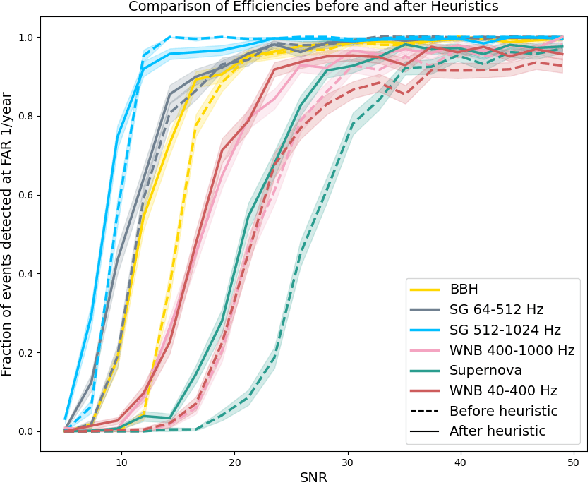
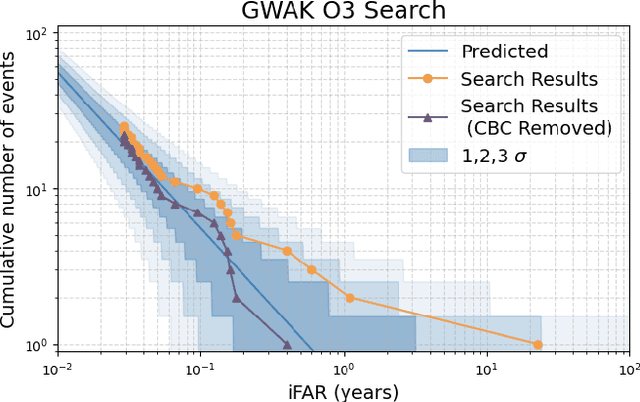
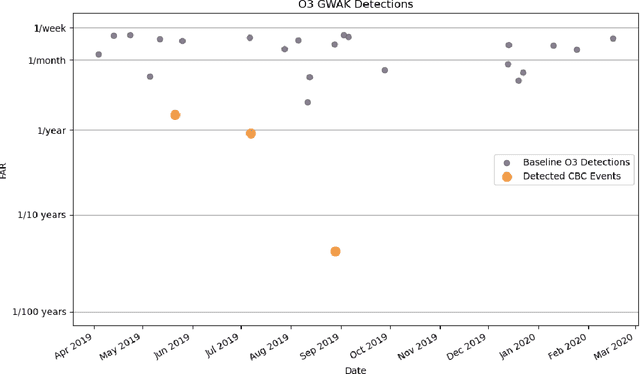

This paper presents the results of a Neural Network (NN)-based search for short-duration gravitational-wave transients in data from the third observing run of LIGO, Virgo, and KAGRA. The search targets unmodeled transients with durations of milliseconds to a few seconds in the 30-1500 Hz frequency band, without assumptions about the incoming signal direction, polarization, or morphology. Using the Gravitational Wave Anomalous Knowledge (GWAK) method, three compact binary coalescences (CBCs) identified by existing pipelines are successfully detected, along with a range of detector glitches. The algorithm constructs a low-dimensional embedded space to capture the physical features of signals, enabling the detection of CBCs, detector glitches, and unmodeled transients. This study demonstrates GWAK's ability to enhance gravitational-wave searches beyond the limits of existing pipelines, laying the groundwork for future detection strategies.
Rapid Likelihood Free Inference of Compact Binary Coalescences using Accelerated Hardware
Jul 26, 2024
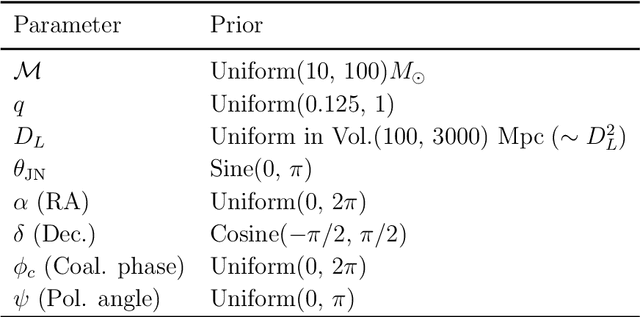


We report a gravitational-wave parameter estimation algorithm, AMPLFI, based on likelihood-free inference using normalizing flows. The focus of AMPLFI is to perform real-time parameter estimation for candidates detected by machine-learning based compact binary coalescence search, Aframe. We present details of our algorithm and optimizations done related to data-loading and pre-processing on accelerated hardware. We train our model using binary black-hole (BBH) simulations on real LIGO-Virgo detector noise. Our model has $\sim 6$ million trainable parameters with training times $\lesssim 24$ hours. Based on online deployment on a mock data stream of LIGO-Virgo data, Aframe + AMPLFI is able to pick up BBH candidates and infer parameters for real-time alerts from data acquisition with a net latency of $\sim 6$s.
Optimizing Likelihood-free Inference using Self-supervised Neural Symmetry Embeddings
Dec 11, 2023Likelihood-free inference is quickly emerging as a powerful tool to perform fast/effective parameter estimation. We demonstrate a technique of optimizing likelihood-free inference to make it even faster by marginalizing symmetries in a physical problem. In this approach, physical symmetries, for example, time-translation are learned using joint-embedding via self-supervised learning with symmetry data augmentations. Subsequently, parameter inference is performed using a normalizing flow where the embedding network is used to summarize the data before conditioning the parameters. We present this approach on two simple physical problems and we show faster convergence in a smaller number of parameters compared to a normalizing flow that does not use a pre-trained symmetry-informed representation.
Tails: Chasing Comets with the Zwicky Transient Facility and Deep Learning
Feb 26, 2021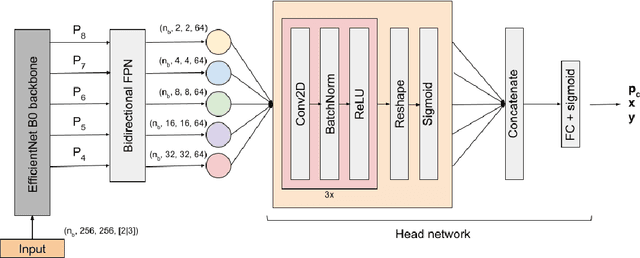

We present Tails, an open-source deep-learning framework for the identification and localization of comets in the image data of the Zwicky Transient Facility (ZTF), a robotic optical time-domain survey currently in operation at the Palomar Observatory in California, USA. Tails employs a custom EfficientDet-based architecture and is capable of finding comets in single images in near real time, rather than requiring multiple epochs as with traditional methods. The system achieves state-of-the-art performance with 99% recall, 0.01% false positive rate, and 1-2 pixel root mean square error in the predicted position. We report the initial results of the Tails efficiency evaluation in a production setting on the data of the ZTF Twilight survey, including the first AI-assisted discovery of a comet (C/2020 T2) and the recovery of a comet (P/2016 J3 = P/2021 A3).