 Add to Chrome
 Add to Firefox
 Add to Edge
Leveraging Multimodality for Real-Time Classification of Transients and Variables found by the Zwicky Transient Facility
Jun 30, 2026
Modern time-domain surveys such as the Zwicky Transient Facility (ZTF) generate hundreds of thousands of alerts each night, making real-time decisions for follow-up observations a central challenge in time-domain astronomy. Robust early classification is crucial for making informed decisions, but is hindered by sparse light curves and degeneracies between classes. In this work, we leverage multimodality to substantially improve real-time classification and demonstrate the practicality of our approach by deploying our model on the ZTF alert stream. Building on the Online Ranked Astrophysical CLass Estimator (ORACLE), we introduce the ORACLE-2 models, which combine light curves, metadata, and images for real-time hierarchical classification. Using both real and simulated datasets, we show that incorporating additional modalities consistently improves classification performance. On observations from ZTF's Bright Transient Survey, our best-performing model, ORACLE-2 Omni, achieves a macro F1 score of 0.73 -- an improvement of up to 11% over models using light curves and metadata alone, and up to 40% over light-curve-only models, with the strongest gains realized at early times. To demonstrate applicability to the Legacy Survey of Space and Time, which will increase alert volume by more than an order of magnitude, we train a light curve + metadata variant on the simulated ELAsTiCC dataset. This model achieves a macro F1 score of 0.88, an improvement of up to 13% over the light-curve-only variant, matching the performance of other state-of-the-art models. Finally, we quantify the trade-offs between performance and throughput, identifying regimes where multimodal approaches offer the greatest benefit. These results show that combining multiple modalities improves early-time classification, enabling more effective triage of high-volume alert streams for current and future time-domain surveys.

SELDON: Supernova Explosions Learned by Deep ODE Networks
Mar 04, 2026The discovery rate of optical transients will explode to 10 million public alerts per night once the Vera C. Rubin Observatory's Legacy Survey of Space and Time comes online, overwhelming the traditional physics-based inference pipelines. A continuous-time forecasting AI model is of interest because it can deliver millisecond-scale inference for thousands of objects per day, whereas legacy MCMC codes need hours per object. In this paper, we propose SELDON, a new continuous-time variational autoencoder for panels of sparse and irregularly time-sampled (gappy) astrophysical light curves that are nonstationary, heteroscedastic, and inherently dependent. SELDON combines a masked GRU-ODE encoder with a latent neural ODE propagator and an interpretable Gaussian-basis decoder. The encoder learns to summarize panels of imbalanced and correlated data even when only a handful of points are observed. The neural ODE then integrates this hidden state forward in continuous time, extrapolating to future unseen epochs. This extrapolated time series is further encoded by deep sets to a latent distribution that is decoded to a weighted sum of Gaussian basis functions, the parameters of which are physically meaningful. Such parameters (e.g., rise time, decay rate, peak flux) directly drive downstream prioritization of spectroscopic follow-up for astrophysical surveys. Beyond astronomy, the architecture of SELDON offers a generic recipe for interpretable and continuous-time sequence modeling in any time domain where data are multivariate, sparse, heteroscedastic, and irregularly spaced.
Opportunities in AI/ML for the Rubin LSST Dark Energy Science Collaboration
Jan 20, 2026The Vera C. Rubin Observatory's Legacy Survey of Space and Time (LSST) will produce unprecedented volumes of heterogeneous astronomical data (images, catalogs, and alerts) that challenge traditional analysis pipelines. The LSST Dark Energy Science Collaboration (DESC) aims to derive robust constraints on dark energy and dark matter from these data, requiring methods that are statistically powerful, scalable, and operationally reliable. Artificial intelligence and machine learning (AI/ML) are already embedded across DESC science workflows, from photometric redshifts and transient classification to weak lensing inference and cosmological simulations. Yet their utility for precision cosmology hinges on trustworthy uncertainty quantification, robustness to covariate shift and model misspecification, and reproducible integration within scientific pipelines. This white paper surveys the current landscape of AI/ML across DESC's primary cosmological probes and cross-cutting analyses, revealing that the same core methodologies and fundamental challenges recur across disparate science cases. Since progress on these cross-cutting challenges would benefit multiple probes simultaneously, we identify key methodological research priorities, including Bayesian inference at scale, physics-informed methods, validation frameworks, and active learning for discovery. With an eye on emerging techniques, we also explore the potential of the latest foundation model methodologies and LLM-driven agentic AI systems to reshape DESC workflows, provided their deployment is coupled with rigorous evaluation and governance. Finally, we discuss critical software, computing, data infrastructure, and human capital requirements for the successful deployment of these new methodologies, and consider associated risks and opportunities for broader coordination with external actors.
Pre-training vision models for the classification of alerts from wide-field time-domain surveys
Dec 12, 2025Modern wide-field time-domain surveys facilitate the study of transient, variable and moving phenomena by conducting image differencing and relaying alerts to their communities. Machine learning tools have been used on data from these surveys and their precursors for more than a decade, and convolutional neural networks (CNNs), which make predictions directly from input images, saw particularly broad adoption through the 2010s. Since then, continually rapid advances in computer vision have transformed the standard practices around using such models. It is now commonplace to use standardized architectures pre-trained on large corpora of everyday images (e.g., ImageNet). In contrast, time-domain astronomy studies still typically design custom CNN architectures and train them from scratch. Here, we explore the affects of adopting various pre-training regimens and standardized model architectures on the performance of alert classification. We find that the resulting models match or outperform a custom, specialized CNN like what is typically used for filtering alerts. Moreover, our results show that pre-training on galaxy images from Galaxy Zoo tends to yield better performance than pre-training on ImageNet or training from scratch. We observe that the design of standardized architectures are much better optimized than the custom CNN baseline, requiring significantly less time and memory for inference despite having more trainable parameters. On the eve of the Legacy Survey of Space and Time and other image-differencing surveys, these findings advocate for a paradigm shift in the creation of vision models for alerts, demonstrating that greater performance and efficiency, in time and in data, can be achieved by adopting the latest practices from the computer vision field.
ORACLE: A Real-Time, Hierarchical, Deep-Learning Photometric Classifier for the LSST
Jan 02, 2025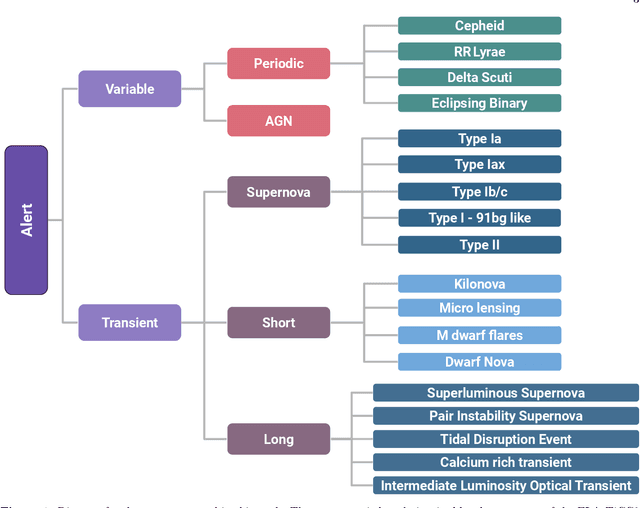
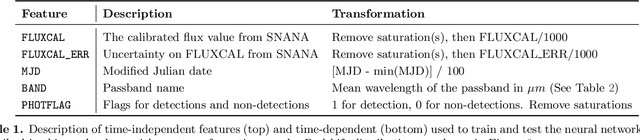
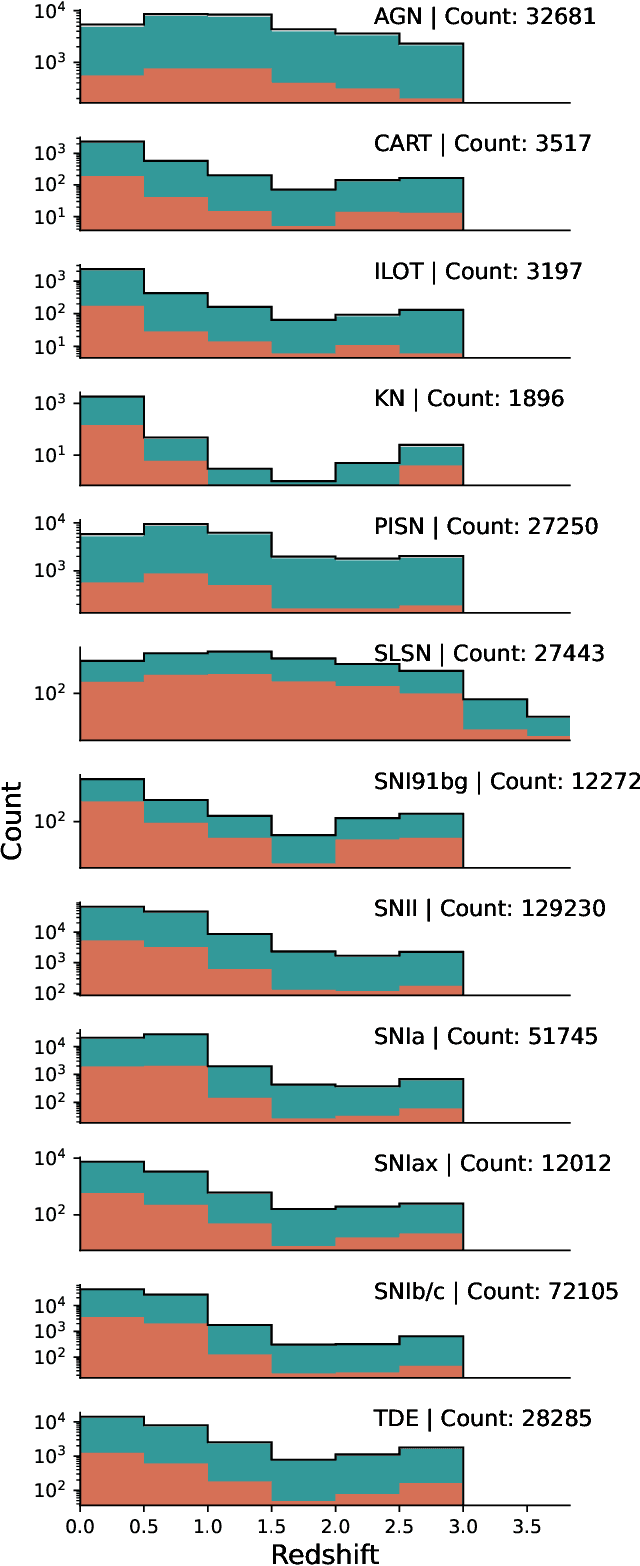
We present ORACLE, the first hierarchical deep-learning model for real-time, context-aware classification of transient and variable astrophysical phenomena. ORACLE is a recurrent neural network with Gated Recurrent Units (GRUs), and has been trained using a custom hierarchical cross-entropy loss function to provide high-confidence classifications along an observationally-driven taxonomy with as little as a single photometric observation. Contextual information for each object, including host galaxy photometric redshift, offset, ellipticity and brightness, is concatenated to the light curve embedding and used to make a final prediction. Training on $\sim$0.5M events from the Extended LSST Astronomical Time-Series Classification Challenge, we achieve a top-level (Transient vs Variable) macro-averaged precision of 0.96 using only 1 day of photometric observations after the first detection in addition to contextual information, for each event; this increases to $>$0.99 once 64 days of the light curve has been obtained, and 0.83 at 1024 days after first detection for 19-way classification (including supernova sub-types, active galactic nuclei, variable stars, microlensing events, and kilonovae). We also compare ORACLE with other state-of-the-art classifiers and report comparable performance for the 19-way classification task, in addition to delivering accurate top-level classifications much earlier. The code and model weights used in this work are publicly available at our associated GitHub repository (https://github.com/uiucsn/ELAsTiCC-Classification).