 Add to Chrome
 Add to Firefox
 Add to Edge
Machine Learning on Heterogeneous, Edge, and Quantum Hardware for Particle Physics (ML-HEQUPP)
Feb 24, 2026
The next generation of particle physics experiments will face a new era of challenges in data acquisition, due to unprecedented data rates and volumes along with extreme environments and operational constraints. Harnessing this data for scientific discovery demands real-time inference and decision-making, intelligent data reduction, and efficient processing architectures beyond current capabilities. Crucial to the success of this experimental paradigm are several emerging technologies, such as artificial intelligence and machine learning (AI/ML) and silicon microelectronics, and the advent of quantum algorithms and processing. Their intersection includes areas of research such as low-power and low-latency devices for edge computing, heterogeneous accelerator systems, reconfigurable hardware, novel codesign and synthesis strategies, readout for cryogenic or high-radiation environments, and analog computing. This white paper presents a community-driven vision to identify and prioritize research and development opportunities in hardware-based ML systems and corresponding physics applications, contributing towards a successful transition to the new data frontier of fundamental science.

Enabling Low-Latency Machine learning on Radiation-Hard FPGAs with hls4ml
Feb 17, 2026This paper presents the first demonstration of a viable, ultra-fast, radiation-hard machine learning (ML) application on FPGAs, which could be used in future high-energy physics experiments. We present a three-fold contribution, with the PicoCal calorimeter, planned for the LHCb Upgrade II experiment, used as a test case. First, we develop a lightweight autoencoder to compress a 32-sample timing readout, representative of that of the PicoCal, into a two-dimensional latent space. Second, we introduce a systematic, hardware-aware quantization strategy and show that the model can be reduced to 10-bit weights with minimal performance loss. Third, as a barrier to the adoption of on-detector ML is the lack of support for radiation-hard FPGAs in the High-Energy Physics community's standard ML synthesis tool, hls4ml, we develop a new backend for this library. This new back-end enables the automatic translation of ML models into High-Level Synthesis (HLS) projects for the Microchip PolarFire family of FPGAs, one of the few commercially available and radiation hard FPGAs. We present the synthesis of the autoencoder on a target PolarFire FPGA, which indicates that a latency of 25 ns can be achieved. We show that the resources utilized are low enough that the model can be placed within the inherently protected logic of the FPGA. Our extension to hls4ml is a significant contribution, paving the way for broader adoption of ML on FPGAs in high-radiation environments.
A Neural Network-Based Search for Unmodeled Transients in LIGO-Virgo-KAGRA's Third Observing Run
Dec 27, 2024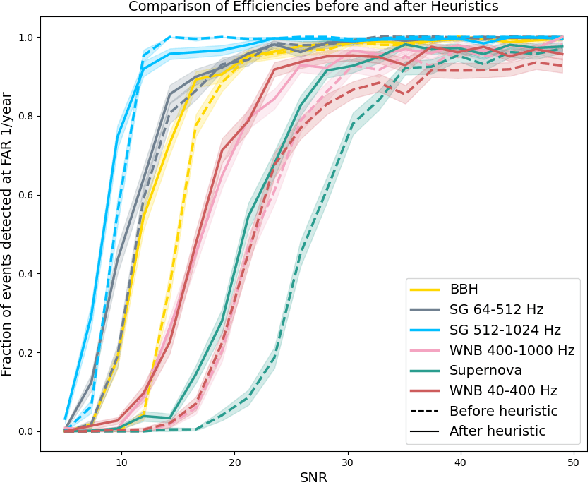
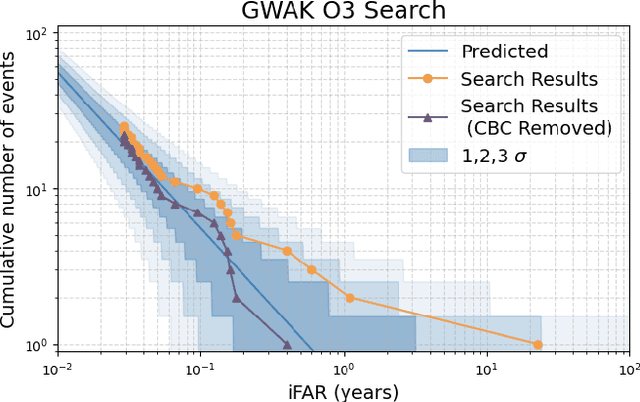
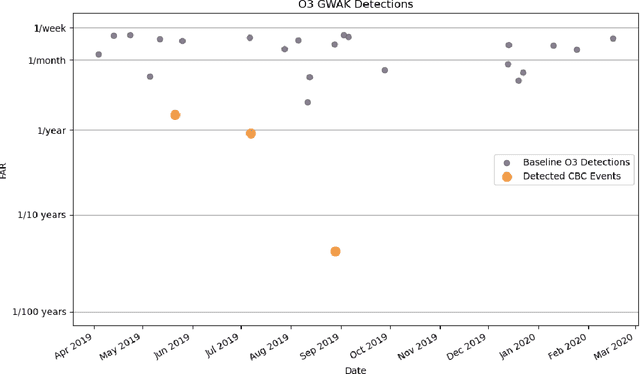

This paper presents the results of a Neural Network (NN)-based search for short-duration gravitational-wave transients in data from the third observing run of LIGO, Virgo, and KAGRA. The search targets unmodeled transients with durations of milliseconds to a few seconds in the 30-1500 Hz frequency band, without assumptions about the incoming signal direction, polarization, or morphology. Using the Gravitational Wave Anomalous Knowledge (GWAK) method, three compact binary coalescences (CBCs) identified by existing pipelines are successfully detected, along with a range of detector glitches. The algorithm constructs a low-dimensional embedded space to capture the physical features of signals, enabling the detection of CBCs, detector glitches, and unmodeled transients. This study demonstrates GWAK's ability to enhance gravitational-wave searches beyond the limits of existing pipelines, laying the groundwork for future detection strategies.