 Add to Chrome
 Add to Firefox
 Add to Edge
AI-enabled gravitational-waves searches for binary neutron stars at optimal sensitivity
Jul 01, 2026
Gravitational Waves (GWs) represent the newest window of astronomy, furthering our understanding of compact objects like black holes and neutron stars in the Universe. The signal from two merging neutron stars is especially interesting since it brings the prospect of concordant electromagnetic and neutrino emissions. Such multi-messenger observations have a transformational impact on fundamental physics, nuclear matter, astrophysics, and gravity. It was first witnessed in 2017 with the detection of the binary neutron star (BNS) merger GW170817. However, searching for BNS signals in real-time in the LIGO-Virgo-KAGRA (LVK) GW detectors presents a computational challenge, as the data streaming out must be matched against $\sim$ million reference waveforms, which requires up to a thousand CPU cores. We present a different approach using neural networks to learn the presence of a signal in the data. Our algorithm, called Aframe, was deployed in the LVK's fourth observing run and was the first artificial intelligence (AI)-enabled search to detect multiple binary black holes (BBHs) live. In this work, we demonstrate that the approach extends to the lower-mass BNS regime, and is the first AI-enabled search that achieves sensitivity comparable to matched-filter pipelines at lower computational and latency costs. The challenge of the longer-duration BNS signals is addressed by heterodyning the data, following which the network architecture used for BBHs is sufficient to distinguish signal versus background. We also show that this analysis requires a single non-flagship GPU for online deployment. Furthermore, the design and adoption of inference-as-a-service tools allow rapid offline analysis using a distributed pool of GPU resources. Hence, aside from the use case of rapid online data analysis, we also establish the use of Aframe for efficient archival data analysis.

Building Machine Learning Challenges for Anomaly Detection in Science
Mar 03, 2025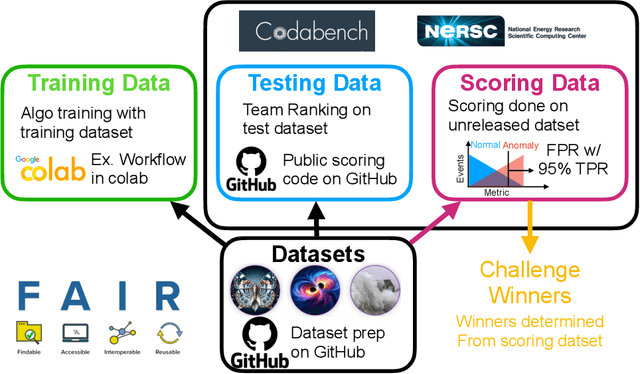
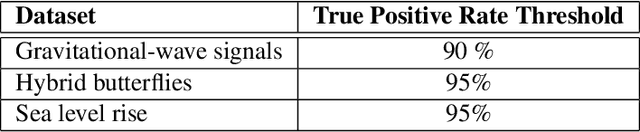
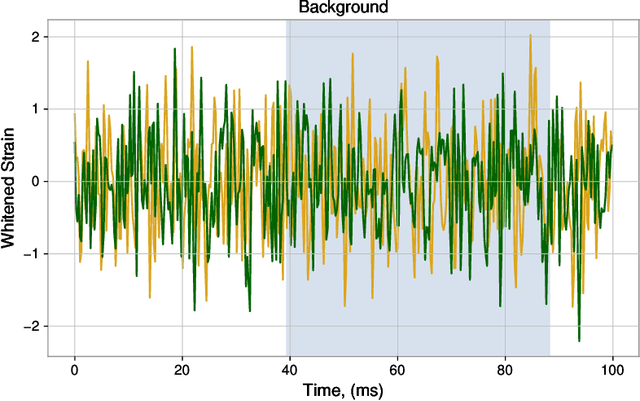
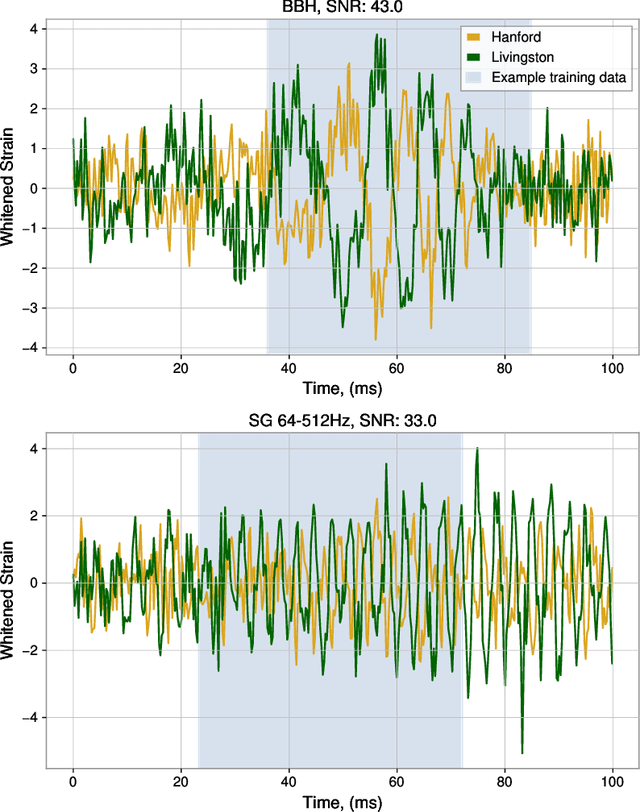
Scientific discoveries are often made by finding a pattern or object that was not predicted by the known rules of science. Oftentimes, these anomalous events or objects that do not conform to the norms are an indication that the rules of science governing the data are incomplete, and something new needs to be present to explain these unexpected outliers. The challenge of finding anomalies can be confounding since it requires codifying a complete knowledge of the known scientific behaviors and then projecting these known behaviors on the data to look for deviations. When utilizing machine learning, this presents a particular challenge since we require that the model not only understands scientific data perfectly but also recognizes when the data is inconsistent and out of the scope of its trained behavior. In this paper, we present three datasets aimed at developing machine learning-based anomaly detection for disparate scientific domains covering astrophysics, genomics, and polar science. We present the different datasets along with a scheme to make machine learning challenges around the three datasets findable, accessible, interoperable, and reusable (FAIR). Furthermore, we present an approach that generalizes to future machine learning challenges, enabling the possibility of large, more compute-intensive challenges that can ultimately lead to scientific discovery.
A Neural Network-Based Search for Unmodeled Transients in LIGO-Virgo-KAGRA's Third Observing Run
Dec 27, 2024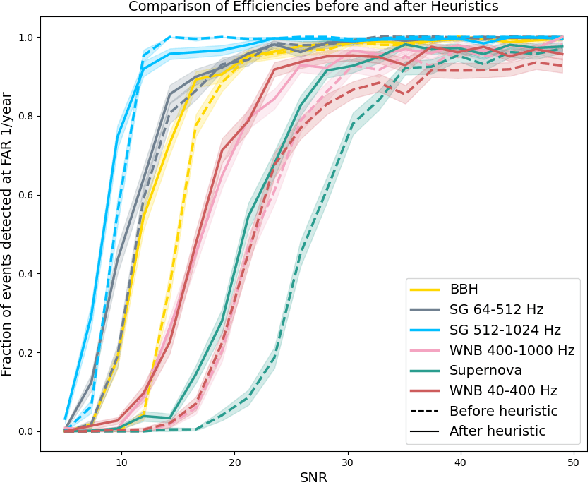
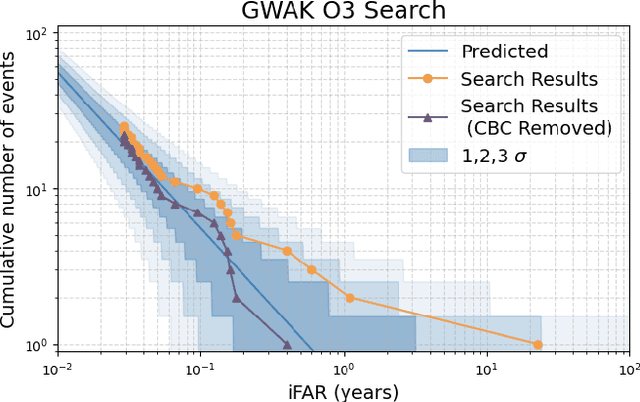
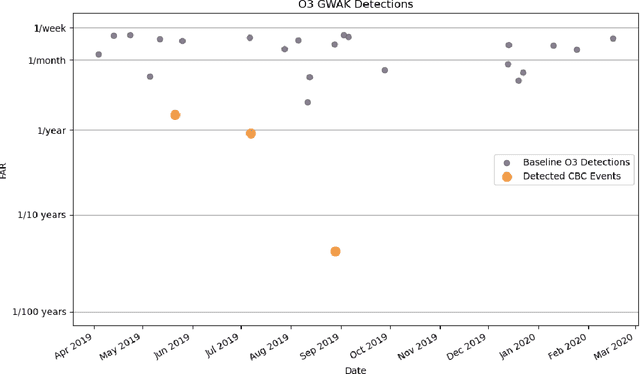

This paper presents the results of a Neural Network (NN)-based search for short-duration gravitational-wave transients in data from the third observing run of LIGO, Virgo, and KAGRA. The search targets unmodeled transients with durations of milliseconds to a few seconds in the 30-1500 Hz frequency band, without assumptions about the incoming signal direction, polarization, or morphology. Using the Gravitational Wave Anomalous Knowledge (GWAK) method, three compact binary coalescences (CBCs) identified by existing pipelines are successfully detected, along with a range of detector glitches. The algorithm constructs a low-dimensional embedded space to capture the physical features of signals, enabling the detection of CBCs, detector glitches, and unmodeled transients. This study demonstrates GWAK's ability to enhance gravitational-wave searches beyond the limits of existing pipelines, laying the groundwork for future detection strategies.
Higgs analysis with quantum classifiers
Apr 15, 2021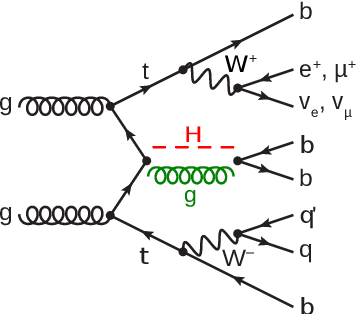
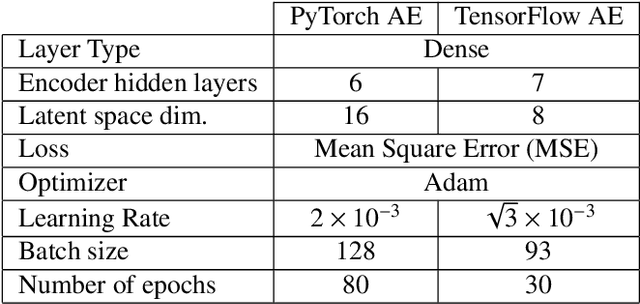
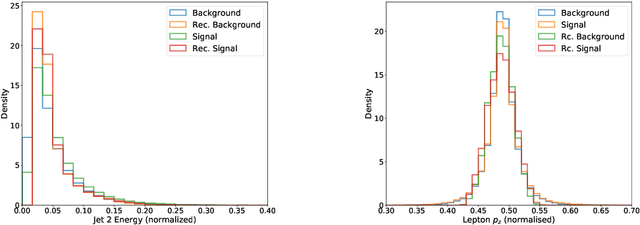
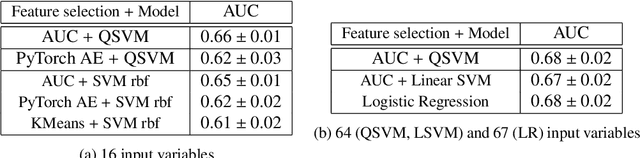
We have developed two quantum classifier models for the $t\bar{t}H(b\bar{b})$ classification problem, both of which fall into the category of hybrid quantum-classical algorithms for Noisy Intermediate Scale Quantum devices (NISQ). Our results, along with other studies, serve as a proof of concept that Quantum Machine Learning (QML) methods can have similar or better performance, in specific cases of low number of training samples, with respect to conventional ML methods even with a limited number of qubits available in current hardware. To utilise algorithms with a low number of qubits -- to accommodate for limitations in both simulation hardware and real quantum hardware -- we investigated different feature reduction methods. Their impact on the performance of both the classical and quantum models was assessed. We addressed different implementations of two QML models, representative of the two main approaches to supervised quantum machine learning today: a Quantum Support Vector Machine (QSVM), a kernel-based method, and a Variational Quantum Circuit (VQC), a variational approach.