 Add to Chrome
 Add to Firefox
 Add to Edge
AI Agents Can Already Autonomously Perform Experimental High Energy Physics
Mar 20, 2026
Large language model-based AI agents are now able to autonomously execute substantial portions of a high energy physics (HEP) analysis pipeline with minimal expert-curated input. Given access to a HEP dataset, an execution framework, and a corpus of prior experimental literature, we find that Claude Code succeeds in automating all stages of a typical analysis: event selection, background estimation, uncertainty quantification, statistical inference, and paper drafting. We argue that the experimental HEP community is underestimating the current capabilities of these systems, and that most proposed agentic workflows are too narrowly scoped or scaffolded to specific analysis structures. We present a proof-of-concept framework, Just Furnish Context (JFC), that integrates autonomous analysis agents with literature-based knowledge retrieval and multi-agent review, and show that this is sufficient to plan, execute, and document a credible high energy physics analysis. We demonstrate this by conducting analyses on open data from ALEPH, DELPHI, and CMS to perform electroweak, QCD, and Higgs boson measurements. Rather than replacing physicists, these tools promise to offload the repetitive technical burden of analysis code development, freeing researchers to focus on physics insight, truly novel method development, and rigorous validation. Given these developments, we advocate for new strategies for how the community trains students, organizes analysis efforts, and allocates human expertise.

A Neural Network-Based Search for Unmodeled Transients in LIGO-Virgo-KAGRA's Third Observing Run
Dec 27, 2024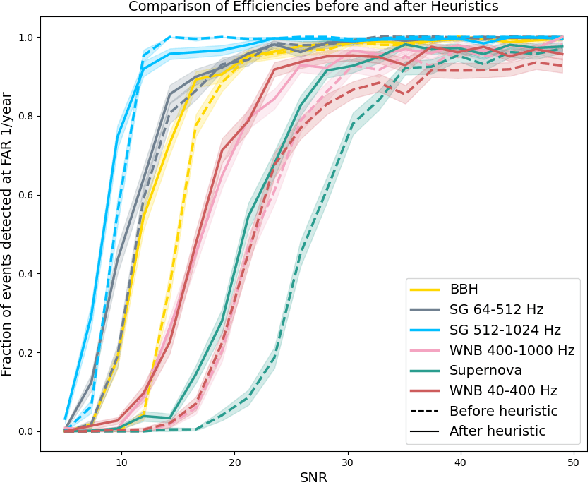
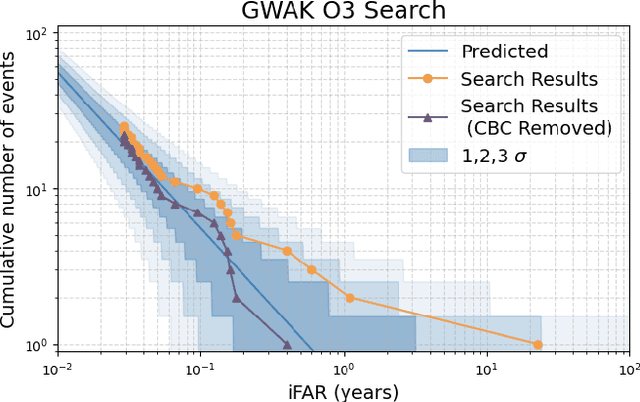
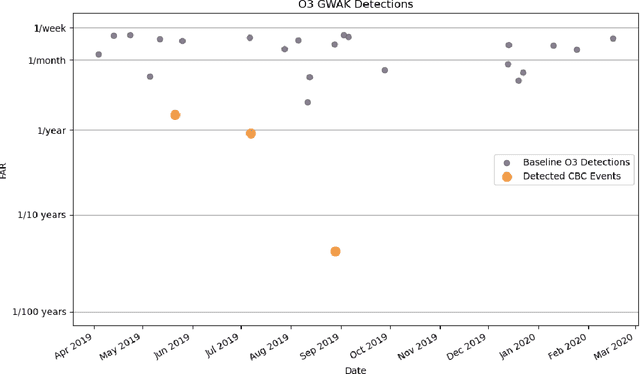

This paper presents the results of a Neural Network (NN)-based search for short-duration gravitational-wave transients in data from the third observing run of LIGO, Virgo, and KAGRA. The search targets unmodeled transients with durations of milliseconds to a few seconds in the 30-1500 Hz frequency band, without assumptions about the incoming signal direction, polarization, or morphology. Using the Gravitational Wave Anomalous Knowledge (GWAK) method, three compact binary coalescences (CBCs) identified by existing pipelines are successfully detected, along with a range of detector glitches. The algorithm constructs a low-dimensional embedded space to capture the physical features of signals, enabling the detection of CBCs, detector glitches, and unmodeled transients. This study demonstrates GWAK's ability to enhance gravitational-wave searches beyond the limits of existing pipelines, laying the groundwork for future detection strategies.
Low Latency Transformer Inference on FPGAs for Physics Applications with hls4ml
Sep 08, 2024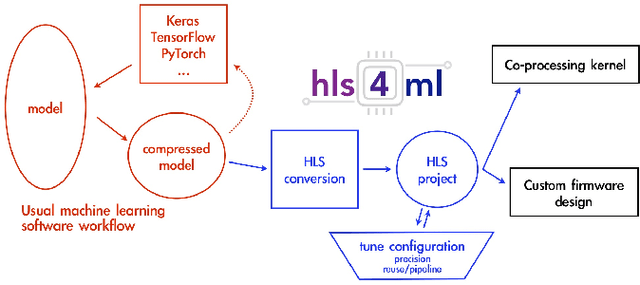
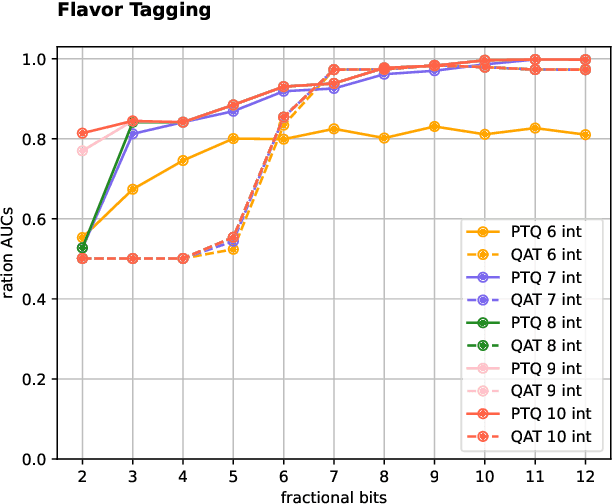
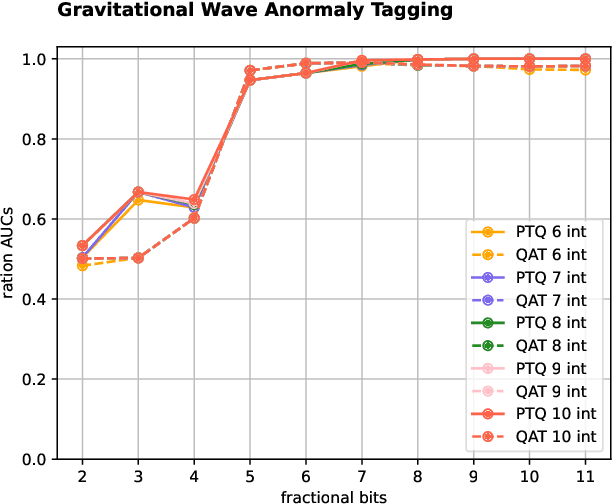
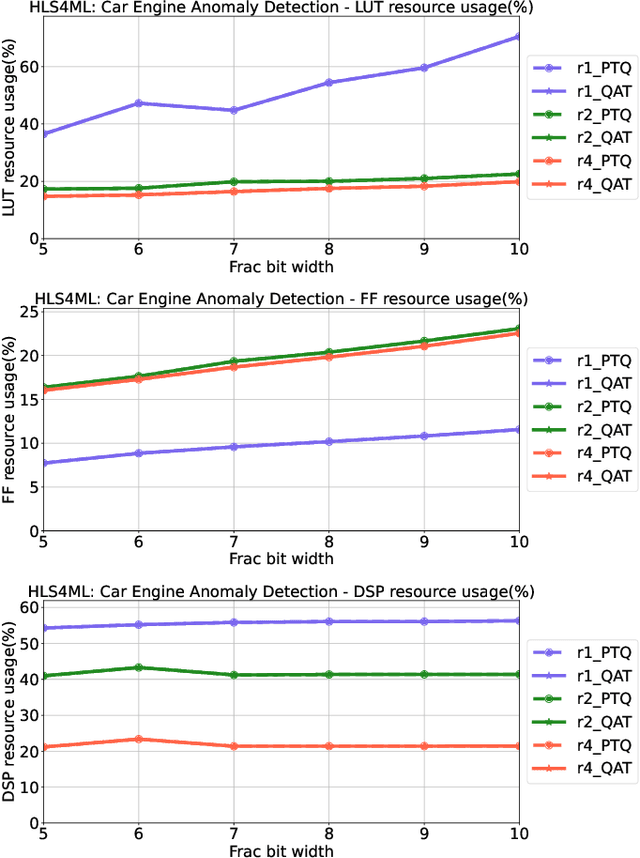
This study presents an efficient implementation of transformer architectures in Field-Programmable Gate Arrays(FPGAs) using hls4ml. We demonstrate the strategy for implementing the multi-head attention, softmax, and normalization layer and evaluate three distinct models. Their deployment on VU13P FPGA chip achieved latency less than 2us, demonstrating the potential for real-time applications. HLS4ML compatibility with any TensorFlow-built transformer model further enhances the scalability and applicability of this work. Index Terms: FPGAs, machine learning, transformers, high energy physics, LIGO
Source-Agnostic Gravitational-Wave Detection with Recurrent Autoencoders
Aug 13, 2021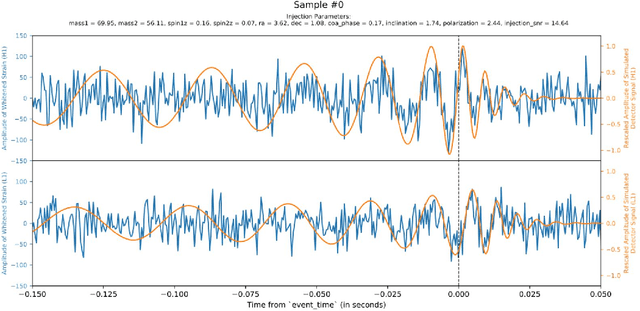
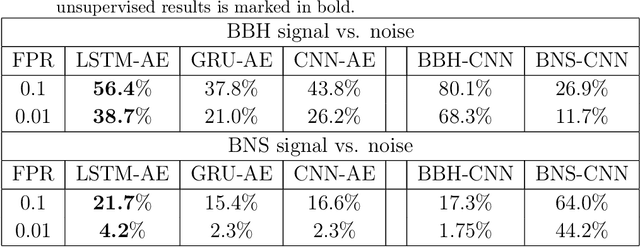
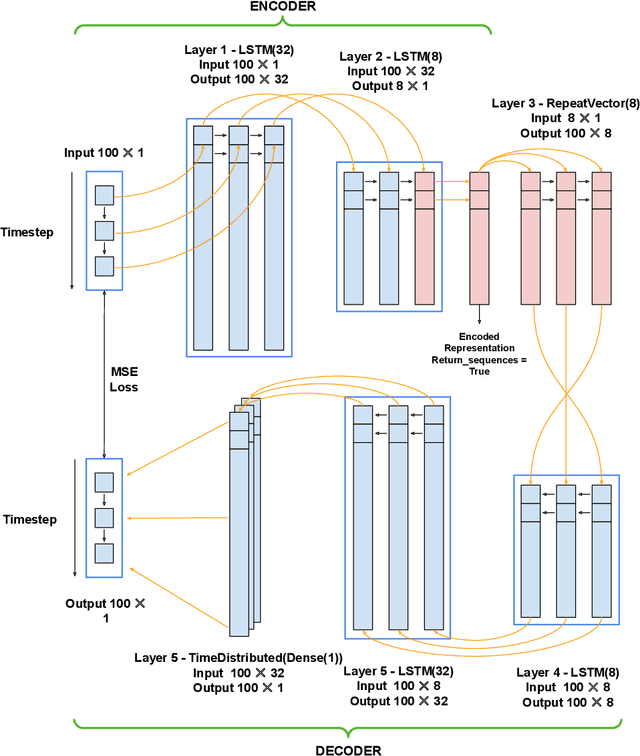
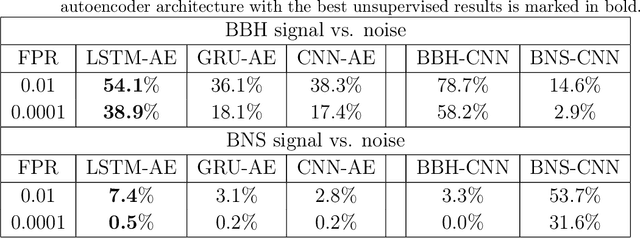
We present an application of anomaly detection techniques based on deep recurrent autoencoders to the problem of detecting gravitational wave signals in laser interferometers. Trained on noise data, this class of algorithms could detect signals using an unsupervised strategy, i.e., without targeting a specific kind of source. We develop a custom architecture to analyze the data from two interferometers. We compare the obtained performance to that obtained with other autoencoder architectures and with a convolutional classifier. The unsupervised nature of the proposed strategy comes with a cost in terms of accuracy, when compared to more traditional supervised techniques. On the other hand, there is a qualitative gain in generalizing the experimental sensitivity beyond the ensemble of pre-computed signal templates. The recurrent autoencoder outperforms other autoencoders based on different architectures. The class of recurrent autoencoders presented in this paper could complement the search strategy employed for gravitational wave detection and extend the reach of the ongoing detection campaigns.