 Add to Chrome
 Add to Firefox
 Add to Edge
MC-RAG System: A Structure-Driven RAG System for Multi-Constraint Queries
Jul 11, 2026
Retrieval-Augmented Generation (RAG) systems are widely adopted in question answering, yet they often fail to satisfy complex multi-constraint queries, leading to constraint violations, factual inconsistencies, or hallucinations. We present Structure-Driven RAG System for Multi-Constraint Queries(MC-RAG), a structure-driven RAG system that reformulates retrieval as a subgraph matching problem over a knowledge graph. By integrating semantic and structural embeddings with path-level indexing, MC-RAG performs interpretable, structure-aware, and constraint-consistent retrieval and generation. During the demonstration, participants can input medical or encyclopedic multi-constraint queries, visualize how the system parses constraints, performs structural matching, and generates answers, thereby experiencing an end-to-end, interactive, and explainable RAG pipeline. A demo video is available at https://youtu.be/J8kahzmAnu0.

HMAF: A Hierarchical Multi-Slot GD-RTB Allocation Framework
Jun 04, 2026In modern online advertising platforms, Guaranteed Delivery (GD) contracts coexist and bid with Real-Time Bidding (RTB) auctions. Recent approaches either decouple GD and RTB optimization or rely on heuristic priority rules, and thus fail to effectively balance short-term revenue maximization with long-term contract delivery under complex multi-slot delivery and impression constraints. To address these challenges, we propose HMAF (Hierarchical Multi-Slot Allocation Framework), a unified framework designed to optimize impression allocation in GD--RTB advertising platforms. HMAF employs the Plan--Calibrate--Execute paradigm as its core structure, and integrates offline constraint optimization with online decision-making, balancing offline GD resource planning, dynamically calibrating GD--RTB competitiveness, and making real-time listwise rank decisions across multi-slot environments. HMAF has been implemented in multiple marketing scenarios at Meituan, one of the world's largest online food delivery platforms, leading to a 3.72% increase in GD delivery rate and a 1.59% increase in total advertisement revenue.
CausalPOI: Spatio-Temporal Graph-Based Causal Modeling for Cold-Start POI Check-in Forecasting
Jun 03, 2026As urban environments continue to evolve rapidly, accurately modeling the dynamic behaviour of Points of Interest is essential for supporting data-driven urban planning and commercial decision-making. While recent advancements in spatio-temporal graph learning have improved POI forecasting, most methods rely on proximity-based graphs and correlation-driven modeling, which overlook the functional dependencies between POIs and fail to capture the causal effects of urban interventions. In this paper, we introduce a novel research problem -- cold-start POI check-in forecasting, which aims to predict the future check-in pattern of a newly introduced POI, by modeling its temporal evolution and functional interactions with nearby POIs in a structured urban spatial context. To address these challenges, we propose CausalPOI, a spatio-temporal graph-based causal representation learning framework. CausalPOI leverages Spatio-Temporal Functional Interaction Graph to model semantic and spatial relationships between POIs, and constructs structurally aligned treatment and control graphs to simulate factual and counterfactual scenarios. Extensive experiments on real-world SafeGraph datasets demonstrate that CausalPOI significantly outperforms state-of-the-art baselines across the board, validating its effectiveness in spatio-temporal forecasting, semantic interaction modeling, and causal effect estimation, providing a more interpretable and actionable foundation for urban intervention analysis. Source code is available at Github.
Beyond Single Slot: Joint Optimization for Multi-Slot Guaranteed Display Advertising
May 20, 2026Guaranteed display advertising is crucial for platform monetization, yet existing methods often operate under a single-slot assumption, limiting their ability to optimize allocation across multi-slot page views. In this paper, we propose a novel joint optimization framework for multi-slot GD allocation, addressing key challenges such as slot-level redundancy, contract imbalance, and exposure concentration. Our approach formulates the allocation as an offline bipartite matching problem with a contract roulette mechanism for slot exclusivity and Page View constraints for impression control, and incorporates a scalable allocation optimization algorithm for efficient large-scale deployment. Extensive online tests on the Meituan advertising platform demonstrate that our method significantly improves merchant ROI, platform revenue efficiency, and contract fulfillment robustness. Specifically, online A/B tests show a 28.99% increase in Average Revenue Per User under 70% traffic, and DID analysis further indicates improved contract stability, demonstrating the strong applicability and effectiveness of our framework in real-world advertising deployments.
A Component-Based Survey of Interactions between Large Language Models and Multi-Armed Bandits
Jan 21, 2026Large language models (LLMs) have become powerful and widely used systems for language understanding and generation, while multi-armed bandit (MAB) algorithms provide a principled framework for adaptive decision-making under uncertainty. This survey explores the potential at the intersection of these two fields. As we know, it is the first survey to systematically review the bidirectional interaction between large language models and multi-armed bandits at the component level. We highlight the bidirectional benefits: MAB algorithms address critical LLM challenges, spanning from pre-training to retrieval-augmented generation (RAG) and personalization. Conversely, LLMs enhance MAB systems by redefining core components such as arm definition and environment modeling, thereby improving decision-making in sequential tasks. We analyze existing LLM-enhanced bandit systems and bandit-enhanced LLM systems, providing insights into their design, methodologies, and performance. Key challenges and representative findings are identified to help guide future research. An accompanying GitHub repository that indexes relevant literature is available at https://github.com/bucky1119/Awesome-LLM-Bandit-Interaction.
Geographical Hidden Markov Tree for Flood Extent Mapping (With Proof Appendix)
May 24, 2018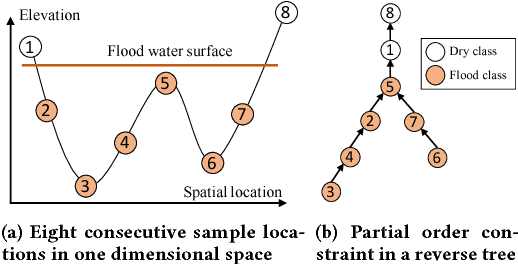
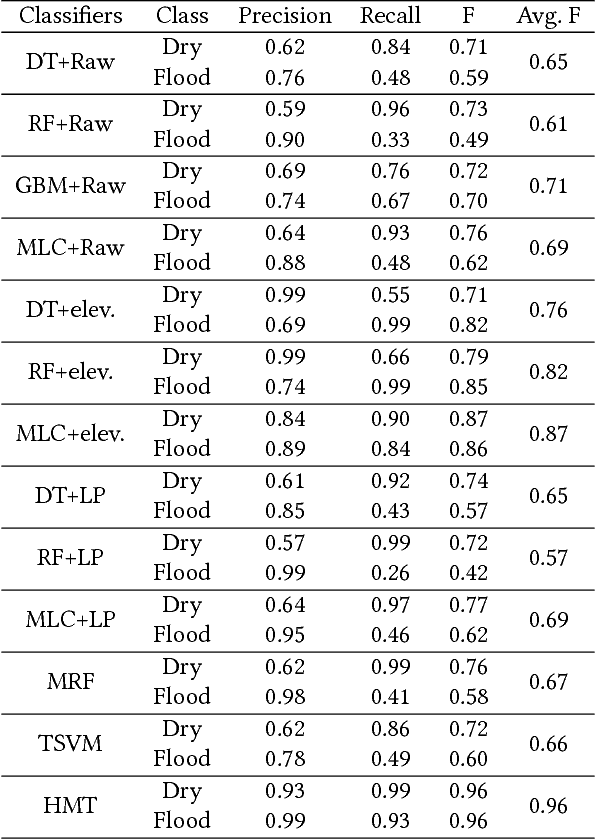
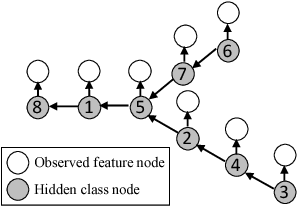
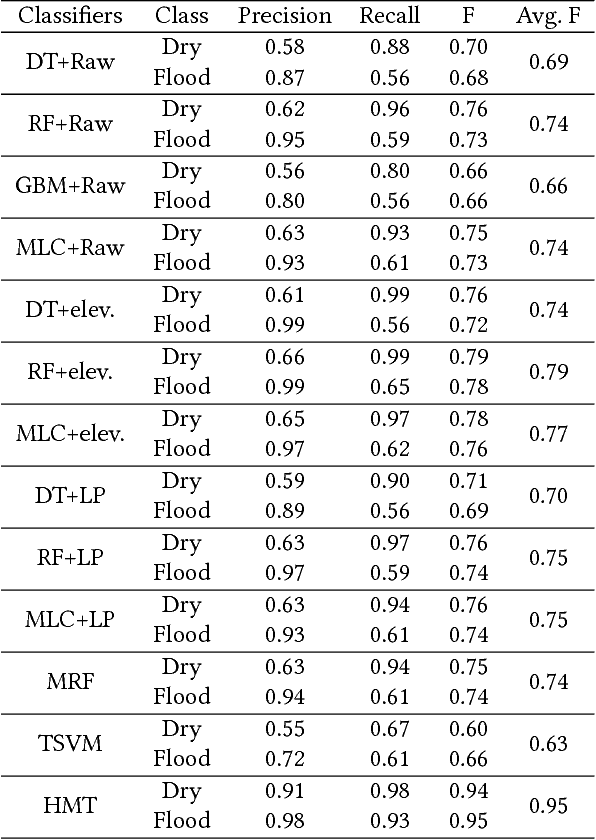
Flood extent mapping plays a crucial role in disaster management and national water forecasting. Unfortunately, traditional classification methods are often hampered by the existence of noise, obstacles and heterogeneity in spectral features as well as implicit anisotropic spatial dependency across class labels. In this paper, we propose geographical hidden Markov tree, a probabilistic graphical model that generalizes the common hidden Markov model from a one dimensional sequence to a two dimensional map. Anisotropic spatial dependency is incorporated in the hidden class layer with a reverse tree structure. We also investigate computational algorithms for reverse tree construction, model parameter learning and class inference. Extensive evaluations on both synthetic and real world datasets show that proposed model outperforms multiple baselines in flood mapping, and our algorithms are scalable on large data sizes.