 Add to Chrome
 Add to Firefox
 Add to Edge
HMAF: A Hierarchical Multi-Slot GD-RTB Allocation Framework
Jun 04, 2026
In modern online advertising platforms, Guaranteed Delivery (GD) contracts coexist and bid with Real-Time Bidding (RTB) auctions. Recent approaches either decouple GD and RTB optimization or rely on heuristic priority rules, and thus fail to effectively balance short-term revenue maximization with long-term contract delivery under complex multi-slot delivery and impression constraints. To address these challenges, we propose HMAF (Hierarchical Multi-Slot Allocation Framework), a unified framework designed to optimize impression allocation in GD--RTB advertising platforms. HMAF employs the Plan--Calibrate--Execute paradigm as its core structure, and integrates offline constraint optimization with online decision-making, balancing offline GD resource planning, dynamically calibrating GD--RTB competitiveness, and making real-time listwise rank decisions across multi-slot environments. HMAF has been implemented in multiple marketing scenarios at Meituan, one of the world's largest online food delivery platforms, leading to a 3.72% increase in GD delivery rate and a 1.59% increase in total advertisement revenue.

CausalPOI: Spatio-Temporal Graph-Based Causal Modeling for Cold-Start POI Check-in Forecasting
Jun 03, 2026As urban environments continue to evolve rapidly, accurately modeling the dynamic behaviour of Points of Interest is essential for supporting data-driven urban planning and commercial decision-making. While recent advancements in spatio-temporal graph learning have improved POI forecasting, most methods rely on proximity-based graphs and correlation-driven modeling, which overlook the functional dependencies between POIs and fail to capture the causal effects of urban interventions. In this paper, we introduce a novel research problem -- cold-start POI check-in forecasting, which aims to predict the future check-in pattern of a newly introduced POI, by modeling its temporal evolution and functional interactions with nearby POIs in a structured urban spatial context. To address these challenges, we propose CausalPOI, a spatio-temporal graph-based causal representation learning framework. CausalPOI leverages Spatio-Temporal Functional Interaction Graph to model semantic and spatial relationships between POIs, and constructs structurally aligned treatment and control graphs to simulate factual and counterfactual scenarios. Extensive experiments on real-world SafeGraph datasets demonstrate that CausalPOI significantly outperforms state-of-the-art baselines across the board, validating its effectiveness in spatio-temporal forecasting, semantic interaction modeling, and causal effect estimation, providing a more interpretable and actionable foundation for urban intervention analysis. Source code is available at Github.
Beyond Single Slot: Joint Optimization for Multi-Slot Guaranteed Display Advertising
May 20, 2026Guaranteed display advertising is crucial for platform monetization, yet existing methods often operate under a single-slot assumption, limiting their ability to optimize allocation across multi-slot page views. In this paper, we propose a novel joint optimization framework for multi-slot GD allocation, addressing key challenges such as slot-level redundancy, contract imbalance, and exposure concentration. Our approach formulates the allocation as an offline bipartite matching problem with a contract roulette mechanism for slot exclusivity and Page View constraints for impression control, and incorporates a scalable allocation optimization algorithm for efficient large-scale deployment. Extensive online tests on the Meituan advertising platform demonstrate that our method significantly improves merchant ROI, platform revenue efficiency, and contract fulfillment robustness. Specifically, online A/B tests show a 28.99% increase in Average Revenue Per User under 70% traffic, and DID analysis further indicates improved contract stability, demonstrating the strong applicability and effectiveness of our framework in real-world advertising deployments.
Event Extraction in Large Language Model
Dec 22, 2025Large language models (LLMs) and multimodal LLMs are changing event extraction (EE): prompting and generation can often produce structured outputs in zero shot or few shot settings. Yet LLM based pipelines face deployment gaps, including hallucinations under weak constraints, fragile temporal and causal linking over long contexts and across documents, and limited long horizon knowledge management within a bounded context window. We argue that EE should be viewed as a system component that provides a cognitive scaffold for LLM centered solutions. Event schemas and slot constraints create interfaces for grounding and verification; event centric structures act as controlled intermediate representations for stepwise reasoning; event links support relation aware retrieval with graph based RAG; and event stores offer updatable episodic and agent memory beyond the context window. This survey covers EE in text and multimodal settings, organizing tasks and taxonomy, tracing method evolution from rule based and neural models to instruction driven and generative frameworks, and summarizing formulations, decoding strategies, architectures, representations, datasets, and evaluation. We also review cross lingual, low resource, and domain specific settings, and highlight open challenges and future directions for reliable event centric systems. Finally, we outline open challenges and future directions that are central to the LLM era, aiming to evolve EE from static extraction into a structurally reliable, agent ready perception and memory layer for open world systems.
OneTrans: Unified Feature Interaction and Sequence Modeling with One Transformer in Industrial Recommender
Oct 30, 2025In recommendation systems, scaling up feature-interaction modules (e.g., Wukong, RankMixer) or user-behavior sequence modules (e.g., LONGER) has achieved notable success. However, these efforts typically proceed on separate tracks, which not only hinders bidirectional information exchange but also prevents unified optimization and scaling. In this paper, we propose OneTrans, a unified Transformer backbone that simultaneously performs user-behavior sequence modeling and feature interaction. OneTrans employs a unified tokenizer to convert both sequential and non-sequential attributes into a single token sequence. The stacked OneTrans blocks share parameters across similar sequential tokens while assigning token-specific parameters to non-sequential tokens. Through causal attention and cross-request KV caching, OneTrans enables precomputation and caching of intermediate representations, significantly reducing computational costs during both training and inference. Experimental results on industrial-scale datasets demonstrate that OneTrans scales efficiently with increasing parameters, consistently outperforms strong baselines, and yields a 5.68% lift in per-user GMV in online A/B tests.
Distortion Bounds of Subdivision Models for SO(3)
Mar 29, 2025In the subdivision approach to robot path planning, we need to subdivide the configuration space of a robot into nice cells to perform various computations. For a rigid spatial robot, this configuration space is $SE(3)=\mathbb{R}^3\times SO(3)$. The subdivision of $\mathbb{R}^3$ is standard but so far, there are no global subdivision schemes for $SO(3)$. We recently introduced a representation for $SO(3)$ suitable for subdivision. This paper investigates the distortion of the natural metric on $SO(3)$ caused by our representation. The proper framework for this study lies in the Riemannian geometry of $SO(3)$, enabling us to obtain sharp distortion bounds.
DTN: Deep Multiple Task-specific Feature Interactions Network for Multi-Task Recommendation
Aug 21, 2024
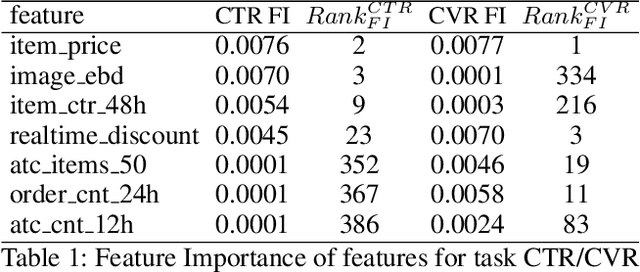

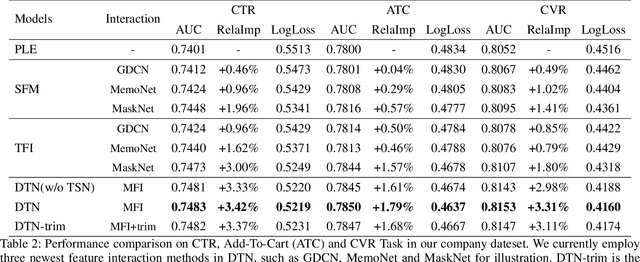
Neural-based multi-task learning (MTL) has been successfully applied to many recommendation applications. However, these MTL models (e.g., MMoE, PLE) did not consider feature interaction during the optimization, which is crucial for capturing complex high-order features and has been widely used in ranking models for real-world recommender systems. Moreover, through feature importance analysis across various tasks in MTL, we have observed an interesting divergence phenomenon that the same feature can have significantly different importance across different tasks in MTL. To address these issues, we propose Deep Multiple Task-specific Feature Interactions Network (DTN) with a novel model structure design. DTN introduces multiple diversified task-specific feature interaction methods and task-sensitive network in MTL networks, enabling the model to learn task-specific diversified feature interaction representations, which improves the efficiency of joint representation learning in a general setup. We applied DTN to our company's real-world E-commerce recommendation dataset, which consisted of over 6.3 billion samples, the results demonstrated that DTN significantly outperformed state-of-the-art MTL models. Moreover, during online evaluation of DTN in a large-scale E-commerce recommender system, we observed a 3.28% in clicks, a 3.10% increase in orders and a 2.70% increase in GMV (Gross Merchandise Value) compared to the state-of-the-art MTL models. Finally, extensive offline experiments conducted on public benchmark datasets demonstrate that DTN can be applied to various scenarios beyond recommendations, enhancing the performance of ranking models.
Theory and Explicit Design of a Path Planner for an SE(3) Robot
Jul 06, 2024


We consider path planning for a rigid spatial robot with 6 degrees of freedom (6 DOFs), moving amidst polyhedral obstacles. A correct, complete and practical path planner for such a robot has never been achieved, although this is widely recognized as a key challenge in robotics. This paper provides a complete "explicit" design, down to explicit geometric primitives that are easily implementable. Our design is within an algorithmic framework for path planners, called Soft Subdivision Search (SSS). The framework is based on the twin foundations of $\epsilon$-exactness and soft predicates, which are critical for rigorous numerical implementations. The practicality of SSS has been previously demonstrated for various robots including 5-DOF spatial robots. In this paper, we solve several significant technical challenges for SE(3) robots: (1) We first ensure the correct theory by proving a general form of the Fundamental Theorem of the SSS theory. We prove this within an axiomatic framework, thus making it easy for future applications of this theory. (2) One component of $SE(3) = R^3 \times SO(3)$ is the non-Euclidean, non-orientable space SO(3). We design a novel topologically correct data structure for SO(3). Using the concept of subdivision charts and atlases for SO(3), we can now carry out subdivision of SO(3). (3) The geometric problem of collision detection takes place in $R^3$, via the footprint map. Unlike sampling-based approaches, we must reason with the notion of footprints of configuration boxes, which is much harder to characterize. Exploiting the theory of soft predicates, we design suitable approximate footprints which, when combined with the highly effective feature-set technique, lead to soft predicates. (4) Finally, we make the underlying geometric computation "explicit", i.e., avoiding a general solver of polynomial systems, in order to allow a direct implementation.
Dynamic Malware Analysis with Feature Engineering and Feature Learning
Sep 09, 2019


Dynamic malware analysis executes the program in an isolated environment and monitors its run-time behaviour (e.g., system API calls) for malware detection. This technique has been proven to be effective against various code obfuscation techniques and newly released ("zero-day") malware. However, existing works typically only consider the API name while ignoring the arguments, or require complex feature engineering operations and expert knowledge to process the arguments. In this paper, we propose a novel and low-cost feature extraction approach, and an effective deep neural network architecture for accurate and fast malware detection. Specifically, the feature representation approach utilizes a feature hashing trick to encode the API call arguments associated with the API name. The deep neural network architecture applies multiple Gated-CNNs (convolutional neural networks) to transform the extracted features of each API call. The outputs are further processed through LSTM (long-short term memory networks) to learn the sequential correlation among API calls. Experiments show that our solution outperforms baselines significantly on a large real dataset. Valuable insights about feature engineering and architecture design are derived from ablation study.