 Add to Chrome
 Add to Firefox
 Add to Edge
From Social Coding to Agentic Coding: Productivity and Relational Reconfiguration in Open-Source Communities
Aug 04, 2026
Open-source software communities are a form of digital public infrastructure that not only produces code, but also generates public knowledge and interpersonal relationships through visible collaboration. Generative coding agents (CAs) are an advanced tool to improve development efficiency while shifting part of activities from public human interaction to private human-agent loops. We study this shift using an LLM-based multi-agent simulation initialized with real GitHub data from 1,084 active developers and their repository relationships. After a warm-up with historical commits, we branch the same community state into parallel No-CA and CA conditions for 4-week simulations. CA introduction increases planned and completed tasks by 34.0% and 39.0%, respectively, and reduces median completion time from 45 to 20 minutes. However, adoption reaches only 26.0%, and the gains concentrate among developers who are already more active and well connected. CAs also restructure task execution pathways. Direct human-human interaction declines from 32.4% to 11.6%, while CA-involved modes increase to 57.3%, including 40.3% completed through CA-assisted self-loops. Public knowledge generated under CA condition also provides less support for later tasks. On a standardized retrieval benchmark, the CA corpus achieves 22.3% knowledge coverage, far below the 81.1% achieved by the real-human corpus, and requires more retrieval steps with a lower success rate. These results reveal a productivity-public knowledge tension: coding agents increase technical production, but more work shifts to agent-mediated or private loops, leaving public records less useful to future contributors.

Towards Inclusive Mobility Modeling: Characterizing and Evaluating Elderly Trajectory Patterns in Urban Systems
Jun 30, 2026The rapid advance of smart cities increasingly depends on trajectory data mining, yet underrepresented demographic groups, particularly the elderly, are often sparsely represented in public mobility datasets. This underrepresentation can introduce systematic bias into mobility modeling and downstream urban planning. Using the 2016-2020 Jersey City subset of the Citi Bike System Data, this study quantitatively examines how the absence of underrepresented subgroups' mobility signatures affects mobility modeling, using synthetic trajectory generation as a case study. The analysis reveals that elderly riders exhibit a structurally distinct mobility signature, including localized activity spaces (958 m vs. 1,189 m for young riders), lower mobility entropy (1.82 vs. 4.15), and asymmetric off-peak temporal patterns. To demonstrate that relying on majority-dominated training data yields biased synthetic outcomes, we further evaluate both a first-order Markov chain and a Qwen3-4B model fine-tuned with QLoRA across three demographic training settings: the full population, young riders only, and elderly riders only. Results show that models trained on majority-dominated populations systematically misrepresent elderly mobility behavior, particularly for spatial mobility metrics. The Markov model trained on the full population overestimates elderly step length by 4.5% and dwell time by 8.9%, whereas the elderly-specific model achieves substantially lower errors across most metrics. Comparisons between the Markov and LLM-based frameworks further show that higher-capability models do not necessarily improve subgroup-level fidelity under limited demographic data. These findings underscore the importance of demographic representation in mobility modeling and its downstream applications for underrepresented populations.
Cross-Domain Feature Expansion for Tabular Medical Data via Knowledge Graphs Injection
Jun 30, 2026Acquiring comprehensive cross-domain biomedical profiles is often costly and time-consuming, resulting in severe data scarcity in medical research. To address this challenge, we propose MedKGTab, a knowledge-injected framework specifically engineered for cross-domain feature expansion in tabular medical data. MedKGTab seeks to infer uncollected biomedical features from available ones by exploiting their inherent statistical dependencies and established medical correlations. By employing a row-column dual-attention mechanism, MedKGTab operates directly on raw structured tabular data, inherently capturing exact numerical distributions without the structural loss caused by tokenization. Crucially, MedKGTab integrates data-driven statistical priors with the SPOKE biomedical knowledge graph, achieving an optimal synergy between the data and knowledge channels. Within this synergy, the representations derived from the data channel are modulated by the injected biomedical knowledge, ensuring the final generated data are grounded in empirical medical research. Experimental results demonstrate that MedKGTab achieves high data fidelity and realistic data representation in cross-domain feature expansion. It outperforms both SOTA medical large models (e.g., Baichuan M3-plus) and specialized tabular models designed for medical data generation. Furthermore, MedKGTab consistently delivers superior performance across various data generation scenarios, whether inferring missing features within the same dataset or generalizing across different medical cohorts.
Technical Report for Soccernet 2023 -- Dense Video Captioning
Oct 31, 2024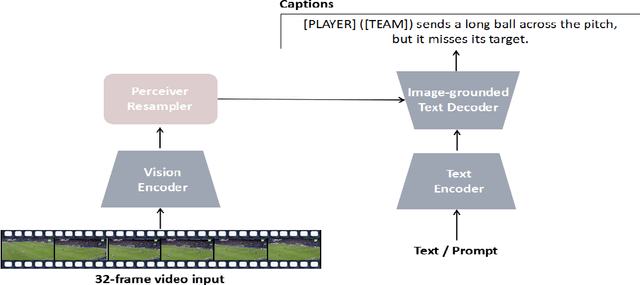
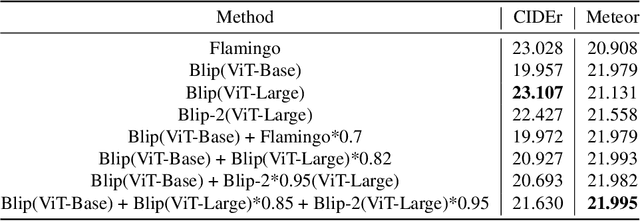
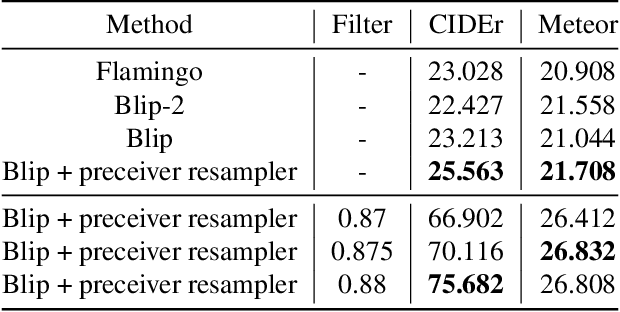
In the task of dense video captioning of Soccernet dataset, we propose to generate a video caption of each soccer action and locate the timestamp of the caption. Firstly, we apply Blip as our video caption framework to generate video captions. Then we locate the timestamp by using (1) multi-size sliding windows (2) temporal proposal generation and (3) proposal classification.
SoccerNet 2023 Challenges Results
Sep 12, 2023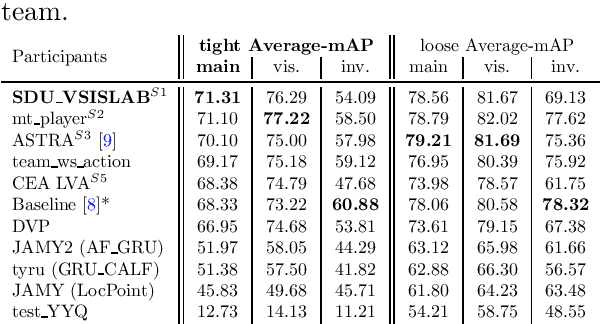
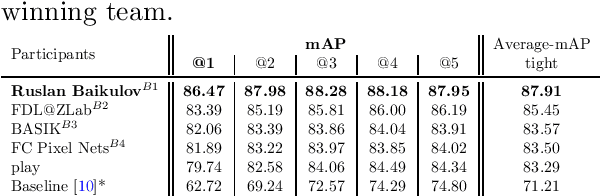
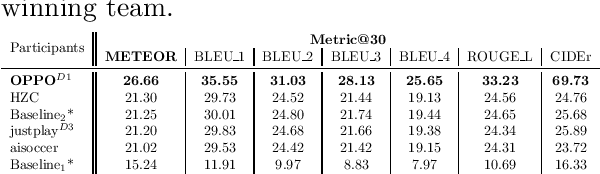
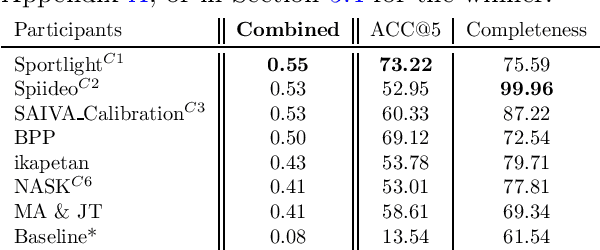
The SoccerNet 2023 challenges were the third annual video understanding challenges organized by the SoccerNet team. For this third edition, the challenges were composed of seven vision-based tasks split into three main themes. The first theme, broadcast video understanding, is composed of three high-level tasks related to describing events occurring in the video broadcasts: (1) action spotting, focusing on retrieving all timestamps related to global actions in soccer, (2) ball action spotting, focusing on retrieving all timestamps related to the soccer ball change of state, and (3) dense video captioning, focusing on describing the broadcast with natural language and anchored timestamps. The second theme, field understanding, relates to the single task of (4) camera calibration, focusing on retrieving the intrinsic and extrinsic camera parameters from images. The third and last theme, player understanding, is composed of three low-level tasks related to extracting information about the players: (5) re-identification, focusing on retrieving the same players across multiple views, (6) multiple object tracking, focusing on tracking players and the ball through unedited video streams, and (7) jersey number recognition, focusing on recognizing the jersey number of players from tracklets. Compared to the previous editions of the SoccerNet challenges, tasks (2-3-7) are novel, including new annotations and data, task (4) was enhanced with more data and annotations, and task (6) now focuses on end-to-end approaches. More information on the tasks, challenges, and leaderboards are available on https://www.soccer-net.org. Baselines and development kits can be found on https://github.com/SoccerNet.