 Add to Chrome
 Add to Firefox
 Add to Edge
Solaris: Building a Multiplayer Video World Model in Minecraft
Feb 26, 2026
Existing action-conditioned video generation models (video world models) are limited to single-agent perspectives, failing to capture the multi-agent interactions of real-world environments. We introduce Solaris, a multiplayer video world model that simulates consistent multi-view observations. To enable this, we develop a multiplayer data system designed for robust, continuous, and automated data collection on video games such as Minecraft. Unlike prior platforms built for single-player settings, our system supports coordinated multi-agent interaction and synchronized videos + actions capture. Using this system, we collect 12.64 million multiplayer frames and propose an evaluation framework for multiplayer movement, memory, grounding, building, and view consistency. We train Solaris using a staged pipeline that progressively transitions from single-player to multiplayer modeling, combining bidirectional, causal, and Self Forcing training. In the final stage, we introduce Checkpointed Self Forcing, a memory-efficient Self Forcing variant that enables a longer-horizon teacher. Results show our architecture and training design outperform existing baselines. Through open-sourcing our system and models, we hope to lay the groundwork for a new generation of multi-agent world models.

ProCreate, Don't Reproduce! Propulsive Energy Diffusion for Creative Generation
Aug 06, 2024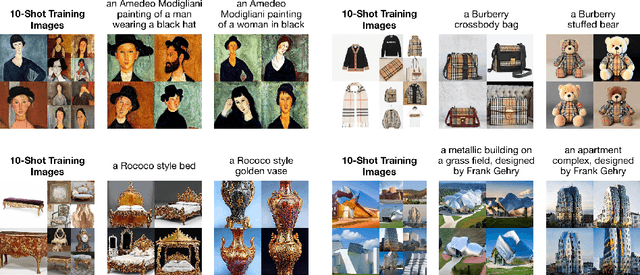
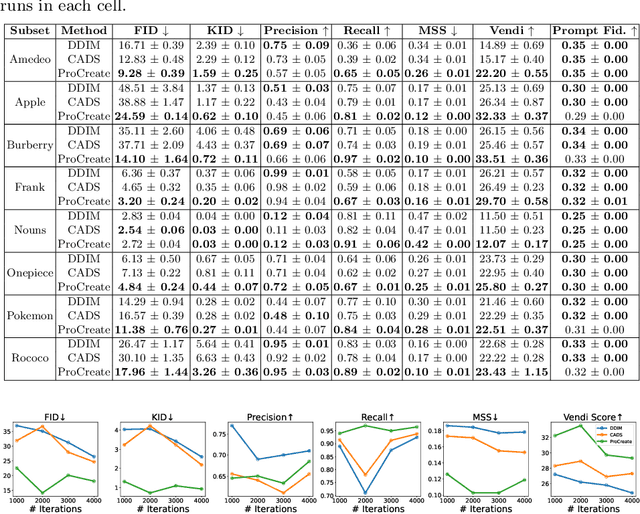
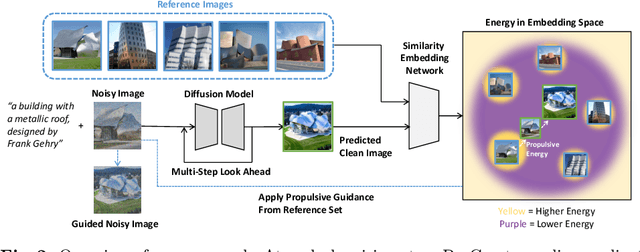
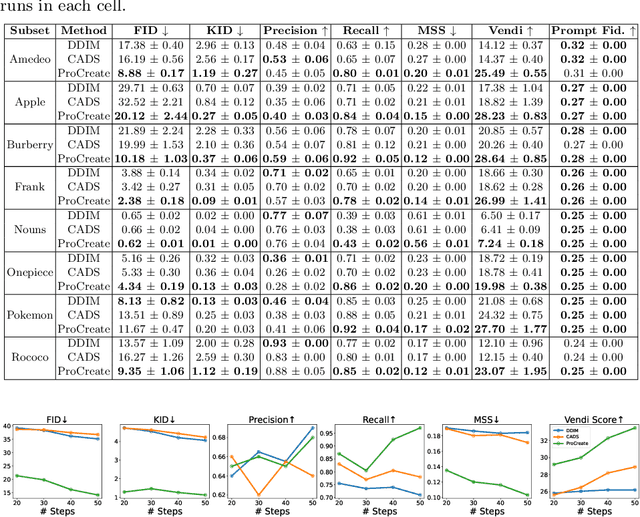
In this paper, we propose ProCreate, a simple and easy-to-implement method to improve sample diversity and creativity of diffusion-based image generative models and to prevent training data reproduction. ProCreate operates on a set of reference images and actively propels the generated image embedding away from the reference embeddings during the generation process. We propose FSCG-8 (Few-Shot Creative Generation 8), a few-shot creative generation dataset on eight different categories -- encompassing different concepts, styles, and settings -- in which ProCreate achieves the highest sample diversity and fidelity. Furthermore, we show that ProCreate is effective at preventing replicating training data in a large-scale evaluation using training text prompts. Code and FSCG-8 are available at https://github.com/Agentic-Learning-AI-Lab/procreate-diffusion-public. The project page is available at https://procreate-diffusion.github.io.
Fibrosis-Net: A Tailored Deep Convolutional Neural Network Design for Prediction of Pulmonary Fibrosis Progression from Chest CT Images
Mar 06, 2021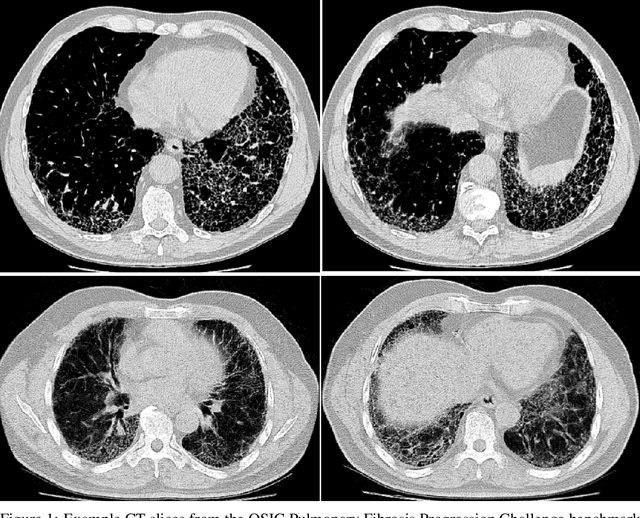
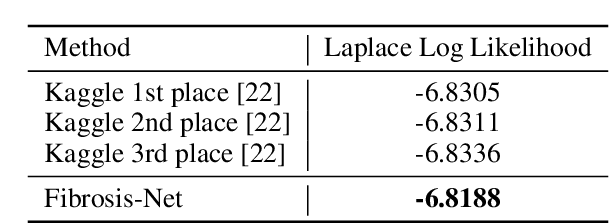
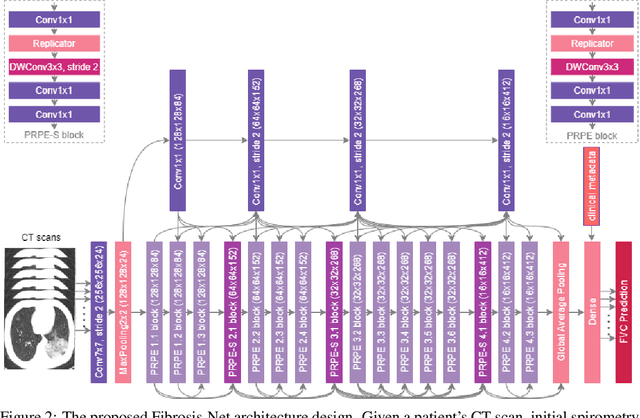
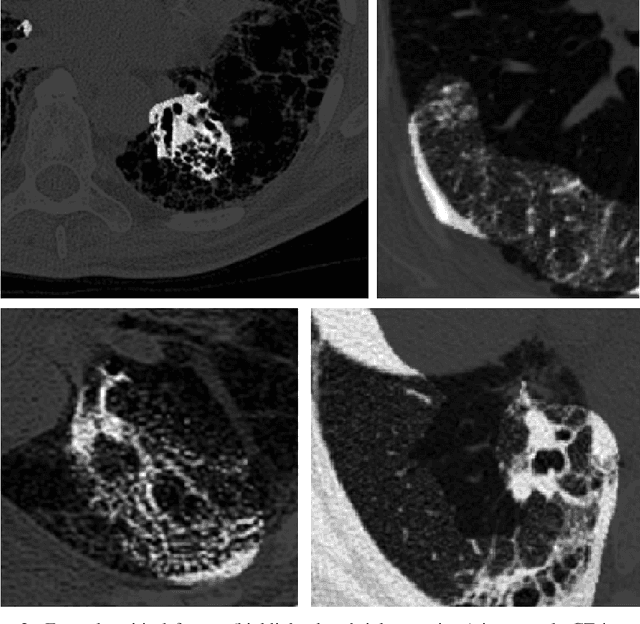
Pulmonary fibrosis is a devastating chronic lung disease that causes irreparable lung tissue scarring and damage, resulting in progressive loss in lung capacity and has no known cure. A critical step in the treatment and management of pulmonary fibrosis is the assessment of lung function decline, with computed tomography (CT) imaging being a particularly effective method for determining the extent of lung damage caused by pulmonary fibrosis. Motivated by this, we introduce Fibrosis-Net, a deep convolutional neural network design tailored for the prediction of pulmonary fibrosis progression from chest CT images. More specifically, machine-driven design exploration was leveraged to determine a strong architectural design for CT lung analysis, upon which we build a customized network design tailored for predicting forced vital capacity (FVC) based on a patient's CT scan, initial spirometry measurement, and clinical metadata. Finally, we leverage an explainability-driven performance validation strategy to study the decision-making behaviour of Fibrosis-Net as to verify that predictions are based on relevant visual indicators in CT images. Experiments using the OSIC Pulmonary Fibrosis Progression Challenge benchmark dataset showed that the proposed Fibrosis-Net is able to achieve a significantly higher modified Laplace Log Likelihood score than the winning solutions on the challenge leaderboard. Furthermore, explainability-driven performance validation demonstrated that the proposed Fibrosis-Net exhibits correct decision-making behaviour by leveraging clinically-relevant visual indicators in CT images when making predictions on pulmonary fibrosis progress. While Fibrosis-Net is not yet a production-ready clinical assessment solution, we hope that releasing the model in open source manner will encourage researchers, clinicians, and citizen data scientists alike to leverage and build upon it.