 Add to Chrome
 Add to Firefox
 Add to Edge
A Sovereign, Open-Source Foundation Model for German and English
Jul 13, 2026
We present Soofi S 30B-A3B, a sovereign, open-source Mixture-of-Experts (MoE) hybrid Mamba Transformer foundation model for German and English. Its hybrid design activates only 3B of 30B parameters per token and keeps the inference cache near-constant as context grows, giving it a decisive throughput advantage over dense models for long-context, high-concurrency deployment. Pretrained on roughly 27 trillion tokens with deliberately up-weighted German, Soofi S matches dense 14 to 27B models on aggregate English and German benchmarks while achieving the best code aggregates in both languages among 17 open base models, and outperforms every European sovereign baseline in our comparison, including ones far larger in active parameters. Among fully open models, Soofi S obtains the highest English and German evaluation scores, ahead of Olmo 3 32B and Apertus 70B. Soofi S was built end-to-end on the German Industrial AI Cloud, a sovereign HPC scale AI infrastructure operated by Deutsche Telekom in Munich. Soofi S will be released under highly permissive, open-access terms: weights, selected intermediate checkpoints, full per-source data accounting, hyperparameters, and training and evaluation code. Where source licenses permit, data-construction artifacts are released under permissive licenses; commercially licensed sources are documented with aggregate statistics and exact mixture accounting.

LLM Parameters for Math Across Languages: Shared or Separate?
Jun 16, 2026Large language models (LLMs) exhibit substantial cross-lingual variation in mathematical reasoning performance, but it remains unclear whether these differences reflect language-specific parameters or a shared mechanism that manifests differently by language. We present a cross-lingual mechanistic analysis of mathematical reasoning in LLMs, enabling us to localize and compare model parameters that support mathematical reasoning across languages. We find that the extracted math-associated parameters exhibit partial cross-lingual overlap, with the strongest overlap concentrated in intermediate model layers. We further observe that English consistently produces the largest set of math-relevant parameters, whereas lower-resource languages reveal smaller sets of relevant parameters. These results suggest that math-related behavior in multilingual LLMs is neither fully language-invariant nor fully language-specific, but instead exhibits partial cross-lingual parameter overlap with systematic language-dependent differences.
KletterMix: Climbing Toward High-Quality German Pretraining Data
Jun 02, 2026High-quality pretraining data is a central ingredient in modern language models, but German-language resources remain far less developed than their English counterparts: they are often smaller, less carefully curated, weakly documented, and rarely validated through controlled training experiments. We introduce KletterMix, a high-quality German corpus for language model pretraining and annealing, designed as a reusable dataset artifact for the natural language processing and modeling community. KletterMix is built by translating a state-of-the-art English pretraining corpus into German while preserving document boundaries, metadata, source structure, and topical diversity. This construction yields a German corpus with the scale and diversity of a modern pretraining dataset, while enabling direct comparison to its English source. We document the dataset through a broad set of corpus-level analyses, including translation quality, document length distributions, topic coverage, source composition, and geographic metadata. Using COMETKiwi, we show that the translated documents achieve strong quality across diverse domains, suggesting that careful translation can preserve much of the semantic and stylistic richness of the original corpus. Beyond dataset construction, we evaluate KletterMix as training data. Through controlled pretraining and annealing ablations against established German corpora, we show that models trained on KletterMix achieve measurable improvements on German-language downstream evaluations. These results demonstrate that carefully curated translated data can substantially strengthen the German pretraining data ecosystem.
A Dual-Path Architecture for Scaling Compute and Capacity in LLMs
May 28, 2026Looped transformers apply a shared block multiple times and have emerged as a parameter-efficient route to scaling compute in language models. However, at fixed FLOPs a looped model has strictly less capacity than a baseline transformer. We propose a novel dual-path block that can flexibly scale compute, the number of sequential operations applied to a hidden state, and capacity, the parameters available at a single step. For this we expose both axes as parallel pathways within a single layer: a deep sublayer re-applied K times with shared parameters, and a wide sublayer with an enlarged feed-forward network applied once. Independent per-token gates combine both axes and allow detailed per-token routing analyses. We show that across two FLOP budgets, our dual-path model surpasses iso-FLOP matched models on language modeling and downstream evaluations, while using fewer parameters than the baseline at matched FLOPs. The learned gates are directly interpretable and show systematic per-token allocation with function words and lexical content trend wide, while punctuation, symbols, and arithmetic tokens trend deep.
Adaptive Loops and Memory in Transformers: Think Harder or Know More?
Mar 11, 2026Chain-of-thought (CoT) prompting enables reasoning in language models but requires explicit verbalization of intermediate steps. Looped transformers offer an alternative by iteratively refining representations within hidden states. This parameter efficiency comes at a cost, as looped models lack the storage capacity of deeper models which use unique weights per layer. In this work, we investigate transformer models that feature both adaptive per-layer looping, where each transformer block learns to iterate its hidden state via a learned halting mechanism, and gated memory banks, that provide additional learned storage. We find that looping primarily benefits mathematical reasoning, while memory banks help recover performance on commonsense tasks compared to parameter and FLOP matched models. Combining both mechanisms yields a model that outperforms an iso-FLOP baseline, with three times the number of layers, across math benchmarks. Analysis of model internals reveals layer specialization: early layers learn to loop minimally and access memory sparingly, while later layers do both more heavily.
Is continuous CoT better suited for multi-lingual reasoning?
Mar 09, 2026We investigate whether performing reasoning in a continuous latent space leads to more robust multilingual capabilities. We compare Continuous Chain-of-Thought (using the CODI framework) against standard supervised fine-tuning across five typologically diverse languages: English, Chinese, German, French, and Urdu. Our experiments on GSM8k and CommonsenseQA demonstrate that continuous reasoning significantly outperforms explicit reasoning on low-resource languages, particularly in zero-shot settings where the target language was not seen during training. Additionally, this approach achieves extreme efficiency, compressing reasoning traces by approximately $29\times$ to $50\times$. These findings indicate that continuous latent representations naturally exhibit greater language invariance, offering a scalable solution for cross-lingual reasoning.
Modalities, a PyTorch-native Framework For Large-scale LLM Training and Research
Feb 09, 2026Today's LLM (pre-) training and research workflows typically allocate a significant amount of compute to large-scale ablation studies. Despite the substantial compute costs of these ablations, existing open-source frameworks provide limited tooling for these experiments, often forcing researchers to write their own wrappers and scripts. We propose Modalities, an end-to-end PyTorch-native framework that integrates data-driven LLM research with large-scale model training from two angles. Firstly, by integrating state-of-the-art parallelization strategies, it enables both efficient pretraining and systematic ablations at trillion-token and billion-parameter scale. Secondly, Modalities adopts modular design with declarative, self-contained configuration, enabling reproducibility and extensibility levels that are difficult to achieve out-of-the-box with existing LLM training frameworks.
Judging Quality Across Languages: A Multilingual Approach to Pretraining Data Filtering with Language Models
May 28, 2025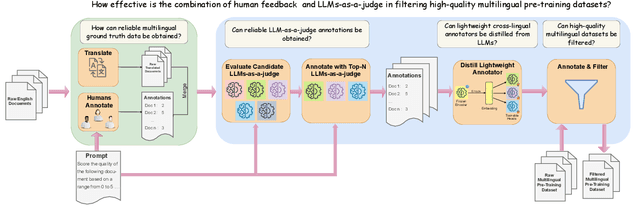
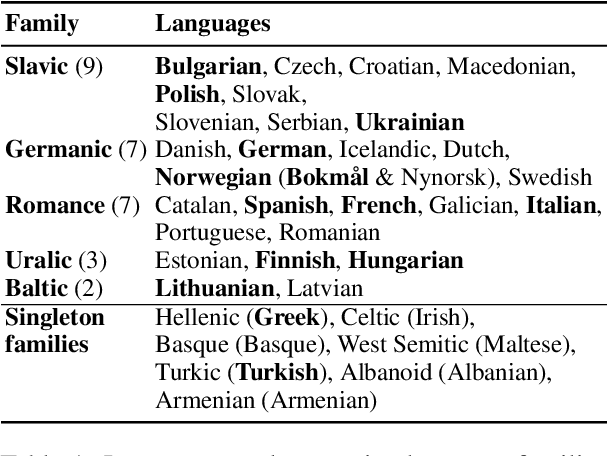
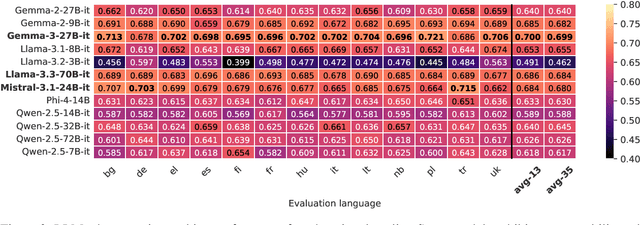
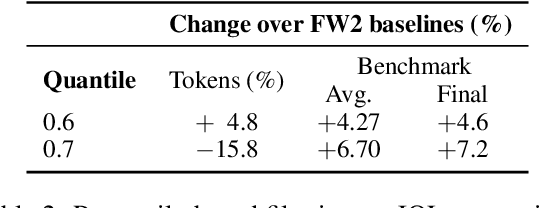
High-quality multilingual training data is essential for effectively pretraining large language models (LLMs). Yet, the availability of suitable open-source multilingual datasets remains limited. Existing state-of-the-art datasets mostly rely on heuristic filtering methods, restricting both their cross-lingual transferability and scalability. Here, we introduce JQL, a systematic approach that efficiently curates diverse and high-quality multilingual data at scale while significantly reducing computational demands. JQL distills LLMs' annotation capabilities into lightweight annotators based on pretrained multilingual embeddings. These models exhibit robust multilingual and cross-lingual performance, even for languages and scripts unseen during training. Evaluated empirically across 35 languages, the resulting annotation pipeline substantially outperforms current heuristic filtering methods like Fineweb2. JQL notably enhances downstream model training quality and increases data retention rates. Our research provides practical insights and valuable resources for multilingual data curation, raising the standards of multilingual dataset development.
Towards Multilingual LLM Evaluation for European Languages
Oct 17, 2024


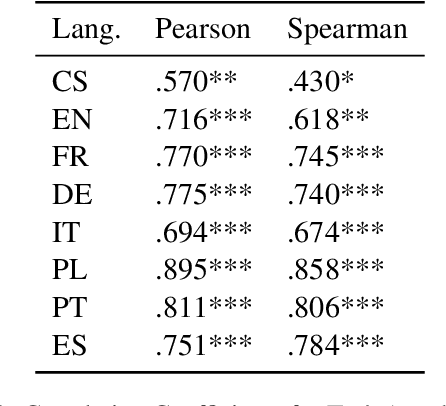
The rise of Large Language Models (LLMs) has revolutionized natural language processing across numerous languages and tasks. However, evaluating LLM performance in a consistent and meaningful way across multiple European languages remains challenging, especially due to the scarcity of language-parallel multilingual benchmarks. We introduce a multilingual evaluation approach tailored for European languages. We employ translated versions of five widely-used benchmarks to assess the capabilities of 40 LLMs across 21 European languages. Our contributions include examining the effectiveness of translated benchmarks, assessing the impact of different translation services, and offering a multilingual evaluation framework for LLMs that includes newly created datasets: EU20-MMLU, EU20-HellaSwag, EU20-ARC, EU20-TruthfulQA, and EU20-GSM8K. The benchmarks and results are made publicly available to encourage further research in multilingual LLM evaluation.
Towards Cross-Lingual LLM Evaluation for European Languages
Oct 11, 2024The rise of Large Language Models (LLMs) has revolutionized natural language processing across numerous languages and tasks. However, evaluating LLM performance in a consistent and meaningful way across multiple European languages remains challenging, especially due to the scarcity of multilingual benchmarks. We introduce a cross-lingual evaluation approach tailored for European languages. We employ translated versions of five widely-used benchmarks to assess the capabilities of 40 LLMs across 21 European languages. Our contributions include examining the effectiveness of translated benchmarks, assessing the impact of different translation services, and offering a multilingual evaluation framework for LLMs that includes newly created datasets: EU20-MMLU, EU20-HellaSwag, EU20-ARC, EU20-TruthfulQA, and EU20-GSM8K. The benchmarks and results are made publicly available to encourage further research in multilingual LLM evaluation.