 Add to Chrome
 Add to Firefox
 Add to Edge
Textual Data Bias Detection and Mitigation -- An Extensible Pipeline with Experimental Evaluation
Dec 12, 2025
Textual data used to train large language models (LLMs) exhibits multifaceted bias manifestations encompassing harmful language and skewed demographic distributions. Regulations such as the European AI Act require identifying and mitigating biases against protected groups in data, with the ultimate goal of preventing unfair model outputs. However, practical guidance and operationalization are lacking. We propose a comprehensive data bias detection and mitigation pipeline comprising four components that address two data bias types, namely representation bias and (explicit) stereotypes for a configurable sensitive attribute. First, we leverage LLM-generated word lists created based on quality criteria to detect relevant group labels. Second, representation bias is quantified using the Demographic Representation Score. Third, we detect and mitigate stereotypes using sociolinguistically informed filtering. Finally, we compensate representation bias through Grammar- and Context-Aware Counterfactual Data Augmentation. We conduct a two-fold evaluation using the examples of gender, religion and age. First, the effectiveness of each individual component on data debiasing is evaluated through human validation and baseline comparison. The findings demonstrate that we successfully reduce representation bias and (explicit) stereotypes in a text dataset. Second, the effect of data debiasing on model bias reduction is evaluated by bias benchmarking of several models (0.6B-8B parameters), fine-tuned on the debiased text dataset. This evaluation reveals that LLMs fine-tuned on debiased data do not consistently show improved performance on bias benchmarks, exposing critical gaps in current evaluation methodologies and highlighting the need for targeted data manipulation to address manifested model bias.

Data Processing for the OpenGPT-X Model Family
Oct 11, 2024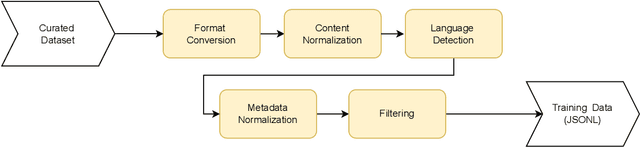


This paper presents a comprehensive overview of the data preparation pipeline developed for the OpenGPT-X project, a large-scale initiative aimed at creating open and high-performance multilingual large language models (LLMs). The project goal is to deliver models that cover all major European languages, with a particular focus on real-world applications within the European Union. We explain all data processing steps, starting with the data selection and requirement definition to the preparation of the final datasets for model training. We distinguish between curated data and web data, as each of these categories is handled by distinct pipelines, with curated data undergoing minimal filtering and web data requiring extensive filtering and deduplication. This distinction guided the development of specialized algorithmic solutions for both pipelines. In addition to describing the processing methodologies, we provide an in-depth analysis of the datasets, increasing transparency and alignment with European data regulations. Finally, we share key insights and challenges faced during the project, offering recommendations for future endeavors in large-scale multilingual data preparation for LLMs.