 Add to Chrome
 Add to Firefox
 Add to Edge
Adaptive Loops and Memory in Transformers: Think Harder or Know More?
Mar 11, 2026
Chain-of-thought (CoT) prompting enables reasoning in language models but requires explicit verbalization of intermediate steps. Looped transformers offer an alternative by iteratively refining representations within hidden states. This parameter efficiency comes at a cost, as looped models lack the storage capacity of deeper models which use unique weights per layer. In this work, we investigate transformer models that feature both adaptive per-layer looping, where each transformer block learns to iterate its hidden state via a learned halting mechanism, and gated memory banks, that provide additional learned storage. We find that looping primarily benefits mathematical reasoning, while memory banks help recover performance on commonsense tasks compared to parameter and FLOP matched models. Combining both mechanisms yields a model that outperforms an iso-FLOP baseline, with three times the number of layers, across math benchmarks. Analysis of model internals reveals layer specialization: early layers learn to loop minimally and access memory sparingly, while later layers do both more heavily.

Is continuous CoT better suited for multi-lingual reasoning?
Mar 09, 2026We investigate whether performing reasoning in a continuous latent space leads to more robust multilingual capabilities. We compare Continuous Chain-of-Thought (using the CODI framework) against standard supervised fine-tuning across five typologically diverse languages: English, Chinese, German, French, and Urdu. Our experiments on GSM8k and CommonsenseQA demonstrate that continuous reasoning significantly outperforms explicit reasoning on low-resource languages, particularly in zero-shot settings where the target language was not seen during training. Additionally, this approach achieves extreme efficiency, compressing reasoning traces by approximately $29\times$ to $50\times$. These findings indicate that continuous latent representations naturally exhibit greater language invariance, offering a scalable solution for cross-lingual reasoning.
Domain-Adaptation through Synthetic Data: Fine-Tuning Large Language Models for German Law
Jan 20, 2026Large language models (LLMs) often struggle in specialized domains such as legal reasoning due to limited expert knowledge, resulting in factually incorrect outputs or hallucinations. This paper presents an effective method for adapting advanced LLMs to German legal question answering through a novel synthetic data generation approach. In contrast to costly human-annotated resources or unreliable synthetic alternatives, our approach systematically produces high-quality, diverse, and legally accurate question-answer pairs directly from authoritative German statutes. Using rigorous automated filtering methods and parameter-efficient fine-tuning techniques, we demonstrate that LLMs adapted with our synthetic dataset significantly outperform their baseline counterparts on German legal question answering tasks. Our results highlight the feasibility of using carefully designed synthetic data as a robust alternative to manual annotation in high-stakes, knowledge-intensive domains.
Once Upon a Time: Interactive Learning for Storytelling with Small Language Models
Sep 19, 2025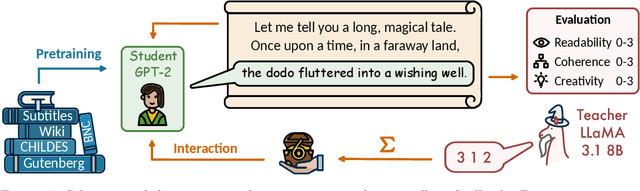
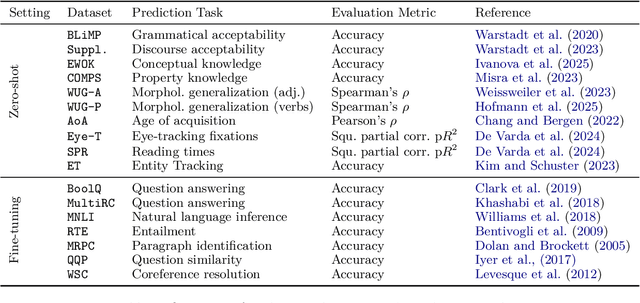
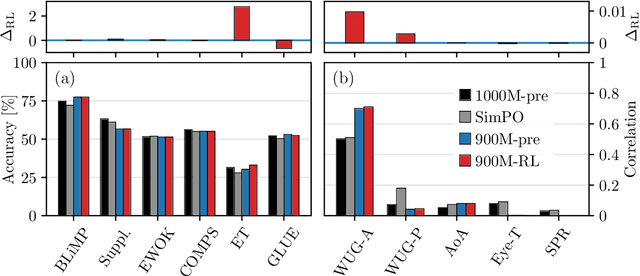
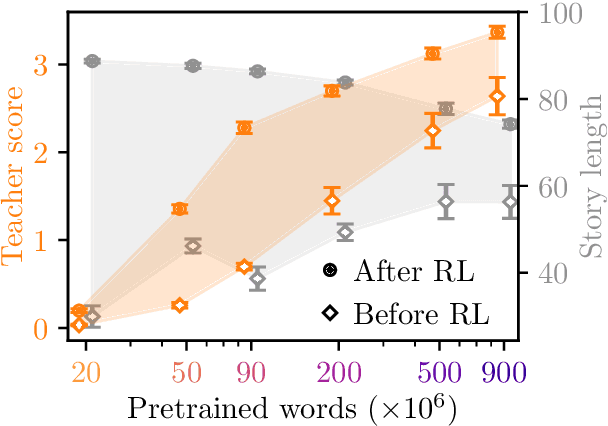
Children efficiently acquire language not just by listening, but by interacting with others in their social environment. Conversely, large language models are typically trained with next-word prediction on massive amounts of text. Motivated by this contrast, we investigate whether language models can be trained with less data by learning not only from next-word prediction but also from high-level, cognitively inspired feedback. We train a student model to generate stories, which a teacher model rates on readability, narrative coherence, and creativity. By varying the amount of pretraining before the feedback loop, we assess the impact of this interactive learning on formal and functional linguistic competence. We find that the high-level feedback is highly data efficient: With just 1 M words of input in interactive learning, storytelling skills can improve as much as with 410 M words of next-word prediction.